Friday, March 30, 2007

Brazilian Institute for Oriental Studies


Apparently, the Institute for Oriental Studies at the Federal University of Santa Catarina in Brazil is a real organization and this was their real logo. After the logo proliferated across the Net and won awards, the institute's website went offline.

Thursday, March 29, 2007

Order of Letters in a Word

"Aoccdrnig to a rscheearch at an Elingsh uinervtisy, it deosn't mttaer in waht oredr the ltteers in a wrod are, the olny iprmoetnt tihng is taht the frist and lsat ltteer is in the rghit pclae. The rset can be a toatl mses and you can sitll raed it wouthit porbelm. Tihs is bcuseae we do not raed ervey lteter by it slef but the wrod as a wlohe."

This was a popular email forward a few years back. However, this anonymous software engineer believes the notion to be false, and wrote a program to prove it:

Rgaadin Nfheuealn's Web Log

classic joke

What is the difference between a duck?

One of its legs are both the same.

The Wild Hunt


The Wild Hunt
Peter Nicolai Arbo
1831-1892 Norwegian

Tuesday, March 27, 2007

Wild Nights

Wild Nights--Wild Nights!
Were I with thee
Wild Nights should be
Our luxury!

Futile--the Winds--
To a Heart in port--
Done with the Compass--
Done with the Chart!

Rowing in Eden--
Ah, the Sea!
Might I but moor--Tonight--
In Thee!

--Emily Dickinson

This is an illuminating piece on one of the most memorable of American poems:

"Dickinson's 'Wild Nights'" by James L. Dean in Explicator

"A third possibility is that 'Thee' refers only to the sea, and it is this latter that I would like briefly to discuss.

"If we take 'Sea' to mean something like 'high seas'... and assume that at sea passionate nature unleashes itself--then we have an interesting paradox to deal with. The speaker desires something at once impossible and possible. Ships do not moor at sea, unless, of course, they are under command of an extravagant adventurer who delights in the paradox of mooring where it is impossible to do so. Such an extravagant statement is typical of Dickinson, as, for example, in the well-known line, 'I taste a liquor never brewed.'"

Monday, March 26, 2007

Mongolia Mining Less Attractive

Unfortunately, this was the perfectly predictable result of last year's "Windfall Tax" on mining companies:

"TORONTO, March 5 /PRNewswire/ - The attractiveness of Mongolia for mineral exploration has dropped significantly in the eyes of mining executives, according to the Survey of Mining Companies 2006/2007, released today by independent research organization The Fraser Institute. Mongolia's ranking fell significantly, dropping to 62nd from 33rd last year, reflective of the regulatory difficulties and lack of openness experienced by mineral exploration companies operating in Mongolia in the past year.

"'Our experience with the survey has shown that above all, mineral exploration companies value stability and certainty when it comes to government policy,' said Fred McMahon, co-ordinator of the survey and the institute's Director of Trade and Globalization Studies."

-Mongolia Web

Konchog, Floki


I can't believe I've never mentioned Konchog. He's this big American Buddhist monk. He cuts one of the most distinctive figures in UB, running around the city in his orange and red robes. I caught him last year in the Turkish restaurant across the street. Turns out he is living pretty much next door to me, on the other side of Centrepoint. Very nice guy. I see him every once in a while. Last December, we chatted near the State Department Store amidst the Santa Claus decorations, and I couldn't resist tossing him a cheeky "Merry Christmas." His response was "Yeah, thanks," which is nearly how I respond to the phrase. Anyway, he's looking for a home for his young St. Bernard, Floki, so if you know anyone in the Mongolian countryside who could take care of a big dog, let him know: Dreaming of Danzan Ravjaa - Konchog is a formidable blogger.

Book Cover from Jeff


This is definitely the same book.

Friday, February 23, 2007

Nairamdal

“Where is your son serving in the army?” we asked.

“My son Ulzii is an officer in Baishint. You may perhaps know him,” replied Damba and showed us a photograph taken from the wooden box. The photo had the image of a Russian and a Mongolian soldier.

“Which of them is your son?” we asked jokingly.

“They are both my sons,” Doulma said, “the Russian and the Mongolian alike. This Russian fought alongside my son at Khalkhiin Gol* and he carried my son when he was wounded on the battlefield. Now my son Ulzii constantly corresponds with this Russian boy.”

The old man kept silent as if thinking, and looking at the photograph he exclaimed sadly: “These photos are a wonder! The image remains forever. It was a sad pity that photographs were not taken when we were on the battlefield.”

The old man’s face shone with joy when we asked him, “Did you ever go to war?”

“A Russian officer gave me this sword,” said he, showing a sword. “He was one of those brave comrades who was fighting for the freedom and happiness of our Mongolians. I think he is now fighting the German fascists...

“After hunting marmots for my family, I joined the people’s partisans with the only horse I had then.

“Since then the Mongolian nation has been changing before my eyes. Our life is improving as the nation is moving forward. Now I own about twenty horses, thirty cows and a hundred sheep...”


*Khalkhiin Gol – in 1939, imperialist Japan waged a war against Mongolia and was defeated


--Ts.Damdinsuren, “They Are Both My Sons,” 1943, translated by Ch.Burenbayar

Sunday, February 18, 2007

Jon loaned me this book and it's pretty good

“He visited my class, we set some poetry readings up for him, and we set up his Free University meeting room and place. I think the title of the class we said he would teach was Tantric Yoga—no it was Telepathic Communication. His class was a tremendous success, though not because of his lecturing on telepathy. The first night he was supposed to teach it, we walked with him to the student union building. The room was on the first floor and was packed with people sitting quietly, intently, as though waiting for Jim Jones to pass the Kool-Aid. Either it was that or something else, something false, levy picked up on, and he simply walked on by the door and out the side. I thought for a moment of going in and telling them it was another no-show, but what the hell. We all walked over to the 602 Club and then thought no more about it, until Ann Krooth told me that levy’s class was one of the most successful in all the Free University. People there assumed he was trying to reach them telepathically, and many of them heard him, as they sat there, meditating in the classroom. That class went on for several months after levy had returned to Cleveland—months after levy was no longer alive.”

--Morris Edelson in “Portrait of a Young Man Trying to Eat the Sun (the life, legend, & mysterious death of d. a. levy)” by Mike Golden, first published in BEET magazine in 1994, collected in The Outlaw Bible of American Essays

Thursday, February 15, 2007

Happy Valentines Two Days Ago!

Tell me, dearest, what is love?
'Tis a lightning from above;
'Tis an arrow, 'tis a fire,
'Tis a boy they call Desire.
'Tis a grave
Gapes to have
Those poor fools that long to prove.

Tell me more, are women true?
Yes, some are, and some as you.
Some are willing, some are strange,
Since you men first taught to change.
And till troth
Be in both,
All shall love, to love anew.

Tell me more yet, can they grieve?
Yes, and sicken sore, but live:
And be wise, and delay,
When you men are as wise as they.
Then I see,
Faith will be,
Never till they both believe.

--John Fletcher, 1613?

Saturday, January 27, 2007

Ungern


A post on Baron Ungern at Way To Russia:

"But gone are the days when you could take a capital city with a ragtag army of soldiers and mercenaries. In 1921, however, Baron Roman Ungern von Sternberg, known as the Bloody Baron, did just that when he captured Ulan Bataar in one of the strangest incidents of the Russian Civil War...

"By surrounding the city and burning a huge number of camp fires he created the illusion of commanding a large army. The Chinese withdrew and the Bloody Baron entered the city and installed himself as dictator...

"Then, after some similar, short-lived shenanigans in Buryatia, he was finally captured and executed in Novisibirsk.

"In spite of his atrocities von Sternberg is often seen as a liberator by Mongolians and was declared a Mahakala incarnation by the 13th Dalai Lama. His incredible story has for some reason mostly gone untold. However, producer Alexander Proshkin did announce plans to make a film about the Bloody Baron in the near future."

It might be noted that much of the Baron's bloody reputation might have been attributable to his underlings.

It might also be noted that the shrewd Bogd Khan invited Ungern to Mongolia to help him get rid of the Chinese, and the Khan was successful. And that later, the Bogd Khan invited the Reds to Mongolia to help him get rid of Ungern, and the Khan was again successful.

Wednesday, January 24, 2007

On a Darkling Plain

Ah, love, let us be true
To one another! for the world, which seems
To lie before us like a land of dreams,
So various, so beautiful, so new,
Hath really neither joy, nor love, nor light,
Nor certitude, nor peace, nor help for pain;
And we are here as on a darkling plain
Swept with confused alarms of struggle and flight,
Where ignorant armies clash by night.


excerpt from "Dover Beach," 1867
by Matthew Arnold, 1822-1888, English

Leafy Sea Dragon


The leafy sea dragon of Australia.

Friday, January 19, 2007

Coat of Arms of Nunavut


The Coat of Arms of the Territory of Nunavut features a caribou and a narwhal as its supporters.

Monday, January 15, 2007

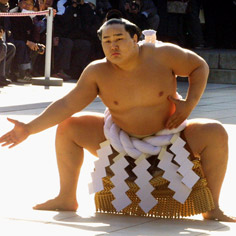
"Sumo falls to a Mongol invasion"


"Thirty-four Mongolians compete regularly in Japan's national, indigenous sport. One of them, Asashoryu, has dominated the ring since being promoted in 2003 to the highest rank of Grand Champion. Currently the only wrestler at that level, he could soon be joined by a Bulgarian, the strongest of the 14 or so East Europeans who have also broken into the sport.

"Since the 1960s there have always been a few foreigners in Sumo. Several Hawaiians made it to the top, an achievement that means adopting Japanese nationality, dress and behaviour...

"But conservative Japanese are dismayed at the recent involvement of so many outsiders. More than a sport, Sumo, with its ancient history, is steeped in the rituals of the Shinto religion that the Japanese believe only they can fully comprehend...

"And foreigners do not always behave with the necessary decorum. The Mongolian Grand Champion has been disqualified for hair-pulling and has refused to take Japanese nationality.

"The Sumo authorities, however, appreciate the excitement and ticket sales that foreign wrestlers generate."

-The First Post

Friday, January 12, 2007

Chinese Elves, Dwarves, and Wizards Conquering the World


There are as many World of Warcraft accounts in China alone – 3.5 million – as there are in all the countries of Europe, the U.S., and Canada combined.

Playfuls.com: World of Warcraft - 8 Million and Counting

Tuesday, January 09, 2007

You Are Going To Die Needlessly


More from the profound Nick Bostrom:

The Fable of the Dragon-Tyrant

"Searching for a cure for aging is not just a nice thing that we should perhaps one day get around to. It is an urgent, screaming moral imperative... If we get the cure in 25 years rather than in 24 years, a population greater than that of Canada will die as a result. In this matter, time equals life, at a rate of approximately 70 lives per minute."

Thursday, January 04, 2007

Springboots


Jump high, run fast.

The Epicurean Paradox


"God either wants to eliminate bad things and cannot, or can but does not want to, or neither wishes to nor can, or both wants to and can. If he wants to and cannot, he is weak -- and this does not apply to god. If he can but does not want to, then he is spiteful -- which is equally foreign to god's nature. If he neither wants to nor can, he is both weak and spiteful and so not a god. If he wants to and can, which is the only thing fitting for a god, where then do bad things come from? Or why does he not eliminate them?"

--Epicurus, 341-270 BCE, Greek, in The Epicurus Reader, translated and edited by Brad Inwood and Lloyd P. Gerson

Wednesday, January 03, 2007

Inner Mongolia - Han vs. Mongol


review by Celia Lowe of Beyond Great Walls: Environment, Identity, and Development on the Chinese Grasslands of Inner Mongolia by Dee Mack Williams:

"Although Williams does not dispute the degraded state of the land, he does contest both Chinese and Western authoritative interpretations of its meanings and causes. The author brings together culture, politics, history, and nature at international, national, and local scales to compare Mongol herders' sensibilities with those of Han and Western scientists...

"Mongol marginalization is at the heart of grassland disputes...

"Discourses of science help mask Han-Mongol antagonisms, and Williams demonstrates that Mongol notions are often accurate where scientists' theories fail...

"Whereas the research station praises its Han scientists, saying 'heart blood has become sweet dew, the desert has become an oasis,' herders restate this verse as 'an oasis has become a desert under the management of the research station'...

"One great joy in this book is Williams's ability to narrate the life stories of Mongol herders. Beyond Great Walls is a pleasure to read..."

-American Ethnologist

Monday, January 01, 2007

Get a loan on your ger


"Many banks prefer clients who can pledge rock-solid 'immovables' -- brick-and-mortar homes, for example -- as collateral which the bank can claim when borrowers do not repay their loans. But what if the immovable is, in fact, move-able? What if it is made of wool and wood, and could be picked up and carted off in the middle of the night by a debtor on the run?

"XacBank’s experience is proof of the micro-finance credo that poor people make the most reliable borrowers..."

-European Bank for Reconstruction and Development

hny

Happy new year, and all that.

Saturday, December 30, 2006

Jack Weatherford: Great Law of Genghis Khan in Iraq

Los Angeles Times, 2006 December 29

“In his final televised speech to the Iraqi people in 2003, Saddam Hussein denounced the invading Americans as ‘the Mongols of this age,’ a reference to the last time infidels had conquered his country, in 1258. But the comparison isn't very apt — unlike the Mongols, the Americans don't have the organizational genius of Genghis Khan...

“The legal justification for the Mongol invasion of Iraq derived from the reluctance of the caliph of Baghdad to control the Shiite Cult of the Assassins, whom the Mongols accused of attempting to kill their khan.

“The Assassins operated from a series of fortified mountain camps spread from contemporary Afghanistan to Iraq, and the Baghdad invasion did not begin until the Mongols had eradicated the threat from the Assassins and destroyed their fortresses...

“The Mongols took no prisoners and allowed no torture, but they executed swiftly and efficiently, including the soldiers of the defeated army who, they believed, would be a constant source of future problems if allowed to live. The first several months of a Mongol invasion were bloody, but once the takeover ended, the bloodshed ended.

“By contrast, the American military campaign was quick, with comparatively few Iraqi (or coalition) casualties, but the bloodshed has continued for years...

“And while the violence continues, the U.S. can't come close to establishing a government that rivals what the Mongols achieved...

“They fiercely enforced religious freedom, which created an essentially secular state... They lowered taxes for merchants and eliminated them for religious, medical and educational professionals. They educated women along with men...

“Fundamentalist Muslims look back at Mongol secularism as a scourge. But, although U.S. rule in Iraq has produced a constant flow of refugees, particularly religious minorities, out of the country, under Mongol rule Christian, Muslim, Jewish and even Buddhist immigrants poured into the newly conquered Iraq to live under the Great Law of Genghis Khan...

“By the time of the U.S.-led invasion of Iraq, the political achievements of the Mongols had been forgotten, and only the destructive fury of their wars was remembered.”

-Jack Weatherford

Who's your daddy?

Thursday, December 28, 2006

Ulemj’s birthday

This post has moved to Adventuria - Travels of Radigan Neuhalfen.

Zaya’s dance thing


On Sunday, went to Zaya’s holiday production at her tsetserleg (an abridgement of “khuukhdiin tsetserleg,” which is literally: “child garden”; used as “kindergarten,” which is literally: “child garden”).

Poor little kids, being forced to sing and dance for old people’s amusement.