Showing posts with label Mongols. Show all posts

Sunday, March 13, 2011

Art by Nicholas Roerich

"My heartiest thanks for the magnificent work which you sent to me. I admire those creations so much that I can say without exaggeration that never have landscapes made such a great impression on me."

--Albert Einstein, letter to Roerich Museum, 1931

RoerichTrust.org


The Black Gobi
1928

And We Do Not Fear
1922

Book of Life
1938

Changthang, Northern Tibet
1939

Song of Shambhala

Idols (Pagan Russia)
1910

Issa and the Skull of the Giant

Message to Tiron
1940

Abode of Gesar
1947

Mongolia

Mongolia I
1938

Monhegan, Maine
1922

Mother of Genghis Khan
1933

Most Sacred Treasure of the Mountain
1933

On the Heights, Tumo
1936

Stronghold of Tibet
1932

Descent into Hell
1933

Star of the Hero
1936

Guests from Overseas
1901
USSR postage stamp
1974


1874-1947 Russian

Tuesday, June 15, 2010

Queens of Mongolia

"Jack Weatherford will give a talk entitled 'Queens of Mongolia' this coming Wednesday the 16th of June at 8pm.

"His presentation will focus on the daughters of Genghis Khan, their history and achievements and their place in Mongolia’s society. This is the story of his second book: The Secret History of the Mongol Queens: How the Daughters of Genghis Khan Rescued His Empire.

"Jack Weatherford is a professor of anthropology at Macalester College in Minnesota. He is a specialist in tribal peoples and the author of Indian Givers, Native Roots, Savages and Civilization, The History of Money, and Genghis Khan and the Making of the Modern World.

"Come early as this talk is expected to be exceedingly popular. See you all then!

"--Café Amsterdam"

Friday, March 19, 2010

the felt tents of his encampment

“In the 1190s a young and somewhat embittered Mongol who had become khan of his people began to seek revenge for slights and injuries to them by the Tatars (another nomadic nation). Within a few years he was accepted by all the Mongol tribes as their 'universal khan,' or, in their own tongue, 'Chinghis Khan.' Mispronounced in Arabic, this name became 'Genghis Khan' to Europeans. He proved to be the greatest conqueror the world has ever seen, terrorizing Europe and Asia alike. But Chinghis also built up something much more like a true empire than any other nomad chief, even though its only capital was the felt tents of his encampment....

“The unity of Chinghis Khan's empire had given way to a loose connexion of khanates ruled independently by Mongol princes, but with much in common. A sort of Mongol federation stretched at its greatest extent over something like a sixth of the old world's land surface. Its communications were good and well policed and the Mongols made intelligent use of their conquered subjects. They enlisted them in their armies, while Chinghis used Chinese civil servants to run his taxation system and borrowed the Turkish script in order to write down the Mongol language.... The Great Khans came to see themselves as somewhat like Chinese emperors. They expected other peoples to pay them tribute, not to negotiate with them as equals, and believed they exercised a universal monarchy on behalf of their own sky god. Yet they were tolerant in religion and the diversity of belief at the Mongol court impressed Christians.”


--J.M. Roberts, A Short History of the World, 1993

Friday, September 04, 2009

spiritual over-lord

"The Buddhism of Tibet is not the pure original doctrine of the gentle Indian prince who lived and died six centuries before the birth of Christ. It is the usual degenerate form, full of devils and spooks, and it has forgotten a great many of the noble teachings of the founder of that great Asiatic faith. But Tibet has been a bulwark of Buddhism which has been of great help in preserving that religion against the attacks of the Mohammedans from the west and the pagan creeds of southern India....

"During the reign of Kublai Khan, the grandson of Genghis Khan and an ardent convert to Buddhism, the abbots of an important Tibetan monastery were recognized as the political rulers of all Tibet. In return for this favor, the new Dalai Lama, in his quality of spiritual over-lord of the whole Buddhist world, officially crowned the Tartar Khan Emperor of Mongolia, just as Pope Leo III had crowned Charlemagne."


--Hendrik van Loon, Van Loon's Geography: The Story of the World We Live In, 1932

Tuesday, January 20, 2009

reputation for barbarism and cruelty

"The Mongol period is not only noted for its supposed barbarity, but also for the plethora of historians and chronicles it produced. These many scribes, both within the Mongol camp and without, were happy to pander to the Mongols' desire for notoriety and a reputation for barbarism and cruelty. Primary sources in a wealth of languages have survived the so-called Mongol mayhem. Critical analysis and comparison of these various sources yield a more balanced and less sensationalist picture of what actually occurred during the thirteenth and fourteenth centuries than the lurid portrait that myths and legends have conjured up. Since Bernard Lewis questioned the basis of the Mongols' tainted reputation in 1995, scholarly opinion has grown more sympathetic toward the legacy of Genghis Khan."

--George Lane, eNotes.com

Sunday, October 26, 2008

Western preference

"The narratives of Buddhism in the United States have ignored the contribution and presence of Mongols. While 'Tibetan' Buddhism remains, arguably, the most visible and popular type of Buddhism in North America, how and why it has achieved this status has not been sufficiently queried.... By taking into account the central role of race and how it is defined and manipulated in U.S. immigration and naturalization law, the experience of Kalmyk Mongol Buddhist immigrants in the 1950s can be recovered. Tracing the life and experience of the Mongol 'Living Buddha' within the context of the west's reception of Buddhism reveals a preference for orientalist versions of Asian religions at the expense of Asian American racial and ethnic identities."

--abstract of "Mongols or Mongolians? And the Strange Career of the 'Living Buddha' in America" by Rudiger Busto

Wednesday, January 16, 2008

Franco-Mongol alliance

“From Wikipedia, the free encyclopedia

“The factual accuracy of this article is disputed.

“Many attempts were made towards forming a Franco-Mongol alliance between the mid-1200s and the early 1300s, starting around the time of the Seventh Crusade. Historians note that in hindsight, an alliance between the Mongols and the Franks often appears a logical choice. The Mongols were already very sympathetic to Christianity as many Mongols were Nestorian Christians. The Europeans were open to the idea of assistance coming from the East, due to the longrunning legend of a mythical Prester John, an Eastern king in a magical kingdom who many believed would arrive someday to help with the fight in the Holy Land. The Mongols and the Franks also shared a common enemy in the Muslims. There were numerous exchanges of letters, gifts and emissaries between the Mongols and the Europeans as well as offers for varying types of cooperation. However, despite many attempts, there was never any successful military collaboration. Modern historians also debate whether or not such an alliance, if it had been successful, would have been effective in shifting the balance of power in the region, and/or whether or not it would have been a wise choice on the part of the Europeans. Traditionally, the Mongols tended to see outside parties as either subjects, or enemies, with little room in the middle for something such as an ally.”

Thursday, October 25, 2007

Russian America

“His comrades were Slavonian hunters and Russian adventurers, Mongols and Tartars and Siberian aborigines; and through the savages of the new world they had cut a path of blood.”

--Jack London, “Lost Face,” 1910

Wednesday, April 11, 2007

Saturday, December 30, 2006

Jack Weatherford: Great Law of Genghis Khan in Iraq

Los Angeles Times, 2006 December 29

“In his final televised speech to the Iraqi people in 2003, Saddam Hussein denounced the invading Americans as ‘the Mongols of this age,’ a reference to the last time infidels had conquered his country, in 1258. But the comparison isn't very apt — unlike the Mongols, the Americans don't have the organizational genius of Genghis Khan...

“The legal justification for the Mongol invasion of Iraq derived from the reluctance of the caliph of Baghdad to control the Shiite Cult of the Assassins, whom the Mongols accused of attempting to kill their khan.

“The Assassins operated from a series of fortified mountain camps spread from contemporary Afghanistan to Iraq, and the Baghdad invasion did not begin until the Mongols had eradicated the threat from the Assassins and destroyed their fortresses...

“The Mongols took no prisoners and allowed no torture, but they executed swiftly and efficiently, including the soldiers of the defeated army who, they believed, would be a constant source of future problems if allowed to live. The first several months of a Mongol invasion were bloody, but once the takeover ended, the bloodshed ended.

“By contrast, the American military campaign was quick, with comparatively few Iraqi (or coalition) casualties, but the bloodshed has continued for years...

“And while the violence continues, the U.S. can't come close to establishing a government that rivals what the Mongols achieved...

“They fiercely enforced religious freedom, which created an essentially secular state... They lowered taxes for merchants and eliminated them for religious, medical and educational professionals. They educated women along with men...

“Fundamentalist Muslims look back at Mongol secularism as a scourge. But, although U.S. rule in Iraq has produced a constant flow of refugees, particularly religious minorities, out of the country, under Mongol rule Christian, Muslim, Jewish and even Buddhist immigrants poured into the newly conquered Iraq to live under the Great Law of Genghis Khan...

“By the time of the U.S.-led invasion of Iraq, the political achievements of the Mongols had been forgotten, and only the destructive fury of their wars was remembered.”

-Jack Weatherford

Sunday, December 03, 2006

Khongorzul


Miss Mongolia 2005

Face of Arrogance

"But we will still tell our children stories of Chang'e and the rabbit that lived for thousands of years in the moon, and mooncakes that carried the message of the uprising against the Mongolians, who now have become one of the Chinese minorities. Life goes on."

-China Daily

Friday, December 01, 2006

"Kubla Khan" by Samuel Taylor Coleridge


Kubla Khan, or a Vision in a Dream. A Fragment.
first published in 1816
by Samuel Taylor Coleridge, English, 1772-1834

In Xanadu did Kubla Khan
A stately pleasure-dome decree :
Where Alph, the sacred river, ran
Through caverns measureless to man
Down to a sunless sea.
So twice five miles of fertile ground
With walls and towers were girdled round :
And there were gardens bright with sinuous rills,
Where blossomed many an incense-bearing tree ;
And here were forests ancient as the hills,
Enfolding sunny spots of greenery.

But oh ! that deep romantic chasm which slanted
Down the green hill athwart a cedarn cover !
A savage place ! as holy and enchanted
As e'er beneath a waning moon was haunted
By woman wailing for her demon-lover !
And from this chasm, with ceaseless turmoil seething,
As if this earth in fast thick pants were breathing,
A mighty fountain momently was forced :
Amid whose swift half-intermitted burst
Huge fragments vaulted like rebounding hail,
Or chaffy grain beneath the thresher's flail :
And 'mid these dancing rocks at once and ever
It flung up momently the sacred river.
Five miles meandering with a mazy motion
Through wood and dale the sacred river ran,
Then reached the caverns measureless to man,
And sank in tumult to a lifeless ocean :
And 'mid this tumult Kubla heard from far
Ancestral voices prophesying war !

The shadow of the dome of pleasure
Floated midway on the waves ;
Where was heard the mingled measure
From the fountain and the caves.

It was a miracle of rare device,
A sunny pleasure-dome with caves of ice !

A damsel with a dulcimer
In a vision once I saw :
It was an Abyssinian maid,
And on her dulcimer she played,
Singing of Mount Abora.
Could I revive within me
Her symphony and song,
To such a deep delight 'twould win me,

That with music loud and long,
I would build that dome in air,
That sunny dome ! those caves of ice !
And all who heard should see them there,
And all should cry, Beware ! Beware !
His flashing eyes, his floating hair !
Weave a circle round him thrice,
And close your eyes with holy dread,
For he on honey-dew hath fed,
And drunk the milk of Paradise.

Monday, November 27, 2006

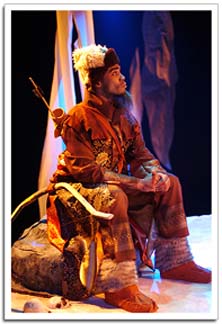
A Genghis Khan Opera in Austin, Texas


A production at the Salvage Vanguard Theater that opened last spring:

"So today I got the coolest email and I’m just going to paste it below. Graham and I talked about this quite a bit last year when we were writing the opera Genghis Khan. Check this out…

"Mr. Neulander

"My name is Dawadash and I am the Second Secretary of the Embassy of Mongolia in Washington DC. I came across to SVT website and the Genghis Khan Opera blog while surfing the net. We congratulate you on the production of Genghis Khan, who is national symbol and hero for my country. The Embassy of Mongolia regrets that we did miss the chance to watch the show, which was a success in Austin. This year Mongolia celebrates the 800th anniversary of the Great Mongolian State created by Genghis Khan in 1206. That year Temuchin was proclaimed Genghis Khan, the ruler of the first unified Mongolian state. We are eager to learn if the Genghis Khan production is still on stage and where and when we can watch it. Have you thought of putting it in other countries, for example in Mongolia. This would great.
Anyways, congratulations on the production and hope to hear from you.
Any questions are welcome at the address below.
Cheers,

"Dawadash Sambuu
Second Secretary
Embassy of Mongolia"

Salvage Vanguard Theater blog

Salvage Vanguard Theater - Genghis Khan: The Opera