"Jack Weatherford will give a talk entitled 'Queens of Mongolia' this coming Wednesday the 16th of June at 8pm.
"His presentation will focus on the daughters of Genghis Khan, their history and achievements and their place in Mongolia’s society. This is the story of his second book: The Secret History of the Mongol Queens: How the Daughters of Genghis Khan Rescued His Empire.
"Jack Weatherford is a professor of anthropology at Macalester College in Minnesota. He is a specialist in tribal peoples and the author of Indian Givers, Native Roots, Savages and Civilization, The History of Money, and Genghis Khan and the Making of the Modern World.
"Come early as this talk is expected to be exceedingly popular. See you all then!
"--Café Amsterdam"
Showing posts with label Jack Weatherford. Show all posts
Showing posts with label Jack Weatherford. Show all posts
Tuesday, June 15, 2010


Saturday, December 30, 2006
Jack Weatherford: Great Law of Genghis Khan in Iraq
Los Angeles Times, 2006 December 29
“In his final televised speech to the Iraqi people in 2003, Saddam Hussein denounced the invading Americans as ‘the Mongols of this age,’ a reference to the last time infidels had conquered his country, in 1258. But the comparison isn't very apt — unlike the Mongols, the Americans don't have the organizational genius of Genghis Khan...
“The legal justification for the Mongol invasion of Iraq derived from the reluctance of the caliph of Baghdad to control the Shiite Cult of the Assassins, whom the Mongols accused of attempting to kill their khan.
“The Assassins operated from a series of fortified mountain camps spread from contemporary Afghanistan to Iraq, and the Baghdad invasion did not begin until the Mongols had eradicated the threat from the Assassins and destroyed their fortresses...
“The Mongols took no prisoners and allowed no torture, but they executed swiftly and efficiently, including the soldiers of the defeated army who, they believed, would be a constant source of future problems if allowed to live. The first several months of a Mongol invasion were bloody, but once the takeover ended, the bloodshed ended.
“By contrast, the American military campaign was quick, with comparatively few Iraqi (or coalition) casualties, but the bloodshed has continued for years...
“And while the violence continues, the U.S. can't come close to establishing a government that rivals what the Mongols achieved...
“They fiercely enforced religious freedom, which created an essentially secular state... They lowered taxes for merchants and eliminated them for religious, medical and educational professionals. They educated women along with men...
“Fundamentalist Muslims look back at Mongol secularism as a scourge. But, although U.S. rule in Iraq has produced a constant flow of refugees, particularly religious minorities, out of the country, under Mongol rule Christian, Muslim, Jewish and even Buddhist immigrants poured into the newly conquered Iraq to live under the Great Law of Genghis Khan...
“By the time of the U.S.-led invasion of Iraq, the political achievements of the Mongols had been forgotten, and only the destructive fury of their wars was remembered.”
-Jack Weatherford
“In his final televised speech to the Iraqi people in 2003, Saddam Hussein denounced the invading Americans as ‘the Mongols of this age,’ a reference to the last time infidels had conquered his country, in 1258. But the comparison isn't very apt — unlike the Mongols, the Americans don't have the organizational genius of Genghis Khan...
“The legal justification for the Mongol invasion of Iraq derived from the reluctance of the caliph of Baghdad to control the Shiite Cult of the Assassins, whom the Mongols accused of attempting to kill their khan.
“The Assassins operated from a series of fortified mountain camps spread from contemporary Afghanistan to Iraq, and the Baghdad invasion did not begin until the Mongols had eradicated the threat from the Assassins and destroyed their fortresses...
“The Mongols took no prisoners and allowed no torture, but they executed swiftly and efficiently, including the soldiers of the defeated army who, they believed, would be a constant source of future problems if allowed to live. The first several months of a Mongol invasion were bloody, but once the takeover ended, the bloodshed ended.
“By contrast, the American military campaign was quick, with comparatively few Iraqi (or coalition) casualties, but the bloodshed has continued for years...
“And while the violence continues, the U.S. can't come close to establishing a government that rivals what the Mongols achieved...
“They fiercely enforced religious freedom, which created an essentially secular state... They lowered taxes for merchants and eliminated them for religious, medical and educational professionals. They educated women along with men...
“Fundamentalist Muslims look back at Mongol secularism as a scourge. But, although U.S. rule in Iraq has produced a constant flow of refugees, particularly religious minorities, out of the country, under Mongol rule Christian, Muslim, Jewish and even Buddhist immigrants poured into the newly conquered Iraq to live under the Great Law of Genghis Khan...
“By the time of the U.S.-led invasion of Iraq, the political achievements of the Mongols had been forgotten, and only the destructive fury of their wars was remembered.”
-Jack Weatherford
Thursday, September 28, 2006
"Jack Weatherford awarded Mongolia's highest national honor"

"Jack Weatherford has been awarded the Order of the Polar Star by President Nambaryn Enkhbayar and the parliament of Mongolia. Weatherford is the author of The New York Times best-seller Genghis Khan and the Making of the Modern World. Weatherford will travel to Mongolia to receive the award in person in February."
-Macalester College
Friday, August 11, 2006
Tuesday, February 14, 2006
Subject: Mongolia

Photo and email message by Benjamin Warde:
Hey Everybody,
It has been so long since my last travel email that at this point a blow-by-blow retelling seems a bit beside the point. Instead, I am going to tell you two discreet stories about my time in Mongolia. You won't have a lot of context for each story, but that's probably OK.
Morin Khuur
I woke up at 5:15 AM, on board the train from Ulaanbaatar (capital city of Mongolia) to Orkhontuul, a small town of about 1,400 people in the north of Mongolia. With me was Tulga, a young man who I met through a mutual friend. I don't speak Mongolian, and Tulga spoke only a few words of English, but we did OK passing back and forth a Mongolian-English/English-Mongolian dictionary.
We were headed for the home of Tulga's parents. At 6:00 AM we arrived at our stop and disembarked into the dark and freezing cold. The stars were still out, and I saw the constellation Orion for the first time this year. The train station is about 20 kilometers away from the town where we were headed, and we waited in the dark for 10 minutes or so until an old Russian minibus pulled up and we, and 17 other people with luggage, piled inside. The eastern horizon turned pink and orange as we spent an hour bumping along rutted dirt tracks until we reached Tulga's village. His parents were happy to see him,and welcomed me, a complete stranger, into their two-room house, and immediately started to feed me, something which they did not stop doing for the rest of the day. I ate practically nonstop, and even so Tulga said, "My parents are worried about you, because you eat so little."
Tulga and I played pool on a home-made pool table in their front garden, and we dug up potatoes and carrots, and fed pigs. There was a school holiday that day, and all the children were engaged in a horse race, followed by wrestling. We watched the festivities, little children riding bareback at full gallop, and then throwing each other around in the grass. Then I think there was more eating. Hanging on the wall in Tulga's parents' home was a small Morin Khuur. The Morin Khuur, or Horse Headed Fiddle, is the national musical instrument of Mongolia. In the old days the sound box was actually made with a horse's skull, but these days they are usually wood. This particular Morin Khuur was hand carved by Tulga's father, and he took it down off the wall and presented it to me as a gift. At first I thought I was misunderstanding him, and when I finally realized that he really did mean to give it to me I was quite taken aback. It looked to me like the most precious thing in the home, and I couldn't possibly accept it, and yet it was even more impossible to refuse, which surely would have been insulting. I tried to be very grateful, without being excessively grateful. Mongolians seem to always be very genuine, but low-key, with their thanks, and if one is too effusive it seems to cause embarrassment. The translation might be a little iffy, but the gist of what Tulga said was that his father knew that I had had to overcome many obstacles to come all the way to his home, and that he appreciated the effort and wanted me to feel welcome.
We had to leave soon, but not before some more eating. Lots of buuz, which are small, meat-filled dumplings. Also home-made pickles, home-made yogurt, and home-made steamed bread. Actually, I can probably drop the "home-made" and you can just take that as a given, because everything was home-made, since there's nowhere that it could be store-bought. I had brought a bottle of vodka for Tulga's father, and he insisted I have a shot of that, and I brought several packages of fruit for Tulga's mother (it's very hard to get fruit out in the countryside), one of which she hid back in my bag when she thought I wasn't looking. Perhaps she was worried that Tulga and I wouldn't have enough to eat over the next couple days, as we were planning to ride horses across the Mongolian steppe to a remote 18th century Buddhist monastery called Amarbayasgalant. Mongolians often sniff each other hello and goodbye, in much the same way that we might kiss each other hello and goodbye. Like the French style of one kiss on each cheek, the Mongolians give one sniff to each cheek. When we left that night Tulga's father held my head in his hands and sniffed each of my cheeks before sending us on our way.
Singing Sands
From where I was sitting atop a 200 meter high sand dune I could see hundreds of miles of desert in every direction. I was there with Marion and Christoph, a friendly Austrian couple with whom I was traveling in the Gobi desert. Far below us, visible only as a speck, was the ger where we would be staying that night (gers are the felt tents that Mongolian nomads live in, you may also have heard them referred to as yurts). It had taken us about half an hour to walk up this sand dune. The tallest dunes at Khongoryn Els reach 300 meters in height and they call them the "singing sands."
I was sitting there trying to catch my breath after the climb, looking around at the incredible vista, and wondering what the heck "singing sands" was supposed to mean, when suddenly I heard a noise. Actually, "heard" might not be the best word. I was aware of a noise. It was so loud and so deeply resonant that I wasn't sure it was actually coming in through my ears, it might have just been humming up through my body. As far as I could tell, the entire 600 foot high pile of sand was vibrating, and felt as if it might just slide away to nothing at any moment. Since I was sitting on top of it, I don't have to tell you that it was a rather awesome and unnerving sensation. A few minutes later it happened again, but more-so.
From a September 1997 Scientific American article by Paul Sholtz, Michael Bretz and Franco Nori: "Sound-producing sand grains constitute one of nature's most puzzling and least understood physical phenomena. Large-scale slumping events on dry booming dunes can produce acoustic emissions that can be heard up to 10 km away and which resemble hums, moans, drums, thunder, foghorns or the drone of low-flying propeller aircraft. These analogies emphasize the uniqueness of the phenomenon and the clarity of the produced sound. Although reports of these sands have existed in the literature for over one thousand years, a satisfactory explanation for this type of acoustic emission is still unavailable."
Witnessing such a strange natural phenomenon so unexpectedly was alarming and wonderful. Let me also just say, when you go running straight down a sand dune as fast as you can, falling is simply inevitable, and the sand is much harder than you think it is. Also, you will (if you do not have access to a shower and clean clothes) spend the next several days picking sand out of your hair, ears, nose, teeth, shoes, pockets, etc... We sat out late that night, staring up at the most stars I have ever seen, and the next morning we watched as the family we were staying with disassembled one of their gers and packed it into a van.
And there are the stories. They do not, of course, make a complete story. For example, they fail to mention Radigan, a former Macalester student who now lives in Ulaanbaatar (because, I quote, "Mongolia is the best country in the world"). Radigan showed me around a bit, introduced me to some folks, let me crash in his apartment for a few days while he was out of town and, perhaps most important of all, came with me as moral and logistical support when I went to get a visa extension. (He also lent me his copy of "Genghis Khan and the Making of the Modern World.") Nor do these stories mention Ruth and Woody, two friendly British women who had just spent a month traveling around the Mongolian countryside, and who were not relishing the thought of returning to England. It was through Ruth and Woody that I met Tulga.
Then of course there was China. I took the train from Ulaanbaatar to Beijing (Mongolia and China use different gauge railways, and at the border all the train cars were decoupled, lifted up on hydraulic jacks, and fitted with new wheel assemblies). I hung out in Beijing for 12 days doing all the tourist things. Tiananmen Square, The Forbidden City, The Temple of Heaven (covered with scaffolding), acrobats. I spent a day hiking along the Great Wall, which really is pretty great. I ate lots of Peking (Beijing?) duck, which is really, really good.
Then I headed home. Well, not directly. There was the small matter of a wedding in San Francisco. In Minnesota I was very happy to see family and friends again. My former employer was kind enough to offer me a temporary position working on a very cool project. And so, for six months, I have a job. I expect to be leaving sometime around the end of June for more travel, but have not yet decided where to go. I'll keep you posted.
Take care,
Ben
P.S. Pictures! http://www.bengeance.blogspot.com/
Monday, October 10, 2005
selected quotations from *Genghis Khan and the Making of the Modern World* by Jack Weatherford, copyright 2004
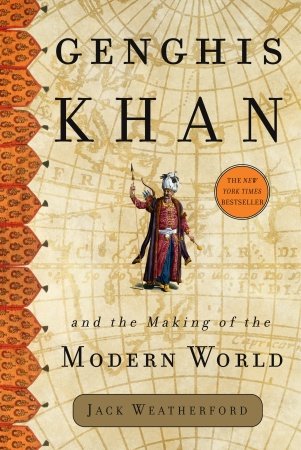
In twenty-five years, the Mongol army subjugated more lands and people than the Romans had conquered in four hundred years. Genghis Khan, together with his sons and grandsons, conquered the most densely populated civilizations of the thirteenth century. Whether measured by the total number of people defeated, the sum of the countries annexed, or by the total area occupied, Genghis Khan conquered more than twice as much as any other man in history. The hooves of the Mongol warriors' horses splashed in the waters of every river and lake from the Pacific Ocean to the Mediterranean Sea. At its zenith, the empire covered between 11 and 12 million contiguous square miles, an area about the size of the African continent and considerably larger than North America, including the United States, Canada, Mexico, Central America, and the islands of the Caribbean combined. It stretched from the snowy tundra of Siberia to the hot plains of India, from the rice paddies of Vietnam to the wheat fields of Hungary, and from Korea to the Balkans. The majority of people today live in countries conquered by the Mongols; on the modern map, Genghis Khan's conquests include thirty countries with well over 3 billion people. The most astonishing aspect of this achievement is that the entire Mongol tribe under him numbered around a million, smaller than the workforce of some modern corporations. From this million, he recruited his army, which was comprised of no more than one hundred thousand warriors—a group that could comfortably fit into the larger sports stadiums of the modern era.
In American terms, the accomplishment of Genghis Khan might be understood if the United States, instead of being created by a group of educated merchants or wealthy planters, had been founded by one of its illiterate slaves, who, by the sheer force of personality, charisma, and determination, liberated America from foreign rule, united the people, created an alphabet, wrote the constitution, established universal religious freedom, invented a new system of warfare, marched an army from Canada to Brazil, and opened roads of commerce in a free-trade zone that stretched across the continents. On every level and from any perspective, the scale and scope of Genghis Khan's accomplishments challenge the limits of imagination and tax the resources of scholarly explanation.
* * *
In nearly every country touched by the Mongols, the initial destruction and shock of conquest by an unknown tribe yielded quickly to an unprecedented rise in cultural communication, expanded trade, and improved civilization. In Europe, the Mongols slaughtered the aristocratic knighthood of the continent, but, disappointed with the general poverty of the area compared with the Chinese and Muslim countries, turned away and did not bother to conquer the cities, loot the countries, or incorporate them into the expanding empire. In the end, Europe suffered the least yet acquired all the advantages of contact through merchants such as the Polo family of Venice and envoys exchanged between the Mongol khans and the popes and kings of Europe. The new technology, knowledge, and commercial wealth created the Renaissance in which Europe rediscovered some of its prior culture, but more importantly, absorbed the technology for printing, firearms, the compass, and the abacus from the East. As English scientist Roger Bacon observed in the thirteenth century, the Mongols succeeded not merely from martial superiority; rather, "they have succeeded by means of science." Although the Mongols "are eager for war," they have advanced so far because they "devote their leisure to the principles of philosophy."
[…]
With so many accomplishments by the Mongols, it hardly seems surprising that Geoffrey Chaucer, the first author in the English language, devoted the longest story in The Canterbury Tales to the Asian conqueror Genghis Khan of the Mongols. He wrote in undisguised awe of him and his accomplishments. Yet, in fact, we are surprised that the learned men of the Renaissance could make such comments about the Mongols, whom the rest of the world now view as the quintessential, bloodthirsty barbarians. The portrait of the Mongols left by Chaucer or Bacon bears little resemblance to the images we know from later books or films that portray Genghis Khan and his army as savage hordes lusting after gold, women, and blood.
* * *
With Genghis Khan's decision to cross the Gobi and invade the Jurched in 1211, he had begun not just another Chinese border war: He had lit a conflagration that would eventually consume the world. No one, not even Genghis Khan, could have seen what was coming. He showed no sign of any global ambitions inasmuch as he fought only one war at a time, and for him the time had come to fight the Jurched. But starting from the Jurched campaign, the well-trained and tightly organized Mongol army would charge out of its highland home and overrun everything from the Indus River to the Danube, from the Pacific Ocean to the Mediterranean Sea. In a flash, only thirty years, the Mongol warriors would defeat every army, capture every fort, and bring down the walls of every city they encountered. Christians, Muslims, Buddhists, and Hindus would soon kneel before the dusty boots of illiterate young Mongol horsemen.
* * *
Although Guchlug was originally a Christian and the Black Khitan were Buddhists, they shared a common mistrust of the Uighur subjects, who were Muslims. In his newly acquired position as ruler of the kingdom, Guchlug began to persecute his Muslim subjects by limiting the practice of their religion. He forbade the call to prayer and prohibited public worship or religious study. When Guchlug left the capital of Balasagun on a campaign, his subjects closed the city gates behind him and tried to prevent his return. In retaliation, he besieged the capital, conquered it, and then razed it.
Without a Muslim ruler willing to protect them, the Muslims of Balasagun turned to Genghis Khan to overthrow their oppressive king. Though the Mongol army was stationed twenty-five hundred miles away, Genghis Khan ordered Jebe to lead twenty thousand Mongol soldiers across the length of Asia and defend the Muslims.
Because the Mongols conducted the campaign at the request of the Uighur Muslims, they did not allow plunder, destroy property, or endanger the lives of civilians. Instead, Jebe's army defeated the army of Guchlug and had him beheaded. Following the execution, the Mongols sent a herald to Kashgar to proclaim the end of religious persecution and the restoration of religious freedom in each community. According to the Persian historian Juvaini, the people of Kashgar proclaimed the Mongols "to be one of the mercies of the Lord and one of the bounties of divine grace."
Although Persian and other Muslim chroniclers recorded the episode in tremendous detail, the Secret History of the Mongols summed up the entire campaign in one simple sentence. "Jebe pursued Guchlug Khan of the Naiman, overtook him at the Yellow Cliff, destroyed him, and came home." From the Mongol perspective, that is probably all that mattered. Jebe had killed the enemy and returned home safely.
* * *
The Mongol army had accomplished in a mere two years what the European Crusaders from the West and the Seljuk Turks from the East had failed to do in two centuries of sustained effort. They had conquered Baghdad, the heart of the Arab world.
* * *
Near the end of 1253, the Year of the Ox, William of Rubruck, a Franciscan monk, came to the Mongol court as an envoy from the French king.
[…]
Despite the common religion, Rubruck greatly resented the Assyrian, Armenian, and Orthodox Christians at the Mongol court. Since he considered all non-Catholics to be heretics, he contemptuously designated the Mongol congregants of the Assyrian Church as Nestorians in reference to Nestorius, the fifth-century Patriarch of Constantinople who was condemned as a heretic by the Council of Ephesus in 431. Among the Assyrian beliefs that Rubruck held to be heretical was that the Virgin Mary was the mother of Christ, but not the mother of God. They also differed from the Catholics in their steadfast refusal to portray Christ on the cross as a violation of the Mongol taboos on depicting death or blood. Even when they admitted to being Christians, Mongols did not consider their religion as their primary identification. As one of the Mongol generals who was a follower of Christianity explained, he was no Christian—he was a Mongol.
[…]
Rubruck informed the officials that he knew the word of God and had come to spread it. In front of the assembled representatives of the various religions, the khan asked Rubruck to explain to them the word of God. Rubruck stumbled over a few phrases and stressed the importance to Christians of the commandment to love God, whereupon one of the Muslim clerics asked him incredulously, "Is there any man who does not love God?"
The discussion continued for some time, and according to Rubruck's own account, it was obvious that he did not fare well in the sometimes acrimonious arguments. He was unaccustomed to debating with people who did not share his basic assumptions of Catholic Christianity. Evidently, Mongke Khan recognized the problems he was having and suggested that all the scholars present take time to write out their thoughts more clearly and then return for a fuller discussion and debate of the issues.
The Mongols loved competitions of all sorts, and they organized debates among rival religions the same way they organized wrestling matches. It began on a specific date with a panel of judges to oversee it. In this case Mongke Khan ordered them to debate before three judges: a Christian, a Muslim, and a Buddhist. A large audience assembled to watch the affair, which began with great seriousness and formality.
As these men gathered together in all their robes and regalia in the tents on the dusty plains of Mongolia, they were doing something that no other set of scholars or theologians had ever done in history. It is doubtful that representatives of so many types of Christianity had come to a single meeting, and certainly they had not debated, as equals, with representatives of the various Muslim and Buddhist faiths. The religious scholars had to compete on the basis of their beliefs and ideas, using no weapons or the authority of any ruler or army behind them. They could use only words and logic to test the ability of their ideas to persuade.
Their debate ranged back and forth over the topics of evil versus good, God's nature, what happens to the souls of animals, the existence of reincarnation, and whether God had created evil. Between each round of wrestling, Mongol athletes would drink fermented mare's milk; in keeping with that tradition, after each round of the debate, the learned men paused to drink deeply in preparation for the next match.
No side seemed to convince the other of anything. At the end of the debate, they concluded the way most Mongol celebrations concluded, with everyone simply too drunk to continue.
While the clerics debated at Karakorum, their religious brethren were hacking at each other and burning one another alive in other parts of the world outside the Mongol Empire. At almost the same time of Rubruck's debate in Mongolia, his sponsor, King Louis IX, was busy rounding up all Talmudic texts and other books of the Jews. The devout king had the Hebrew manuscripts heaped into great piles and set afire. During Rubruck's absence from France, his fellow countrymen burned some twelve thousand hand-written and illuminated Jewish books. For these and other great services to the furtherance of the Gospel of Jesus Christ, his church canonized him as Saint Louis, thereby making him a figure of veneration that good Christians could emulate and to whom they could pray as an intermediary between humans and God.
A few days after the debate at Karakorum, Mongke Khan summoned Rubruck to discharge him and send him back to his home country. He took this occasion to explain to the priest, and through him to the rulers of Europe, that he himself belonged to no single religion, and he lectured Rubruck on Mongol beliefs about tolerance and goodness.
* * *
Thus, between 1242 and 1293, the Mongol expansion reached its maximum, and four battles marked the outer borders of the Mongol world—Poland, Egypt, Java, and Japan. The area inside those four points had suffered devastating conquests and radical adjustments to a markedly different kind of rule, but they were about to enjoy an unprecedented century of political peace with a commercial, technological, and intellectual explosion unlike any in prior history.
Subscribe to:
Posts (Atom)