Showing posts with label Japan. Show all posts

Saturday, April 02, 2011

Sharewood.org


Moi,

Auta Japani jaloilleen!

Liity nyt Sharewoodiin, niin Aurinkomatkat lahjoittaa puolestasi euron Punaiselle Ristille Japaniin.

Sharewood on uusi suomalainen vastuullinen sosiaalinen media, jossa voit lahjoittaa mainostajien rahaa hyväntekeväisyysjärjestöille ja voittaa itsellesi palkintoja.

Sharewoodin hyväntekijöitä ovat jo muun muassa näyttelijä Mikko Leppilampi, työministeri Anni Sinnemäki ja vuoden urheilija Minna Kauppi.

Liity mukaan ja klikkaa linkkiä:


Hi there,

Help the Japanese back on their feet!

Join Sharewood now to donate to the Red Cross for Japan.

Sharewood is a responsible new Finnish social media, where you can donate money to charities and win prizes.

Celebrity Sharewood benefactors include the actor Mikko Leppilampi, the Minister of Labour Anni Sinnemäki, and the athlete Minna Kauppi.

Click the link below and join:

Sunday, March 27, 2011

message from Japan

"subject: Mongolia
2011-03-12

"Hello there. I am an Australian currently writing from Japan and have been given some information that Mongolia may be one of the safest places as far as natural disasters are concerned. As you are aware we got shaken up terribly yesterday...

"Anyway I am seriously considering moving to Mongolia and would like to discuss how things over there are..."

=

RE: Mongolia

Thanks for your message. It's terrible about the disaster in Japan.

Here is a post I wrote about earthquakes in Mongolia, and particularly in the capital city of Ulaanbaatar:

http://radiganneuhalfen.blogspot.com/2010/04/earthquake-in-ulaanbaatar.html

Here is a recent article on the rapidly-changing society of Mongolia:

http://www.foreignpolicy.com/articles/2011/01/02/welcome_to_minegolia

Cheers,
Radigan


2009 October 16
Mongolia, Ulaanbaatar
models backstage at Gobi cashmere fashion show
photo by Timothy Fadek / Polaris Images


2010 June 17
Mongolia, worksite near Uyanga
ninja miners playing pool
photo by Timothy Fadek / Polaris Images


2010 June 25
Mongolia, Gobi Desert, Oyu Tolgoi gold and copper mine
miners
photo by Timothy Fadek / Polaris Images


2010 June 27
Mongolia, Ulaanbaatar, Tuul River
swimming
photo by Timothy Fadek / Polaris Images


2010 July 14
Mongolia, Erdenet
woman with umbrella
photo by Timothy Fadek / Polaris Images

Sunday, February 27, 2011

The Great Wave


The Great Wave off Kanagawa
from the series Thirty-six Views of Mount Fuji
1760-1849 Japanese

Monday, December 07, 2009

Linus Pauling, 1962 Nobel Peace Prize laureate


1945 March 7, Los Angeles Examiner:

"Jap Flag Painted on Garage Door

"Altadena, March 6--'Americans die but we love Japs.'

"On the walls of the garage at the home of Dr. Linus Pauling, Caltech chemistry professor, last night were emblazoned those words. Near by, also in red paint was a crude Jap flag.

"Dr. Pauling, developer and chairman of the chemistry and chemical engineering department at Caltech, recently hired a 24-year-old Japanese-American from the relocation center at Hart Mountain to do gardening work for him.

"The young Japanese-American, George Miniaki, was born in Gardena and is a graduate of Monrovia High School. His parents are still at the relocation center.

"Said Dr. Pauling:

"'I do not know who is responsible for this un-American act. I suspect, however, that this trespass on our home was carried out by one or more of those misguided people who believe that American citizens should be persecuted in the same way that the Nazis have persecuted the Jewish citizens of Germany.'"

towards 1941 December 7: weep on the shoulders

"Let us begin with a short and elementary lesson in practical economics.

"The Japanese, cooped up on their little island, and as prolific as Italians, need more land. All the pretty words in the world and all the treaties in the world and all the well-meant speeches of all the well-meaning old ladies and gentlemen in the world won't change this fact....

"They live in a country that is smaller than California (155,652 square miles for California and 148,756 square miles for Japan) and of these only 16,000,000 acres can be used for agriculture, which is less than 2% of all the arable land of America. If you want the comparison to come a little nearer home, it is a trifle less than the improved farmlands of New York State alone. Even with the help of one of the best staffs of scientific agricultural experts to be found anywhere in the world, you will see at a glance what sort of problem it is that faces these poor island folk. Living so near the sea-shore they would of course fish; but although they have now reached the point where they are raising certain sorts of fish in the muddy water of their rice fields, the difficulty remains unsolved and unsolvable in view the fact that the population increases by more than 650,000 people a year.

"It was inevitable therefore that Japan should look for more territory; and it was only natural that first of all she should think of the badly administered and sadly neglected lands that lay just across the China Sea.... The road to Manchuria was indicated by the land bridge of the Korean peninsula from which the mainland of Japan was separated by the narrow Strait of Korea. This strait is only 102 miles wide and is conveniently divided into halves by the Tsushima islands, those islands near which the Japanese fleet destroyed the Russian squadron in the year 1905, and killed Russia as a possible rival in eastern Asia....

"The immediate causes for a war are rarely interesting. It is the real underlying motives that count. In this case, as in the case of the expedition of 1592, they were to be found directly and absolutely in the necessity of the Japanese government to provide its rapidly increasing population with food.

"As soon as Japan had defeated Russia and had driven the Muscovite troops back from the Yalu River, the river that separates Korea from Manchuria, Korea became a Japanese protectorate. In 1910 it became a part of the Japanese Empire quite as much as Formosa, which the Japanese had taken from the Chinese in 1895, or the southern half of the island of Sakhalin, which they had taken from the Russians in the year 1905 in lieu of a war indemnity. Today already half a million Japanese have moved in among the twenty million Koreans. The rest will follow in due course of time.

"As for Manchuria, it had long been a bone of contention between the two nations that fought for supremacy in the northern half of the Pacific. After the Peace of Portsmouth, which made an end to the Russo-Japanese war, the fate of the country was sealed....

"Many people seem to experience a profound indignation at what they are inclined to denounce as a brutal expression of 'Japanese ambition'. I would rather call them 'Japanese necessities'. In matters of international policy, a certain healthy egoism is rather a desirable quality. Japan has got to find an outlet for the extra people at home. It is finding such an outlet in northern Asia, in a part of the world that is very lightly populated, and that has been accustomed to such outrageous forms of government that the inhabitants cannot possibly be worse off now than they were ever before.

"If this northern Asiatic safety-valve did not exist, the Philippines, the Dutch East Indies, Australia, New Zealand and the western coast of America would be forever exposed to a Japanese invasion and we would be obliged to station a battle-ship in front of every Polynesian island lest it be towed away over night by a Japanese cruiser.

"On the whole, the present arrangement seems much more practical. Those who feel inclined to shed tears at these callous and selfish utterances, are politely requested to weep on the shoulders of our own Indians."


--Hendrik van Loon, Van Loon's Geography: The Story of the World We Live In, 1932

Saturday, September 19, 2009

Health Care

"What Americans often consider a single unique system of health care is an illusion: we exist in a sea of not-so-unique alternatives. Like the citizens of Germany and Japan, workers in the United States share insurance premiums with an employer. Like Canadians, our older, destitute and disabled citizens see private providers with the government paying. Like the British, military veterans and Native Americans receive care in government facilities with the government paying the tab. And like the poor around the world, our uninsured pay cash, finagle charity care, or stay home."

--Abigail Zuger, "One Injury, 10 Countries: A Journey in Health Care," New York Times, 2009 September 14, review of The Healing of America: A Global Quest for Better, Cheaper, and Fairer Health Care by T.R. Reid

Thursday, August 27, 2009

Dharma Bums VII

"We gotta go to Berkeley after this and attend a lecture and discussion at the Buddhist Center."

"Aw I don't wanta go to no such thing, I just wanta drink in alleys."

He was really sad about it, and worried about me, but I just went on drinking.

When we got to Alvah's cottage and it was time to leave for the Buddhist Center lecture I said "I'll just sit here and get drunk and wait for you."

"Okay," said Japhy, looking at me darkly. "It's your life."

He was gone for two hours. I felt sad and drank too much and was dizzy. But I was determined not to pass out and stick it out and prove something to Japhy. Suddenly, at dusk, he came running back into the cottage drunk as a hoot owl yelling "You know what happened Smith? I went to the Buddhist lecture and they were all drinking white raw saki out of teacups and everybody got drunk. All those crazy Japanese saints! You were right! It doesn't make any difference! We all got drunk and discussed prajna! It was great!" And after that Japhy and I never had an argument again.


--Jack Kerouac, The Dharma Bums, 1958

Sunday, June 21, 2009

the entire Eastern seaboard might join the European Union

"The front page of the December 29 issue of the Wall Street Journal carried a story about a Russian professor, who predicts the disintegration of the United States by 2010....

"Igor Panarin, a former KGB analyst, forecasts economic, financial and demographic turmoil in the U.S. leading to a political and social crisis that will result in social unrest and a civil war before the country breaks up along ethnic lines....

"Panarin, the dean of the Russian Foreign Ministry’s academy for future diplomats, first predicted a U.S. collapse in 1998 at a conference in Linz, Austria... [Attendees] lined up afterward and asked him to autograph copies of the map showing how America would break into different regions that would align with foreign lands.


"He essentially predicted nearly a decade ago that California and many western states will become part of China (or fall under Chinese influence), Alaska will go back to Russia, Hawaii will go to either China or Japan, Texas and several southern states will become part of Mexico, northern states will become part of Canada and the entire Eastern seaboard might join the European Union.

"Panarin spends plenty of time at receptions in the Kremlin, lecturing to students, publishing books and appearing in various media outlets as an expert on U.S.-Russian relations, which are pretty dismal right now....

"His projections of a U.S. breakup have made him a darling of the Russian media and power circles.

"White House reaction at a December news conference drew laughter from the press corps. But Panarin warns a similar 1976 prediction by a French political scientist, Emmanuel Todd, correctly predicted the collapse of the Soviet Union 15 years before it happened."

--Rick Killion, Prairie Business Magazine, 2009 March

Saturday, April 04, 2009

Monstrously Disregards

In the United States, received a piece of religious propaganda in the mail, a 16-page, tabloid-sized newspaper entitled Faith for Life, compliments of the local Baptist church. The lead piece, “Why Does a Loving God Allow Bad Things to Happen?,” is a 1,000-word attempt to resolve the Epicurean paradox in favor of Christian faith, though the paradox is not identified by name within the piece.

The first paragraph:

“In July of 1945, during WWII, the warship USS Indianapolis had just delivered the atomic bomb. On its way back home it was torpedoed by the Japanese and sunk, stranding many sailors in the Pacific Ocean. In the days that followed, hundreds of men perished by sharks or other means until the tattered survivors were finally rescued. How could something so tragic ever happen?”

In the first paragraph of the first article on the first page of this lengthy proselytization paper, the writer alludes to an attack on an urban center with an experimental weapon of mass destruction resulting in the instantaneous incineration of 70,000 civilian non-combatants and the consequent fatal radiation poisoning and burning of 70,000 more, and monstrously disregards this in order to, in the same paragraph, designate the death of 900 fighting men in the legitimate sinking of their warship as “something so tragic.” Presumably because the 900 were “us” and the 140,000 were “the enemy,” the writer presents the death of 900 warriors as a tragedy and flouts the massacre of 140,000 innocents as not worthy of comment, in a contemptuous affront to the hippie admonition to “Love thine enemy.” The writer goes on from here to argue for the existence of a benevolent god-being.

The piece is signed: “FfL Editor.” No editor's name, writer's name, or staff member's name appears anywhere within the paper.

Sunday, December 30, 2007

Excellent Mongolia Paper

Here’s an paper comparing development in Mongolia with that of Montana and Wyoming by the Dutch Neoliberal Paul Treanor. The analysis of economic life in both Mongolia and the American West is incisive, and the prescience of the 7-year-old article is gripping, as the predicted pattern of development is what has happened and is happening in Mongolia. The example of Albania is novel and illuminating. There is no fear here to label poverty as poverty; though the evidence provided for rural Mongolian living conditions is anecdotal, scant, and out-of-date, I wouldn’t contest the assertion. The bibliography and links are excellent. The whole paper is striking, but I’ve excerpted the keenest moments, which are numerous.

Treanor concludes that the two areas are not very comparable. I wonder that a worthy comparison might be made between Montana/Wyoming and Inner Mongolia, which is “part of a larger state” where the “original inhabitants” have been “marginalised for generations”: the point near the end of the paper about a model for invasion piques the substitution of “Han” for “Europeans,” and “Mongols” for “American Indians.”

http://web.inter.nl.net/users/Paul.Treanor/mongoltana.html

"Mongolia and Wyoming/Montana

"Will regional development in Mongolia follow the model of the comparable areas in North America? The states of Montana and Wyoming (and adjoining areas in Canada) are the only region outside Eurasia, with a comparable climate and population density. At present a 'third-world' pattern, of primate-city growth and rural decline, seems probable in Mongolia. Revised April 2001....

"At present, about 40% of the population are nomadic herders, the highest percentage in the world. Standards of living in rural Mongolia are probably comparable with rural West Africa. The Soviet-promoted local industrial sector has collapsed: it was mainly in Ulaan Bataar anyway. The national economy is now dependent on the export of minerals, especially copper. Maintaining nomadic pastoralism is not a long-term option: it would mean permanent poverty. It would seem that in the long term (more than one generation), the rural areas will lose most of their population. The rest will go to Ulaan Bataar, the only large city...

"Comparing Mongolia with Wyoming/Montana

:: Mongolia :: Wyoming + Montana
[population] density :: 1,5 / km2 :: 2,1 / km2
employment in agriculture :: 40% to 45% :: 6%
ethnic origin :: indigenous Mongol and minorities :: almost entirely post-1850 immigrant
minorities :: Kazakh 6% :: American Indians 4,5% Hispanic 2%
coal output :: 5 million metric tons :: 355 million tons

"[B]oth regions have the same economic basis: mining. No major industry ever developed in Wyoming and Montana anyway: and in Mongolia the non-extractive industrial sector has collapsed. So there has been a certain convergence of the economic base - but that base is better developed in the two US states anyway. Although reports on Mongolia refer to the 'massive' Soviet-built coal mines, Wyoming produces far more coal (over 300 million tons)....

"General agricultural productivity on Mongolian territory is very low. Compare Mongolia with agriculture in Poland (still considered a low-productivity agricultural sector in comparison with western Europe). In 1997...[m]eat production per km2 was 50 times higher in Poland. These figures are for total land area, and reflect primarily the difference in climate, geography, and ecology. In fact much of Mongolia is 'agricultural land', perhaps more than in Poland, but only in the sense that herds sometimes graze there. It took about 40% of the population to reach even that level of meat production....

"The low agricultural productivity reflects the harsh climate of Mongolia. In fact the combination of cold and aridity is probably harsher than in Wyoming and Montana. In relation to the ecological limitations, the inhabitants had successfully adapted to these harsh conditions. The system of pastoral nomadism in Mongolia emerged over a period of thousands of years… It survived almost unchanged until about 1910....

"In other words, there was in Mongolia a unity of culture, history, economy and society based on pastoral nomadism....

"In contrast, the original inhabitants of Wyoming and Montana were militarily defeated, and marginalised for generations. (The Indian Reservations are known, even outside the United States, as examples of marginalisation). An entirely new society and economy was substituted for the existing version. The new population came primarily from rural Europe: for them, food production meant primarily the family farm. During the 19th century, the immigrants developed a cultural adaptation to the steppe/prairie zone: the cattle ranch.... But despite all the great cowboy mythology, the settlement of the American west was not primarily based on ranching. It certainly could not be based on ranching today: the ranch population is now a fraction of the state total....

"The first transcontinental railroad (Union Pacific) was built through Wyoming, two others through Montana. These rail lines had an important effect on the settlement pattern (more on this below). The rail lines were followed by transcontinental roads and motorways, gas pipelines, and the electricity grid. In contrast, the trans-Mongolia rail link was only completed in 1956: it is still single-track and, not electrified. There is only one ancient trade route through Mongolia (along this line), the so-called Tea Road.

"Perhaps the single most important difference is that Mongolia is not part of a larger state - certainly not a rich one. Wyoming and Montana are part of the richest state on earth. How many people would live there, if there were no federal Government transfer payments into the area? Without federal money for roads, military bases, pensions, and educational or health funds, perhaps there would be only coal-miners. A large proportion of the population, in remote areas of the USA, are being 'paid to live there', in this sense - despite the ideological and cultural commitment to the free market....

"(The location of military bases was a typical means for remote areas to secure inflows of federal funds). In Mongolia there were substantial transfers from the Soviet Union until 1989, some also in the form of military base activity. They may have amounted to 30% of GDP. However that was still small in absolute terms. It was not enough, for instance, to allow construction of surfaced roads to the provincial capitals

"A second important factor is the cultural uniformity of the United States, which allows migration to remote areas. The Rocky Mountain states in the USA have the policy option of promoting leisure and retirement housing development... But future in-migration to Mongolia from high-income areas (western Europe) is unlikely. Language and cultural barriers are very great...

"Local government in Mongolia is probably more rational, than its equivalent in the western United States. ...[T]he local government fragmentation, seen in some eastern European countries, has been avoided....

"In Wyoming and Montana there are two distinct types of local government unit: the county, and the seven Indian Reservations.... The reservations have far-reaching autonomy and deal directly with the federal Government, through the Bureau of Indian Affairs. Curiously, the United States and the former Soviet Union share this pattern, of non-comparable ethnic local government units. The Soviet Union had a standard provincial unit, the oblast, but also ethnic autonomous republics (and regions) of varying sizes. True, the system was under tight control of the Communist Party - but nevertheless the principle of ethnic government was accepted. It has survived into the present Russian Federation.... The impact of Indian self-government in the United States is limited: the total Indian and Alaska native population is less than the population of Mongolia... Montana population was 6% Indian in 1994, in Wyoming only 2% are Indian.... Probably the state borders are more of an obstacle to regional policy, than the presence of Indian tribal territories.

"The future regional structure in Mongolia

"There is no indigenous urban tradition in Mongolia, although some large monasteries were quasi-urban settlements....

"Rural densities are determined by the carrying capacity of the pastures: as low as 0,1 persons/km2 in the Gobi, 2 persons/km2 in the forest-steppe zone. Low density does not mean 'evenly spread'. Half the population lives in the three northern aimaks, containing the three main cities Ulaan Bataar, Erdenet and Darhan - on just 11% of the territory. A larger central zone has about two-thirds of the population, on one-third of the territory: it includes the ecologically favoured Khangai region. This concentration appears to be accelerating, with faster growth in the rural aimaks there. In contrast, the desert zone along the southern border with China is empty: so is most of Dornod aimak. There are also some empty areas in the mountains along the northern border, such as the Hentii range north-east of Ulaan Bataar.

"Inside each province, there is also an uneven distribution of population. The 1990 National Atlas shows, that even a nomadic population is concentrated in favourable areas. That means primarily along river valleys, and in the foothills of mountain ranges. In the highest mountain zones (in the west), population is concentrated in the valleys, and in some classic oasis settlements....

"The Gobi population is small enough, in absolute terms, to fit into a few mining and oil towns. In contrast, the forest-steppe zone will probably lose much of its population. Why this prediction? It is extremely unlikely that the nomadic pastoral lifestyle will survive for another generation: overall productivity is extremely low. If a high-productivity form of meat production replaced nomadic herding, the rural population might be partly stabilised. If not, then the rural population will have the choice of staying where they are, as the poorest people in Asia - or migrating. Given the predicted growth of the Chinese economy, and the demographic labour shortage in Russia and western Europe, emigration will probably be easier than at present....

"The exceptional status of Ulaan Bataar is obvious. The industrial centres Darhan, Erdenet and (on a smaller scale Choibalsan), are the result of planned concentration of investment. They were created by decisions at national level. […] Industrialisation of the aimak centres seems improbable. They are remote and relatively small, with no existing industry, except processing meat and hides....

"The most reasonable prediction of the future population distribution is that the majority of Mongolians will live in one city. At present the best example of 'primate city' growth is Tirana in Albania. That is also a country with extreme rural poverty, and a collapsed industrial sector. Tirana has doubled (perhaps tripled) its population in a decade. However Albania also has a rich neighbour, Italy, and an extremely high rate of illegal emigration. And it has an urban tradition in the coastal regions, and an existing urban hierarchy with regional centres. Mongolia's medium-term future is extreme rural poverty, little emigration, and 100% concentration of development in Ulaan Bataar. That suggests massive movement to the capital.

"It would be difficult to build up regional centres, as a balance for this trend (the classic French 'growth pole' model). In the west the only candidate is Hovd, and it could only serve the 3 western aimaks, with 267 000 inhabitants. In the east Choibalsan is the largest centre, but much of the region is completely empty. If it grew, it would not be a regional centre, but an isolated city in the steppe. The aimak centres in the Khangai are the best candidates, for a 'regional' centre... Although Arvaiheer is a small town, it already has a paved road to the capital, and it is growing faster than other aimak centres. But for all these Khangai towns, the problem is the same. Density is low, transport infrastructure is oriented to the capital, there are no transverse routes. If people must travel two days in winter to reach a small regional capital, then they will probably travel in three days to Ulaan Bataar instead. The 'regional pole' policies in Europe moved a selected city upwards in the urban hierarchy, to become the regional centre. This logic applies inside a well-developed urban hierarchy, but not in Mongolia....

"All in all, at least a doubling of the Ulaan Baataar population seems probable, and at least a 40% share of national population, probably ultimately 60%. The UN medium variant projected 2050 population for Mongolia is 4 398 000 so that would mean a city of 1,7 million or 2,7 million. That is not unusual for Asia: some cities in 'Inner Mongolia', part of China, are already in this size range.

"With this scenario in mind, look again at the economy and population distribution in Wyoming/Montana. What makes it different? Why don't 500 000 people live in Billings, Montana, for example? With US standards of living, they can certainly afford it. Why are they living in small towns instead, and what work do they do there? This is the usefulness of the comparison: it allows a possible alternative for the 'Ulaan Bataar scenario' to be formulated.

"From this perspective the comparison with Canada is less useful. The Province of Alberta seems the closest correspondence in terms of climate, landforms and vegetation. However, this table of the Alberta urban hierarchy (from a report of the Electoral Boundaries Commission) indicates why Alberta is not a good comparison: it is more urbanised, and population density is almost 3 times higher.... The higher population density reflects the large area of arable land in Alberta, and 40 years of oil and gas exports.

"Small-town Montana and Wyoming

"Sheridan, Wyoming is a random example. The population is 14 800, the size of the smallest aimak centres in Mongolia. Another 10 000 live in the surrounding Sheridan County. Even a glance at the the Sheridan Directory website shows the vast difference between life in a remote region of a rich country and in a remote area of a very poor country. Sheridan is 215 km from Billings, Montana, the regional centre. It is 700 km from Denver (Colorado), the nearest large city. The Chamber of Commerce profile shows it has 33 doctors and 16 dentists, 6 libraries, 3 swimming pools, 2 golf courses and 13 tennis courts, 4 local radio stations, 38-channel cable tv, and 7 banks. There is not just piped water and electricity, but a sewage system, sewage plant, and even separate storm drains. A rail line, and the Interstate Highway I-90 (Chicago-Seattle), run through the county.

"...[T]he major employers are related to the transcontinental transit function (railroad, motels), or to 'regional development' in the form of federal facilities (Veterans Administration hospital), or nationally funded government services (local government, schools, hospitals). The extractive industries are also represented, mining, wood processing. In turn this supports an extensive retail and personal services sector.

"Transit functions in Sheridan are still important. But when the railroads were the only long-distance transport, they were probably even more important. That leads to the issue of their influence on settlement. And this seems the key to the population distribution in Montana and Wyoming. Of the 21 largest settlements...14 are on a transcontinental rail line....

"A good comparison with Sheridan is the smaller town of Riverton, Wyoming, located off the main transcontinental routes.... More than in Sheridan, the major employers are government-funded, or service the local market... Riverton's regional economy seems dependent on irrigated agriculture, small oil fields, and (for about 30 years) on uranium. The irrigation was a government project: even in such a remote area, the external economy and government intervention have created high-productivity employment....

"Small-town Mongolia

"In contrast to the high standard of living in Sheridan and Riverton, rural Mongolia is still firmly in the Third World. The normal conditions of life are, by US standards, acute poverty. According to the 2000 population census, half the countries households still live in a ger (the traditional nomads tent). Two-thirds of the rural population have no electricity, only 2% have a telephone....

"In rural areas it seems that only those who have successfully continued (or returned to) nomadic herding can avoid destitution. And even those only survive, no more.

"Conclusions

"Some simple conclusions are possible from the comparisons here. The first is that the areas are less comparable than at first sight. In particular, Montana and Wyoming seem to have more energy and mineral resources. These have been developed for a longer period, so that there is a good local technical infrastructure.

"Second, Mongolia seems so disadvantaged for agriculture, that not even Montana and Wyoming are a good comparison. And this position is unlikely to be reversed, because food production elsewhere can be more easily expanded. China already produces 265 times as much meat as Mongolia. In other words, a 0,4% improvement in productivity there, means more meat than a doubling of Mongolian output. The money needed to transform Mongolian agriculture, into something like Wyoming agriculture, can almost certainly be better spent elsewhere. And even Wyoming-style rural development would still mean that most of the rural population migrate to urban areas.

"Third, a related issue: farming areas of Wyoming and Montana were settled by Europeans under very different agricultural conditions. When population was growing faster than the increase in output per hectare, the only way to feed more people was to use more land. In the last generation, that necessity has disappeared. In the European Union, huge areas of agricultural land, created in the last 1500 years, will be abandoned in the next 25 years. Market forces will probably lead to a similar transformation in the USA.... However, that does not necessarily mean total depopulation. The EU openly subsidises such areas, the United States does that more indirectly. US mountain communities still have votes and political influence - enough to get some federal projects diverted to their area ('pork-barrelling'). And they still receive pensions and health care. This hidden transfer funding slows the population mobility, for which the US is famous. It tends to fossilise the existing settlement pattern.

"Mongolian herders have votes too, but there is no 'pork barrel' for them. No rich federal government will build expensive projects in small provincial towns. The despised Soviet Union was the only state which funded places like Baruun-Urt and Mandalgovi. It is hard to imagine Japan or the EU paying to maintain such settlements - if there is no direct economic advantage.

"A fourth conclusion is that Wyoming and Montana have benefited from the multiple transcontinental routes. In Mongolia there is only one, and it passes through Ulaan Bataar anyway. It will not decentralise development....

"A fifth conclusion is about a false idea: that Mongolia can go through a social/technological phase similar to 19th century Wyoming and Montana. In other words, that it can transform itself into something like 20th century Wyoming/Montana - and yet maintain the unity of culture, economy and society associated with the centuries of pastoral nomadism. But there were no indigenous pastoral nomads in Wyoming/Montana. In the 19th century, no immigrant pastoral nomads came to Wyoming/Montana either. There was no switch from pastoral nomadism to ranching. The American Indians did not make a successful economic transition to ranching, or indeed anything else. They were sent to Reservations, and an entirely new culture, economy and society was built up around them by immigrants. Wyoming and Montana are suitable historical models for an invasion of Mongolia, not for its regional development.

"A sixth conclusion is that 'economic regionalisation' of Mongolia is difficult, in both senses of the term.... The economic-spatial structure of Mongolia is, in simple form, Ulaan Bataar plus pasture land. One city at one location, and 33 million head of livestock spread over 1,5 million km2. Of course, that is an exaggeration and a distortion - but less so than in more densely populated and urbanised countries, where there are more centres and networks of all kinds.

"The general conclusion from the comparisons here is: a Wyoming/Montana pattern of settlement and regional development in Mongolia is unlikely. A third-world flight from rural poverty into slums around Ulaan Bataar seems the probable future. The elimination of poverty in that city will probably be dependent on industrialisation - on the model of the Chinese inland cities to the south. Romantic ideas about a 'sustainable' rural development (promoted by some western activists), are not just unlikely, but unethical. There can be no 'return to tradition' here, because the country has far more people than in the traditional period. (In 1918, before the changes, there were 650 000 inhabitants, a quarter of the present population). So-called 'sustainable' herding would condemn the rural population to permanent poverty, since the inherent productivity of the land is so low. If such a lifestyle were subsidised by rich countries (directly, or through tourism), it would transform the rural areas into a 'Mongol Heritage' theme park. No population would voluntarily and permanently choose either of these alternatives: they would evade them by emigration (legal or illegal). If these were the only futures for a majority of the population, then they could only be enforced in the long term, by closing the border and making the country a prison."

Sunday, October 14, 2007

"...is the crossroads of the world from now on."

He now spoke reflectively in a fearful mix of Rastafarian glossolalia, old African words and rearranged English, but she understood the message: ‘The people of the Caribbean are different. Their early life in Africa made them so, right from the beginning. Terrible years on the sugar plantations increased the difference between them and white people. We think different. We value different things. We live different. And we must make our living in different ways. The white man has nothing to teach us. We build a good life here, we find the money to buy his radios, his televisions, his Sony Betamaxes, his Toyotas.’

‘Everything you mentioned comes from Japan, not from white people.’

Ras-Negus, always displeased when reality was thrust into his dreams, ignored this...


--James Michener, Caribbean, 1989

Sunday, May 20, 2007

Sri Chinmoy


Went with Marc today to listen to some guy speak at the UB Palace. "Who's speaking?" I wanted to know. "Some spiritual teacher."

Six full-size buses were parked in front of the UB Palace, each bearing a computer-printed A4 sign "Shri Chinmoi" in the windshield.

The UB Palace was packed. It turned out it was not a lecture or a reading, but a musical concert, and it was free.

It also turned out to be farcical. Set up on the stage were many Indian stringed instruments and flutes along with several electronic beat-boxes reminiscent of my brother's old electronic Casio keyboard that he had when we were kids in the '80s. Some old dude doddered around onstage between the instruments, sitting with one and playing on it until he seemingly got bored and then moving on to another one. I can only describe the stringed instrument playing as "awful" (this is the land of the morin khuur, after all, and no Ravi Shankar was this guy); I couldn't tell if he was trying to play music on the stringed instruments or just trying to tune them. The electronic sounds were cool, but they didn't seem like anything that I couldn't have produced myself after 20 minutes with a keyboard. On a few occasions, choirs of sari-clad folks from the theater seats congregated in front of the stage and sang a tune.

After the concert, the buses in front loaded up with the people in the saris, most of whom had European facial features. I was mildly interested to find out who this old guy was. I said "Hello" to one older pale-skinned lady in a sari, but she avoided my eyes. I heard a few of the sari people speaking Russian.

Anyway, I got home and googled this "Shri Chinmoi" guy. I discovered that President Enkhbayar awarded him the Friendship Medal last Wednesday. I also discovered that he is a con-man cult leader:

http://www.rickross.com/groups/srichinmoy.html

"Inside the entrance there's a picture of the grimacing Sri lifting a barbell with one arm; the caption says it weighed 7,063 pounds. That's right--7,063 pounds. With one arm. The Sri has lifted elephants and airplanes with one arm too. A man with a beer belly looks at the picture and says 'So how come this guy isn't in the Guinness book of records?'"

"The Toronto Council on Mind Abuse alleged that Chinmoy has misrepresented his status regarding the UN."

"The guru holds meditation meetings at the UN building in Manhattan, but has no official 'delegate' status."

"Sri Chinmoy labeled a visit to Japan he undertook as 'a delegation of about 100 members of the United Nations and Sri Chinmoy,' despite the fact that there was no official backing of this trip. Other events of Sri Chinmoy's organization, including concerts and sporting events, have attempted to portray an official connection with the U.N."

"Arnold Markowitz, director of the New York Jewish Community cult hotline and clinic said, 'Sri Chinmoy has produced the most psychiatric casualties of the meditation groups that I've experienced.'"

"Other national cult watchdog groups and mental health professionals also alleged Sri Chinmoy heads a 'destructive cult' with as many as 1,500 devotees."

"His followers engage in intensive chanting and meditative trances, adopt a distinctive dress, and avoid contact with non-members. Disciples address him as 'The Supreme.' Sri Chinmoy claims to have super-normal powers - including having written 843 poems in 24 hours, created 16,031 paintings in one day, and lifted 7000 pounds with one arm."

Wednesday, April 25, 2007

The Difference Half a Year Makes


This article from a year ago contrasts completely with the article from six months ago ("The Sumo authorities appreciate the excitement and ticket sales that foreign wrestlers generate."):

"Ticket sales are dropping as sumo stars like Bulgaria's Kotooshu and Mongolia's Asashoryu shove contenders from Japan out of the spotlight...

"Ticket sales have been declining, it is becoming harder for sumo to find young recruits and TV ratings have fallen significantly compared with a decade or so ago, when Japanese were still more of a factor in the six annual tournaments."

Friday, February 23, 2007

Nairamdal

“Where is your son serving in the army?” we asked.

“My son Ulzii is an officer in Baishint. You may perhaps know him,” replied Damba and showed us a photograph taken from the wooden box. The photo had the image of a Russian and a Mongolian soldier.

“Which of them is your son?” we asked jokingly.

“They are both my sons,” Doulma said, “the Russian and the Mongolian alike. This Russian fought alongside my son at Khalkhiin Gol* and he carried my son when he was wounded on the battlefield. Now my son Ulzii constantly corresponds with this Russian boy.”

The old man kept silent as if thinking, and looking at the photograph he exclaimed sadly: “These photos are a wonder! The image remains forever. It was a sad pity that photographs were not taken when we were on the battlefield.”

The old man’s face shone with joy when we asked him, “Did you ever go to war?”

“A Russian officer gave me this sword,” said he, showing a sword. “He was one of those brave comrades who was fighting for the freedom and happiness of our Mongolians. I think he is now fighting the German fascists...

“After hunting marmots for my family, I joined the people’s partisans with the only horse I had then.

“Since then the Mongolian nation has been changing before my eyes. Our life is improving as the nation is moving forward. Now I own about twenty horses, thirty cows and a hundred sheep...”


*Khalkhiin Gol – in 1939, imperialist Japan waged a war against Mongolia and was defeated


--Ts.Damdinsuren, “They Are Both My Sons,” 1943, translated by Ch.Burenbayar

Monday, January 15, 2007

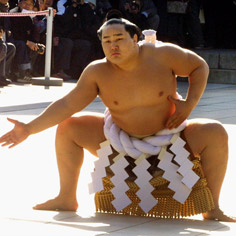
"Sumo falls to a Mongol invasion"


"Thirty-four Mongolians compete regularly in Japan's national, indigenous sport. One of them, Asashoryu, has dominated the ring since being promoted in 2003 to the highest rank of Grand Champion. Currently the only wrestler at that level, he could soon be joined by a Bulgarian, the strongest of the 14 or so East Europeans who have also broken into the sport.

"Since the 1960s there have always been a few foreigners in Sumo. Several Hawaiians made it to the top, an achievement that means adopting Japanese nationality, dress and behaviour...

"But conservative Japanese are dismayed at the recent involvement of so many outsiders. More than a sport, Sumo, with its ancient history, is steeped in the rituals of the Shinto religion that the Japanese believe only they can fully comprehend...

"And foreigners do not always behave with the necessary decorum. The Mongolian Grand Champion has been disqualified for hair-pulling and has refused to take Japanese nationality.

"The Sumo authorities, however, appreciate the excitement and ticket sales that foreign wrestlers generate."

-The First Post

Wednesday, December 20, 2006

Mongolia, China, and Chinggis Khaan in *The Economist*


"Battle for Mongolia's soul

"On the 800th anniversary of his empire's birth, China and Mongolia both claim Genghis Khan as their own"

The Economist, Dec 19th 2006

"The Mongolian government has already suffered the downsides of economic nationalism. By law, all gold output is supposed to be sold to the Bank of Mongolia, the central bank. This year the amount sold has fallen by half even though production has continued to rise, says the central bank's former governor, Ochirbat Chuluunbat. He blames a windfall tax that has encouraged small producers to sell gold on the black market rather than to the bank. Most black-market gold is smuggled across the 4,677km border with China...

"For all Mongolia's nationalism, the government remains acutely aware of the dangers of upsetting its powerful southern neighbour. Officials studiously avoid criticism of China, which provides vital port facilities for Mongolia's exports...

"In order to avoid falling under the sway of either Russia or, particularly, China, Mongolia pursues what it calls a 'third neighbour' policy. This involves remaining on good terms with its giant neighbours but also reaching out to countries such as America and Japan (Mongolia's biggest aid donor). America has been delighted by Mongolia's support for its military operations in Iraq, including the dispatch of some 200 support troops. This is the first time Mongolian troops have been stationed in Iraq since Genghis's grandson, Hulagu, conquered Baghdad...

"A Mongolian general, given warning by an American counterpart of the dangers of operating in Baghdad, is said to have quipped: 'I know. We've been here before.'"

Monday, May 15, 2006

1%

This is awesome.

“According to Japanese newspapers, Mr. Kadokawa (producer of the film) met Mongolian Prime Minister to ask the preparation of 20,000 extras from countryside for this film shoot.... It sounds ridiculous. He must have no idea about Mongolia. ‘20,000 people’ means almost 1% of the whole Mongolian population.”

Monday, October 10, 2005

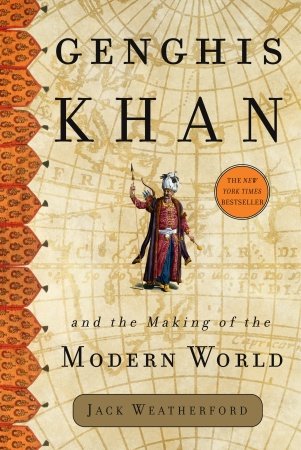
selected quotations from *Genghis Khan and the Making of the Modern World* by Jack Weatherford, copyright 2004


In twenty-five years, the Mongol army subjugated more lands and people than the Romans had conquered in four hundred years. Genghis Khan, together with his sons and grandsons, conquered the most densely populated civilizations of the thirteenth century. Whether measured by the total number of people defeated, the sum of the countries annexed, or by the total area occupied, Genghis Khan conquered more than twice as much as any other man in history. The hooves of the Mongol warriors' horses splashed in the waters of every river and lake from the Pacific Ocean to the Mediterranean Sea. At its zenith, the empire covered between 11 and 12 million contiguous square miles, an area about the size of the African continent and considerably larger than North America, including the United States, Canada, Mexico, Central America, and the islands of the Caribbean combined. It stretched from the snowy tundra of Siberia to the hot plains of India, from the rice paddies of Vietnam to the wheat fields of Hungary, and from Korea to the Balkans. The majority of people today live in countries conquered by the Mongols; on the modern map, Genghis Khan's conquests include thirty countries with well over 3 billion people. The most astonishing aspect of this achievement is that the entire Mongol tribe under him numbered around a million, smaller than the workforce of some modern corporations. From this million, he recruited his army, which was comprised of no more than one hundred thousand warriors—a group that could comfortably fit into the larger sports stadiums of the modern era.

In American terms, the accomplishment of Genghis Khan might be understood if the United States, instead of being created by a group of educated merchants or wealthy planters, had been founded by one of its illiterate slaves, who, by the sheer force of personality, charisma, and determination, liberated America from foreign rule, united the people, created an alphabet, wrote the constitution, established universal religious freedom, invented a new system of warfare, marched an army from Canada to Brazil, and opened roads of commerce in a free-trade zone that stretched across the continents. On every level and from any perspective, the scale and scope of Genghis Khan's accomplishments challenge the limits of imagination and tax the resources of scholarly explanation.

* * *

In nearly every country touched by the Mongols, the initial destruction and shock of conquest by an unknown tribe yielded quickly to an unprecedented rise in cultural communication, expanded trade, and improved civilization. In Europe, the Mongols slaughtered the aristocratic knighthood of the continent, but, disappointed with the general poverty of the area compared with the Chinese and Muslim countries, turned away and did not bother to conquer the cities, loot the countries, or incorporate them into the expanding empire. In the end, Europe suffered the least yet acquired all the advantages of contact through merchants such as the Polo family of Venice and envoys exchanged between the Mongol khans and the popes and kings of Europe. The new technology, knowledge, and commercial wealth created the Renaissance in which Europe rediscovered some of its prior culture, but more importantly, absorbed the technology for printing, firearms, the compass, and the abacus from the East. As English scientist Roger Bacon observed in the thirteenth century, the Mongols succeeded not merely from martial superiority; rather, "they have succeeded by means of science." Although the Mongols "are eager for war," they have advanced so far because they "devote their leisure to the principles of philosophy."
[…]
With so many accomplishments by the Mongols, it hardly seems surprising that Geoffrey Chaucer, the first author in the English language, devoted the longest story in The Canterbury Tales to the Asian conqueror Genghis Khan of the Mongols. He wrote in undisguised awe of him and his accomplishments. Yet, in fact, we are surprised that the learned men of the Renaissance could make such comments about the Mongols, whom the rest of the world now view as the quintessential, bloodthirsty barbarians. The portrait of the Mongols left by Chaucer or Bacon bears little resemblance to the images we know from later books or films that portray Genghis Khan and his army as savage hordes lusting after gold, women, and blood.

* * *

With Genghis Khan's decision to cross the Gobi and invade the Jurched in 1211, he had begun not just another Chinese border war: He had lit a conflagration that would eventually consume the world. No one, not even Genghis Khan, could have seen what was coming. He showed no sign of any global ambitions inasmuch as he fought only one war at a time, and for him the time had come to fight the Jurched. But starting from the Jurched campaign, the well-trained and tightly organized Mongol army would charge out of its highland home and overrun everything from the Indus River to the Danube, from the Pacific Ocean to the Mediterranean Sea. In a flash, only thirty years, the Mongol warriors would defeat every army, capture every fort, and bring down the walls of every city they encountered. Christians, Muslims, Buddhists, and Hindus would soon kneel before the dusty boots of illiterate young Mongol horsemen.

* * *

Although Guchlug was originally a Christian and the Black Khitan were Buddhists, they shared a common mistrust of the Uighur subjects, who were Muslims. In his newly acquired position as ruler of the kingdom, Guchlug began to persecute his Muslim subjects by limiting the practice of their religion. He forbade the call to prayer and prohibited public worship or religious study. When Guchlug left the capital of Balasagun on a campaign, his subjects closed the city gates behind him and tried to prevent his return. In retaliation, he besieged the capital, conquered it, and then razed it.

Without a Muslim ruler willing to protect them, the Muslims of Balasagun turned to Genghis Khan to overthrow their oppressive king. Though the Mongol army was stationed twenty-five hundred miles away, Genghis Khan ordered Jebe to lead twenty thousand Mongol soldiers across the length of Asia and defend the Muslims.

Because the Mongols conducted the campaign at the request of the Uighur Muslims, they did not allow plunder, destroy property, or endanger the lives of civilians. Instead, Jebe's army defeated the army of Guchlug and had him beheaded. Following the execution, the Mongols sent a herald to Kashgar to proclaim the end of religious persecution and the restoration of religious freedom in each community. According to the Persian historian Juvaini, the people of Kashgar proclaimed the Mongols "to be one of the mercies of the Lord and one of the bounties of divine grace."

Although Persian and other Muslim chroniclers recorded the episode in tremendous detail, the Secret History of the Mongols summed up the entire campaign in one simple sentence. "Jebe pursued Guchlug Khan of the Naiman, overtook him at the Yellow Cliff, destroyed him, and came home." From the Mongol perspective, that is probably all that mattered. Jebe had killed the enemy and returned home safely.

* * *

The Mongol army had accomplished in a mere two years what the European Crusaders from the West and the Seljuk Turks from the East had failed to do in two centuries of sustained effort. They had conquered Baghdad, the heart of the Arab world.

* * *

Near the end of 1253, the Year of the Ox, William of Rubruck, a Franciscan monk, came to the Mongol court as an envoy from the French king.
[…]
Despite the common religion, Rubruck greatly resented the Assyrian, Armenian, and Orthodox Christians at the Mongol court. Since he considered all non-Catholics to be heretics, he contemptuously designated the Mongol congregants of the Assyrian Church as Nestorians in reference to Nestorius, the fifth-century Patriarch of Constantinople who was condemned as a heretic by the Council of Ephesus in 431. Among the Assyrian beliefs that Rubruck held to be heretical was that the Virgin Mary was the mother of Christ, but not the mother of God. They also differed from the Catholics in their steadfast refusal to portray Christ on the cross as a violation of the Mongol taboos on depicting death or blood. Even when they admitted to being Christians, Mongols did not consider their religion as their primary identification. As one of the Mongol generals who was a follower of Christianity explained, he was no Christian—he was a Mongol.
[…]
Rubruck informed the officials that he knew the word of God and had come to spread it. In front of the assembled representatives of the various religions, the khan asked Rubruck to explain to them the word of God. Rubruck stumbled over a few phrases and stressed the importance to Christians of the commandment to love God, whereupon one of the Muslim clerics asked him incredulously, "Is there any man who does not love God?"

The discussion continued for some time, and according to Rubruck's own account, it was obvious that he did not fare well in the sometimes acrimonious arguments. He was unaccustomed to debating with people who did not share his basic assumptions of Catholic Christianity. Evidently, Mongke Khan recognized the problems he was having and suggested that all the scholars present take time to write out their thoughts more clearly and then return for a fuller discussion and debate of the issues.

The Mongols loved competitions of all sorts, and they organized debates among rival religions the same way they organized wrestling matches. It began on a specific date with a panel of judges to oversee it. In this case Mongke Khan ordered them to debate before three judges: a Christian, a Muslim, and a Buddhist. A large audience assembled to watch the affair, which began with great seriousness and formality.

As these men gathered together in all their robes and regalia in the tents on the dusty plains of Mongolia, they were doing something that no other set of scholars or theologians had ever done in history. It is doubtful that representatives of so many types of Christianity had come to a single meeting, and certainly they had not debated, as equals, with representatives of the various Muslim and Buddhist faiths. The religious scholars had to compete on the basis of their beliefs and ideas, using no weapons or the authority of any ruler or army behind them. They could use only words and logic to test the ability of their ideas to persuade.

Their debate ranged back and forth over the topics of evil versus good, God's nature, what happens to the souls of animals, the existence of reincarnation, and whether God had created evil. Between each round of wrestling, Mongol athletes would drink fermented mare's milk; in keeping with that tradition, after each round of the debate, the learned men paused to drink deeply in preparation for the next match.

No side seemed to convince the other of anything. At the end of the debate, they concluded the way most Mongol celebrations concluded, with everyone simply too drunk to continue.

While the clerics debated at Karakorum, their religious brethren were hacking at each other and burning one another alive in other parts of the world outside the Mongol Empire. At almost the same time of Rubruck's debate in Mongolia, his sponsor, King Louis IX, was busy rounding up all Talmudic texts and other books of the Jews. The devout king had the Hebrew manuscripts heaped into great piles and set afire. During Rubruck's absence from France, his fellow countrymen burned some twelve thousand hand-written and illuminated Jewish books. For these and other great services to the furtherance of the Gospel of Jesus Christ, his church canonized him as Saint Louis, thereby making him a figure of veneration that good Christians could emulate and to whom they could pray as an intermediary between humans and God.

A few days after the debate at Karakorum, Mongke Khan summoned Rubruck to discharge him and send him back to his home country. He took this occasion to explain to the priest, and through him to the rulers of Europe, that he himself belonged to no single religion, and he lectured Rubruck on Mongol beliefs about tolerance and goodness.

* * *

Thus, between 1242 and 1293, the Mongol expansion reached its maximum, and four battles marked the outer borders of the Mongol world—Poland, Egypt, Java, and Japan. The area inside those four points had suffered devastating conquests and radical adjustments to a markedly different kind of rule, but they were about to enjoy an unprecedented century of political peace with a commercial, technological, and intellectual explosion unlike any in prior history.