Showing posts with label gers. Show all posts

Sunday, March 27, 2011

message from Japan

"subject: Mongolia
2011-03-12

"Hello there. I am an Australian currently writing from Japan and have been given some information that Mongolia may be one of the safest places as far as natural disasters are concerned. As you are aware we got shaken up terribly yesterday...

"Anyway I am seriously considering moving to Mongolia and would like to discuss how things over there are..."

=

RE: Mongolia

Thanks for your message. It's terrible about the disaster in Japan.

Here is a post I wrote about earthquakes in Mongolia, and particularly in the capital city of Ulaanbaatar:

http://radiganneuhalfen.blogspot.com/2010/04/earthquake-in-ulaanbaatar.html

Here is a recent article on the rapidly-changing society of Mongolia:

http://www.foreignpolicy.com/articles/2011/01/02/welcome_to_minegolia

Cheers,
Radigan


2009 October 16
Mongolia, Ulaanbaatar
models backstage at Gobi cashmere fashion show
photo by Timothy Fadek / Polaris Images


2010 June 17
Mongolia, worksite near Uyanga
ninja miners playing pool
photo by Timothy Fadek / Polaris Images


2010 June 25
Mongolia, Gobi Desert, Oyu Tolgoi gold and copper mine
miners
photo by Timothy Fadek / Polaris Images


2010 June 27
Mongolia, Ulaanbaatar, Tuul River
swimming
photo by Timothy Fadek / Polaris Images


2010 July 14
Mongolia, Erdenet
woman with umbrella
photo by Timothy Fadek / Polaris Images

Monday, February 04, 2008

The Story of the Weeping Camel

"so i was wondering if you've seen the film weeping camel and what you might have thought about it. i'm taking another filmmaking class and we're discussing it tomorrow. -lisa"

I saw "Weeping Camel" in Portland, Oregon, in 2004, as I was on my way back to Mongolia. The audience was stunned; the reaction was very positive. I know the film was popular in the politically liberal-minded markets of Europe and the coasts of the States. In Mongolia, it was a huge flop. I read one opinion (I think it was by the filmmaker) that posited that the fact that the film was a documentary turned off Mongolians, because they have ideas about documentaries, held over from Soviet times, as silly propagandizing films portraying the glory of the worker.

But I think "Camel" is just not that interesting to Mongolians. There's not much of a story to it. Many of the film's scenes are simply scenes from regular countryside life. One of the most shocking, humorous, incredible scenes for the Portland audience was when a five-year-old boy runs outside the ger and crawls up onto the back of a huge camel and then whips the camel until it stands up and then he rides away on it. But for a Mongolian, that scene has no novelty and can elicit no reaction; it's just another boring scene in which nothing really happens.

To think about it, would you want to watch a film of some average ol' Americans in Ohio or somewhere, just following them around in their ordinary routine, working and cooking and showering and whatever? Can you think of anything more boring? Anyway, "Weeping Camel" flopped in Mongolia.

I was uncertain about the people portrayed in "Camel." The film's style was of a documentary, but it seemed to me that the people were acting out predetermined roles, or perhaps they were self-conscious about having a camera on them.

I think of "Camel" as an example of a concept that I had read about in "Anthropology of Tourism" seminar: the commodification of culture--specifically, the commodification of so-called "indigenous" culture to be marketed to wealthy, liberal foreigners.

The only Mongolians I know who have seen "Camel" are ones who work in the tourism industry. Many tourists have come to Mongolia stating that their interest was piqued by that movie, so some Mongolians have viewed the movie just out of curiosity. In the main, "Weeping Camel" was ignored in Mongolia, and would be almost entirely unknown if the filmmaker had not received some international recognition through awards, which did make the papers in Ulaanbaatar.

So what do Mongolians watch? Melodramatic South Korean television serials and films. There are Mongolians making films for the Mongolian market, more of them, it seems, with each passing year. Many of these popular films seem to be set in Ulaanbaatar and are crime/gunfight/kick-'em-in-the-face flicks, which in the States might be described with the adjectives "cheesy" and "bad."

I read that the filmmaker's follow-up movie, "The Cave of the Yellow Dog," was very slightly more popular than "Weeping Camel" in Mongolia, perhaps because there was a stronger story to it. I haven't seen that film. In fact, I don't know anyone who has.

Sunday, December 30, 2007

Excellent Mongolia Paper

Here’s an paper comparing development in Mongolia with that of Montana and Wyoming by the Dutch Neoliberal Paul Treanor. The analysis of economic life in both Mongolia and the American West is incisive, and the prescience of the 7-year-old article is gripping, as the predicted pattern of development is what has happened and is happening in Mongolia. The example of Albania is novel and illuminating. There is no fear here to label poverty as poverty; though the evidence provided for rural Mongolian living conditions is anecdotal, scant, and out-of-date, I wouldn’t contest the assertion. The bibliography and links are excellent. The whole paper is striking, but I’ve excerpted the keenest moments, which are numerous.

Treanor concludes that the two areas are not very comparable. I wonder that a worthy comparison might be made between Montana/Wyoming and Inner Mongolia, which is “part of a larger state” where the “original inhabitants” have been “marginalised for generations”: the point near the end of the paper about a model for invasion piques the substitution of “Han” for “Europeans,” and “Mongols” for “American Indians.”

http://web.inter.nl.net/users/Paul.Treanor/mongoltana.html

"Mongolia and Wyoming/Montana

"Will regional development in Mongolia follow the model of the comparable areas in North America? The states of Montana and Wyoming (and adjoining areas in Canada) are the only region outside Eurasia, with a comparable climate and population density. At present a 'third-world' pattern, of primate-city growth and rural decline, seems probable in Mongolia. Revised April 2001....

"At present, about 40% of the population are nomadic herders, the highest percentage in the world. Standards of living in rural Mongolia are probably comparable with rural West Africa. The Soviet-promoted local industrial sector has collapsed: it was mainly in Ulaan Bataar anyway. The national economy is now dependent on the export of minerals, especially copper. Maintaining nomadic pastoralism is not a long-term option: it would mean permanent poverty. It would seem that in the long term (more than one generation), the rural areas will lose most of their population. The rest will go to Ulaan Bataar, the only large city...

"Comparing Mongolia with Wyoming/Montana

:: Mongolia :: Wyoming + Montana
[population] density :: 1,5 / km2 :: 2,1 / km2
employment in agriculture :: 40% to 45% :: 6%
ethnic origin :: indigenous Mongol and minorities :: almost entirely post-1850 immigrant
minorities :: Kazakh 6% :: American Indians 4,5% Hispanic 2%
coal output :: 5 million metric tons :: 355 million tons

"[B]oth regions have the same economic basis: mining. No major industry ever developed in Wyoming and Montana anyway: and in Mongolia the non-extractive industrial sector has collapsed. So there has been a certain convergence of the economic base - but that base is better developed in the two US states anyway. Although reports on Mongolia refer to the 'massive' Soviet-built coal mines, Wyoming produces far more coal (over 300 million tons)....

"General agricultural productivity on Mongolian territory is very low. Compare Mongolia with agriculture in Poland (still considered a low-productivity agricultural sector in comparison with western Europe). In 1997...[m]eat production per km2 was 50 times higher in Poland. These figures are for total land area, and reflect primarily the difference in climate, geography, and ecology. In fact much of Mongolia is 'agricultural land', perhaps more than in Poland, but only in the sense that herds sometimes graze there. It took about 40% of the population to reach even that level of meat production....

"The low agricultural productivity reflects the harsh climate of Mongolia. In fact the combination of cold and aridity is probably harsher than in Wyoming and Montana. In relation to the ecological limitations, the inhabitants had successfully adapted to these harsh conditions. The system of pastoral nomadism in Mongolia emerged over a period of thousands of years… It survived almost unchanged until about 1910....

"In other words, there was in Mongolia a unity of culture, history, economy and society based on pastoral nomadism....

"In contrast, the original inhabitants of Wyoming and Montana were militarily defeated, and marginalised for generations. (The Indian Reservations are known, even outside the United States, as examples of marginalisation). An entirely new society and economy was substituted for the existing version. The new population came primarily from rural Europe: for them, food production meant primarily the family farm. During the 19th century, the immigrants developed a cultural adaptation to the steppe/prairie zone: the cattle ranch.... But despite all the great cowboy mythology, the settlement of the American west was not primarily based on ranching. It certainly could not be based on ranching today: the ranch population is now a fraction of the state total....

"The first transcontinental railroad (Union Pacific) was built through Wyoming, two others through Montana. These rail lines had an important effect on the settlement pattern (more on this below). The rail lines were followed by transcontinental roads and motorways, gas pipelines, and the electricity grid. In contrast, the trans-Mongolia rail link was only completed in 1956: it is still single-track and, not electrified. There is only one ancient trade route through Mongolia (along this line), the so-called Tea Road.

"Perhaps the single most important difference is that Mongolia is not part of a larger state - certainly not a rich one. Wyoming and Montana are part of the richest state on earth. How many people would live there, if there were no federal Government transfer payments into the area? Without federal money for roads, military bases, pensions, and educational or health funds, perhaps there would be only coal-miners. A large proportion of the population, in remote areas of the USA, are being 'paid to live there', in this sense - despite the ideological and cultural commitment to the free market....

"(The location of military bases was a typical means for remote areas to secure inflows of federal funds). In Mongolia there were substantial transfers from the Soviet Union until 1989, some also in the form of military base activity. They may have amounted to 30% of GDP. However that was still small in absolute terms. It was not enough, for instance, to allow construction of surfaced roads to the provincial capitals

"A second important factor is the cultural uniformity of the United States, which allows migration to remote areas. The Rocky Mountain states in the USA have the policy option of promoting leisure and retirement housing development... But future in-migration to Mongolia from high-income areas (western Europe) is unlikely. Language and cultural barriers are very great...

"Local government in Mongolia is probably more rational, than its equivalent in the western United States. ...[T]he local government fragmentation, seen in some eastern European countries, has been avoided....

"In Wyoming and Montana there are two distinct types of local government unit: the county, and the seven Indian Reservations.... The reservations have far-reaching autonomy and deal directly with the federal Government, through the Bureau of Indian Affairs. Curiously, the United States and the former Soviet Union share this pattern, of non-comparable ethnic local government units. The Soviet Union had a standard provincial unit, the oblast, but also ethnic autonomous republics (and regions) of varying sizes. True, the system was under tight control of the Communist Party - but nevertheless the principle of ethnic government was accepted. It has survived into the present Russian Federation.... The impact of Indian self-government in the United States is limited: the total Indian and Alaska native population is less than the population of Mongolia... Montana population was 6% Indian in 1994, in Wyoming only 2% are Indian.... Probably the state borders are more of an obstacle to regional policy, than the presence of Indian tribal territories.

"The future regional structure in Mongolia

"There is no indigenous urban tradition in Mongolia, although some large monasteries were quasi-urban settlements....

"Rural densities are determined by the carrying capacity of the pastures: as low as 0,1 persons/km2 in the Gobi, 2 persons/km2 in the forest-steppe zone. Low density does not mean 'evenly spread'. Half the population lives in the three northern aimaks, containing the three main cities Ulaan Bataar, Erdenet and Darhan - on just 11% of the territory. A larger central zone has about two-thirds of the population, on one-third of the territory: it includes the ecologically favoured Khangai region. This concentration appears to be accelerating, with faster growth in the rural aimaks there. In contrast, the desert zone along the southern border with China is empty: so is most of Dornod aimak. There are also some empty areas in the mountains along the northern border, such as the Hentii range north-east of Ulaan Bataar.

"Inside each province, there is also an uneven distribution of population. The 1990 National Atlas shows, that even a nomadic population is concentrated in favourable areas. That means primarily along river valleys, and in the foothills of mountain ranges. In the highest mountain zones (in the west), population is concentrated in the valleys, and in some classic oasis settlements....

"The Gobi population is small enough, in absolute terms, to fit into a few mining and oil towns. In contrast, the forest-steppe zone will probably lose much of its population. Why this prediction? It is extremely unlikely that the nomadic pastoral lifestyle will survive for another generation: overall productivity is extremely low. If a high-productivity form of meat production replaced nomadic herding, the rural population might be partly stabilised. If not, then the rural population will have the choice of staying where they are, as the poorest people in Asia - or migrating. Given the predicted growth of the Chinese economy, and the demographic labour shortage in Russia and western Europe, emigration will probably be easier than at present....

"The exceptional status of Ulaan Bataar is obvious. The industrial centres Darhan, Erdenet and (on a smaller scale Choibalsan), are the result of planned concentration of investment. They were created by decisions at national level. […] Industrialisation of the aimak centres seems improbable. They are remote and relatively small, with no existing industry, except processing meat and hides....

"The most reasonable prediction of the future population distribution is that the majority of Mongolians will live in one city. At present the best example of 'primate city' growth is Tirana in Albania. That is also a country with extreme rural poverty, and a collapsed industrial sector. Tirana has doubled (perhaps tripled) its population in a decade. However Albania also has a rich neighbour, Italy, and an extremely high rate of illegal emigration. And it has an urban tradition in the coastal regions, and an existing urban hierarchy with regional centres. Mongolia's medium-term future is extreme rural poverty, little emigration, and 100% concentration of development in Ulaan Bataar. That suggests massive movement to the capital.

"It would be difficult to build up regional centres, as a balance for this trend (the classic French 'growth pole' model). In the west the only candidate is Hovd, and it could only serve the 3 western aimaks, with 267 000 inhabitants. In the east Choibalsan is the largest centre, but much of the region is completely empty. If it grew, it would not be a regional centre, but an isolated city in the steppe. The aimak centres in the Khangai are the best candidates, for a 'regional' centre... Although Arvaiheer is a small town, it already has a paved road to the capital, and it is growing faster than other aimak centres. But for all these Khangai towns, the problem is the same. Density is low, transport infrastructure is oriented to the capital, there are no transverse routes. If people must travel two days in winter to reach a small regional capital, then they will probably travel in three days to Ulaan Bataar instead. The 'regional pole' policies in Europe moved a selected city upwards in the urban hierarchy, to become the regional centre. This logic applies inside a well-developed urban hierarchy, but not in Mongolia....

"All in all, at least a doubling of the Ulaan Baataar population seems probable, and at least a 40% share of national population, probably ultimately 60%. The UN medium variant projected 2050 population for Mongolia is 4 398 000 so that would mean a city of 1,7 million or 2,7 million. That is not unusual for Asia: some cities in 'Inner Mongolia', part of China, are already in this size range.

"With this scenario in mind, look again at the economy and population distribution in Wyoming/Montana. What makes it different? Why don't 500 000 people live in Billings, Montana, for example? With US standards of living, they can certainly afford it. Why are they living in small towns instead, and what work do they do there? This is the usefulness of the comparison: it allows a possible alternative for the 'Ulaan Bataar scenario' to be formulated.

"From this perspective the comparison with Canada is less useful. The Province of Alberta seems the closest correspondence in terms of climate, landforms and vegetation. However, this table of the Alberta urban hierarchy (from a report of the Electoral Boundaries Commission) indicates why Alberta is not a good comparison: it is more urbanised, and population density is almost 3 times higher.... The higher population density reflects the large area of arable land in Alberta, and 40 years of oil and gas exports.

"Small-town Montana and Wyoming

"Sheridan, Wyoming is a random example. The population is 14 800, the size of the smallest aimak centres in Mongolia. Another 10 000 live in the surrounding Sheridan County. Even a glance at the the Sheridan Directory website shows the vast difference between life in a remote region of a rich country and in a remote area of a very poor country. Sheridan is 215 km from Billings, Montana, the regional centre. It is 700 km from Denver (Colorado), the nearest large city. The Chamber of Commerce profile shows it has 33 doctors and 16 dentists, 6 libraries, 3 swimming pools, 2 golf courses and 13 tennis courts, 4 local radio stations, 38-channel cable tv, and 7 banks. There is not just piped water and electricity, but a sewage system, sewage plant, and even separate storm drains. A rail line, and the Interstate Highway I-90 (Chicago-Seattle), run through the county.

"...[T]he major employers are related to the transcontinental transit function (railroad, motels), or to 'regional development' in the form of federal facilities (Veterans Administration hospital), or nationally funded government services (local government, schools, hospitals). The extractive industries are also represented, mining, wood processing. In turn this supports an extensive retail and personal services sector.

"Transit functions in Sheridan are still important. But when the railroads were the only long-distance transport, they were probably even more important. That leads to the issue of their influence on settlement. And this seems the key to the population distribution in Montana and Wyoming. Of the 21 largest settlements...14 are on a transcontinental rail line....

"A good comparison with Sheridan is the smaller town of Riverton, Wyoming, located off the main transcontinental routes.... More than in Sheridan, the major employers are government-funded, or service the local market... Riverton's regional economy seems dependent on irrigated agriculture, small oil fields, and (for about 30 years) on uranium. The irrigation was a government project: even in such a remote area, the external economy and government intervention have created high-productivity employment....

"Small-town Mongolia

"In contrast to the high standard of living in Sheridan and Riverton, rural Mongolia is still firmly in the Third World. The normal conditions of life are, by US standards, acute poverty. According to the 2000 population census, half the countries households still live in a ger (the traditional nomads tent). Two-thirds of the rural population have no electricity, only 2% have a telephone....

"In rural areas it seems that only those who have successfully continued (or returned to) nomadic herding can avoid destitution. And even those only survive, no more.

"Conclusions

"Some simple conclusions are possible from the comparisons here. The first is that the areas are less comparable than at first sight. In particular, Montana and Wyoming seem to have more energy and mineral resources. These have been developed for a longer period, so that there is a good local technical infrastructure.

"Second, Mongolia seems so disadvantaged for agriculture, that not even Montana and Wyoming are a good comparison. And this position is unlikely to be reversed, because food production elsewhere can be more easily expanded. China already produces 265 times as much meat as Mongolia. In other words, a 0,4% improvement in productivity there, means more meat than a doubling of Mongolian output. The money needed to transform Mongolian agriculture, into something like Wyoming agriculture, can almost certainly be better spent elsewhere. And even Wyoming-style rural development would still mean that most of the rural population migrate to urban areas.

"Third, a related issue: farming areas of Wyoming and Montana were settled by Europeans under very different agricultural conditions. When population was growing faster than the increase in output per hectare, the only way to feed more people was to use more land. In the last generation, that necessity has disappeared. In the European Union, huge areas of agricultural land, created in the last 1500 years, will be abandoned in the next 25 years. Market forces will probably lead to a similar transformation in the USA.... However, that does not necessarily mean total depopulation. The EU openly subsidises such areas, the United States does that more indirectly. US mountain communities still have votes and political influence - enough to get some federal projects diverted to their area ('pork-barrelling'). And they still receive pensions and health care. This hidden transfer funding slows the population mobility, for which the US is famous. It tends to fossilise the existing settlement pattern.

"Mongolian herders have votes too, but there is no 'pork barrel' for them. No rich federal government will build expensive projects in small provincial towns. The despised Soviet Union was the only state which funded places like Baruun-Urt and Mandalgovi. It is hard to imagine Japan or the EU paying to maintain such settlements - if there is no direct economic advantage.

"A fourth conclusion is that Wyoming and Montana have benefited from the multiple transcontinental routes. In Mongolia there is only one, and it passes through Ulaan Bataar anyway. It will not decentralise development....

"A fifth conclusion is about a false idea: that Mongolia can go through a social/technological phase similar to 19th century Wyoming and Montana. In other words, that it can transform itself into something like 20th century Wyoming/Montana - and yet maintain the unity of culture, economy and society associated with the centuries of pastoral nomadism. But there were no indigenous pastoral nomads in Wyoming/Montana. In the 19th century, no immigrant pastoral nomads came to Wyoming/Montana either. There was no switch from pastoral nomadism to ranching. The American Indians did not make a successful economic transition to ranching, or indeed anything else. They were sent to Reservations, and an entirely new culture, economy and society was built up around them by immigrants. Wyoming and Montana are suitable historical models for an invasion of Mongolia, not for its regional development.

"A sixth conclusion is that 'economic regionalisation' of Mongolia is difficult, in both senses of the term.... The economic-spatial structure of Mongolia is, in simple form, Ulaan Bataar plus pasture land. One city at one location, and 33 million head of livestock spread over 1,5 million km2. Of course, that is an exaggeration and a distortion - but less so than in more densely populated and urbanised countries, where there are more centres and networks of all kinds.

"The general conclusion from the comparisons here is: a Wyoming/Montana pattern of settlement and regional development in Mongolia is unlikely. A third-world flight from rural poverty into slums around Ulaan Bataar seems the probable future. The elimination of poverty in that city will probably be dependent on industrialisation - on the model of the Chinese inland cities to the south. Romantic ideas about a 'sustainable' rural development (promoted by some western activists), are not just unlikely, but unethical. There can be no 'return to tradition' here, because the country has far more people than in the traditional period. (In 1918, before the changes, there were 650 000 inhabitants, a quarter of the present population). So-called 'sustainable' herding would condemn the rural population to permanent poverty, since the inherent productivity of the land is so low. If such a lifestyle were subsidised by rich countries (directly, or through tourism), it would transform the rural areas into a 'Mongol Heritage' theme park. No population would voluntarily and permanently choose either of these alternatives: they would evade them by emigration (legal or illegal). If these were the only futures for a majority of the population, then they could only be enforced in the long term, by closing the border and making the country a prison."

Wednesday, April 18, 2007

The Steppe

Crossing Mongolia on horseback one summer, Rad encounters a man who lives alone upon the steppe. Known to the nomads as “Buddha” but calling himself “Baatar,” the man lives without a horse, a ger, or a herd of sheep, but with a large, mysterious sword that may once have belonged to Genghis Khan. He claims to survive by hunting and eating monstrous, nocturnal “creatures” of the steppe.

As Rad questions Baatar, seeking the truth, he becomes drawn into the man’s strange reality. Soon, Rad realizes that he, like Baatar, may never wish to leave the steppe, nor be able to.

The Steppe imparts a horrifying, challenging truth—that except for your knowledge that you exist now, you do know nothing, and you can know nothing.

Chapter One of The Steppe

The steppe is like the sea. When you are out upon it, it and the sky are all you can see. It is as wide as it is long; it forms a far horizon in every direction.

I crested the small hill with my two horses—riding the one and leading the other as a packhorse—halted, and looked down into the shallow, narrow valley and at the ger at the nadir of it. The day was ending, and shadows were filling the valley.

I rode to the ger. Inside, the approach of the horses must have been heard. The colorful—blue and orange, with wide vertical stripes of red and yellow—short wooden door swung open, and an old man bent through the jamb and stepped out. I raised my hand in greeting as I rode up, and called out, “Sain baina uu?” Are things well?

“Things are well,” he said. Sain, sain.

I drew the horses to a halt and climbed slowly out of the saddle, my knees sore from riding. I tied the leads of the horses to the zel, a rope strung two meters off the ground between two poles, set up beside the ger. Two other horses were tethered to the zel, one of which was saddled.

As I walked to the old man, I reached into the front flap of my deel, found my tobacco bottle, pulled it out, and unwrapped it from its cloth bunting. I offered it to him. He reached out his right hand to accept it, and suddenly grinned. Closer to one another now, he could see my facial features clearly. He accepted the tobacco bottle, pulled the cap open just a bit, held it to his nose, and sniffed.

He pushed the cap almost closed and handed the bottle back to me, asking, “Where are you from?”

“From Ulaanbaatar,” I answered, holding the bottle in my hand without re-wrapping it.

He grinned again. “Ti russki?” he asked, in Russian. Are you Russian?

“No, no—I am American,” I said, in Mongolian.

His grin was large and cheerful. He turned to the door, opened it, ducked down, and went through. I bent down and followed, even as he turned slightly to wave his hand at me and say, “Come in, come in.”

As I pulled the door shut and straightened up inside the ger, the old man was saying laughingly to the women inside, “Look! It is another American.”

An old woman and a young woman were at the stove. They had both looked up from their cooking, their faces blank, their mouths hanging open. I spoke quickly. “Things are well? Are your animals fattening up well?”

They both grinned, and the young woman said, “Very well, very well.”

There were no other men in the ger, so I tightened the cap on my tobacco bottle, wrapped it, and tucked it into my deel.

I walked around the women at the stove, between them and the saddle rack against the wall, and sat on the short stool at the left side of the low, orange table. The old man had seated himself at the top of the table and had found his tobacco bottle. He proffered it to me, still grinning.

I took it with my right hand, touching my right arm at the elbow with my left hand. I opened the cap slightly, sniffed, then replaced the cap loosely and handed it back to him.

“You speak Mongolian well,” the old man said, pushing the bottle into his deel.

“Thank you. It is a beautiful language.”

They all three laughed. “If you say so,” the young woman said. Then she spoke to the old woman, and they began chatting between themselves.

“What is your name?” the old man said through his smile.

“Radnaa,” I said.

“That is a Mongolian name!”

“Yes.”

“What is your original name?”

I told him. “Eh?” he said, bending his head down and leaning his ear closer to me.

“Call me Radnaa.”

“Yes, yes,” he said, grinning. “That is actually a Tibetan name.”

“Yes.”

“Where did you get it?”

“A friend gave it to me in Ulaanbaatar.”

“That is good, that is good,” the old man said, nodding his head in approval.

“He told me that many Mongolians have Tibetan names.”

“It is true! We are very connected to Tibet. We are both Buddhist countries.” He asked, “Are you Buddhist?”

“More or less,” I said.

He laughed. Then he leaned closer to me, conspiratorially, and said, “Me too!”

He had poured two glasses of vodka and set the bottle in the center of the table. He handed one glass to me, then picked up the other glass from the table, raised it, and said in Russian, “To health!”

I raised my glass and said, also in Russian, “To Lenin!”

He laughed. “Yes, to Lenin, to Lenin!” We drank the shots and set the glasses on the table. He immediately refilled them.

For a moment, the ger was silent.

“So who is this other American?” I asked...

The Steppe #3

A man is born in a ger but will die fighting in the steppe.

—B.Rinchen, Lady Anu


Monday, January 01, 2007

Get a loan on your ger


"Many banks prefer clients who can pledge rock-solid 'immovables' -- brick-and-mortar homes, for example -- as collateral which the bank can claim when borrowers do not repay their loans. But what if the immovable is, in fact, move-able? What if it is made of wool and wood, and could be picked up and carted off in the middle of the night by a debtor on the run?

"XacBank’s experience is proof of the micro-finance credo that poor people make the most reliable borrowers..."

-European Bank for Reconstruction and Development

Thursday, August 31, 2006

"Ulan-Bator"


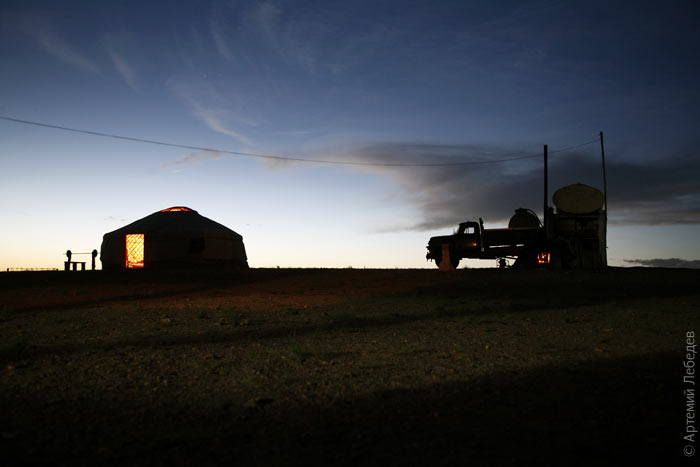
Very striking photos of Ulaanbaatar and the countryside by Artemii Lebedev

In four parts, taken at the end of July, 2006, with amusing commentary in Russian:

http://tema.ru/travel/mongolia-1/

http://tema.ru/travel/mongolia-2/

http://tema.ru/travel/mongolia-3/

http://tema.ru/travel/mongolia-4/


* * *

From Dan in San Francisco:

Hey, that guy is Art Lebedev, a relatively famous industrial designer. He's popular in computer geek circles for the "optimus keyboard" he's working on:
http://www.artlebedev.com/everything/optimus/

For a laugh:
http://www.artlebedev.com/everything/optimus/answers/

Tuesday, February 14, 2006

Subject: Mongolia


Photo and email message by Benjamin Warde:

Hey Everybody,

It has been so long since my last travel email that at this point a blow-by-blow retelling seems a bit beside the point. Instead, I am going to tell you two discreet stories about my time in Mongolia. You won't have a lot of context for each story, but that's probably OK.

Morin Khuur

I woke up at 5:15 AM, on board the train from Ulaanbaatar (capital city of Mongolia) to Orkhontuul, a small town of about 1,400 people in the north of Mongolia. With me was Tulga, a young man who I met through a mutual friend. I don't speak Mongolian, and Tulga spoke only a few words of English, but we did OK passing back and forth a Mongolian-English/English-Mongolian dictionary.

We were headed for the home of Tulga's parents. At 6:00 AM we arrived at our stop and disembarked into the dark and freezing cold. The stars were still out, and I saw the constellation Orion for the first time this year. The train station is about 20 kilometers away from the town where we were headed, and we waited in the dark for 10 minutes or so until an old Russian minibus pulled up and we, and 17 other people with luggage, piled inside. The eastern horizon turned pink and orange as we spent an hour bumping along rutted dirt tracks until we reached Tulga's village. His parents were happy to see him,and welcomed me, a complete stranger, into their two-room house, and immediately started to feed me, something which they did not stop doing for the rest of the day. I ate practically nonstop, and even so Tulga said, "My parents are worried about you, because you eat so little."

Tulga and I played pool on a home-made pool table in their front garden, and we dug up potatoes and carrots, and fed pigs. There was a school holiday that day, and all the children were engaged in a horse race, followed by wrestling. We watched the festivities, little children riding bareback at full gallop, and then throwing each other around in the grass. Then I think there was more eating. Hanging on the wall in Tulga's parents' home was a small Morin Khuur. The Morin Khuur, or Horse Headed Fiddle, is the national musical instrument of Mongolia. In the old days the sound box was actually made with a horse's skull, but these days they are usually wood. This particular Morin Khuur was hand carved by Tulga's father, and he took it down off the wall and presented it to me as a gift. At first I thought I was misunderstanding him, and when I finally realized that he really did mean to give it to me I was quite taken aback. It looked to me like the most precious thing in the home, and I couldn't possibly accept it, and yet it was even more impossible to refuse, which surely would have been insulting. I tried to be very grateful, without being excessively grateful. Mongolians seem to always be very genuine, but low-key, with their thanks, and if one is too effusive it seems to cause embarrassment. The translation might be a little iffy, but the gist of what Tulga said was that his father knew that I had had to overcome many obstacles to come all the way to his home, and that he appreciated the effort and wanted me to feel welcome.

We had to leave soon, but not before some more eating. Lots of buuz, which are small, meat-filled dumplings. Also home-made pickles, home-made yogurt, and home-made steamed bread. Actually, I can probably drop the "home-made" and you can just take that as a given, because everything was home-made, since there's nowhere that it could be store-bought. I had brought a bottle of vodka for Tulga's father, and he insisted I have a shot of that, and I brought several packages of fruit for Tulga's mother (it's very hard to get fruit out in the countryside), one of which she hid back in my bag when she thought I wasn't looking. Perhaps she was worried that Tulga and I wouldn't have enough to eat over the next couple days, as we were planning to ride horses across the Mongolian steppe to a remote 18th century Buddhist monastery called Amarbayasgalant. Mongolians often sniff each other hello and goodbye, in much the same way that we might kiss each other hello and goodbye. Like the French style of one kiss on each cheek, the Mongolians give one sniff to each cheek. When we left that night Tulga's father held my head in his hands and sniffed each of my cheeks before sending us on our way.

Singing Sands

From where I was sitting atop a 200 meter high sand dune I could see hundreds of miles of desert in every direction. I was there with Marion and Christoph, a friendly Austrian couple with whom I was traveling in the Gobi desert. Far below us, visible only as a speck, was the ger where we would be staying that night (gers are the felt tents that Mongolian nomads live in, you may also have heard them referred to as yurts). It had taken us about half an hour to walk up this sand dune. The tallest dunes at Khongoryn Els reach 300 meters in height and they call them the "singing sands."

I was sitting there trying to catch my breath after the climb, looking around at the incredible vista, and wondering what the heck "singing sands" was supposed to mean, when suddenly I heard a noise. Actually, "heard" might not be the best word. I was aware of a noise. It was so loud and so deeply resonant that I wasn't sure it was actually coming in through my ears, it might have just been humming up through my body. As far as I could tell, the entire 600 foot high pile of sand was vibrating, and felt as if it might just slide away to nothing at any moment. Since I was sitting on top of it, I don't have to tell you that it was a rather awesome and unnerving sensation. A few minutes later it happened again, but more-so.

From a September 1997 Scientific American article by Paul Sholtz, Michael Bretz and Franco Nori: "Sound-producing sand grains constitute one of nature's most puzzling and least understood physical phenomena. Large-scale slumping events on dry booming dunes can produce acoustic emissions that can be heard up to 10 km away and which resemble hums, moans, drums, thunder, foghorns or the drone of low-flying propeller aircraft. These analogies emphasize the uniqueness of the phenomenon and the clarity of the produced sound. Although reports of these sands have existed in the literature for over one thousand years, a satisfactory explanation for this type of acoustic emission is still unavailable."

Witnessing such a strange natural phenomenon so unexpectedly was alarming and wonderful. Let me also just say, when you go running straight down a sand dune as fast as you can, falling is simply inevitable, and the sand is much harder than you think it is. Also, you will (if you do not have access to a shower and clean clothes) spend the next several days picking sand out of your hair, ears, nose, teeth, shoes, pockets, etc... We sat out late that night, staring up at the most stars I have ever seen, and the next morning we watched as the family we were staying with disassembled one of their gers and packed it into a van.

And there are the stories. They do not, of course, make a complete story. For example, they fail to mention Radigan, a former Macalester student who now lives in Ulaanbaatar (because, I quote, "Mongolia is the best country in the world"). Radigan showed me around a bit, introduced me to some folks, let me crash in his apartment for a few days while he was out of town and, perhaps most important of all, came with me as moral and logistical support when I went to get a visa extension. (He also lent me his copy of "Genghis Khan and the Making of the Modern World.") Nor do these stories mention Ruth and Woody, two friendly British women who had just spent a month traveling around the Mongolian countryside, and who were not relishing the thought of returning to England. It was through Ruth and Woody that I met Tulga.

Then of course there was China. I took the train from Ulaanbaatar to Beijing (Mongolia and China use different gauge railways, and at the border all the train cars were decoupled, lifted up on hydraulic jacks, and fitted with new wheel assemblies). I hung out in Beijing for 12 days doing all the tourist things. Tiananmen Square, The Forbidden City, The Temple of Heaven (covered with scaffolding), acrobats. I spent a day hiking along the Great Wall, which really is pretty great. I ate lots of Peking (Beijing?) duck, which is really, really good.

Then I headed home. Well, not directly. There was the small matter of a wedding in San Francisco. In Minnesota I was very happy to see family and friends again. My former employer was kind enough to offer me a temporary position working on a very cool project. And so, for six months, I have a job. I expect to be leaving sometime around the end of June for more travel, but have not yet decided where to go. I'll keep you posted.

Take care,
Ben

P.S. Pictures! http://www.bengeance.blogspot.com/

Friday, November 18, 2005

"...stop itinerant cows or sheep..."

FROM THE NORTH AMERICA-MONGOLIA BUSINESS COUNCIL (NAMBC)

November 17, 2005

RE: President Bush and Secretary of State Condoleeza Rice to visit Mongolia November 21

Dear Friends,

President Bush's visit to Mongolia next week caps two years of unprecedented high-level visits by senior US officials and a year that has seen a record number of special conferences devoted to Mongolia in the US.

In January 2005, General Richard B. Myers, chairman of the US Joint Chiefs of Staff, visited Ulaanbaatar, followed four weeks later by the visit of Richard Armitage, US Deputy Secretary of State. This past summer, US House Speaker Dennis Hastert (R-IL) led a high-ranking Congressional Delegation to Mongolia, followed by a smaller Congressional delegation headed by Congressman Jim Leach (R-IO), chairman of the Asia and Pacific Subcommittee of the House International Relations Committee. [When Leach was in the US Foreign Service as a young man, he was one of the few officers assigned to Mongolian language training.]

Last month, Defense Secretary Donald Rumsfeld visited Ulaanbaatar (and received a horse that he named "Montana"), during which he committed $17 million for additional training of the Mongolian military for UN peace-keeping operations (PKO). We are grateful to US Ambassador Pam Slutz for her unrelenting advocacy and facilitation of these high-ranking visits.

Mongolian Ambassador to the US Ravdan Bold was the driving force and "invisible hand" behind three important and high-profile conferences devoted to Mongolia this year. The first was in Washington last February at the Heritage Foundation, co-sponsored by the Asia Foundation and Georgia Tech; the second last month, also in Washington, sponsored by the Asia Society, featured lectures by every former US ambassador to Mongolia plus Ambassador Pam Slutz; the third was held last week in Honolulu, on Northeast Asia and Mongolia, co-sponsored by the Asia-Pacific Center for Security Studies, the School of Hawaiian, Asian and Pacific Studies, the East-West Center and the Mongolian Academy of Management. Ambassador Bold will be in UB for President Bush's visit.

Adding to this new visibility are the growth in the number of English-language websites devoted to coverage of Mongolia. One of the best is _www.mongolianartist.com_ (http://www.mongolianartist.com/), which covers a lot more territory than its site name suggests.

PRESIDENT BUSH TO SPEND A CROWDED FIVE HOURS IN UB -- The President will spend only about five hours in Mongolia on November 21, arriving in the morning from Beijing on Air Force One (a specially configured Boeing 747 jet) and departing in the afternoon for a re-fueling stop at Elmsdorf Air Force Base in Alaska en route home to Crawford, TX, for Thanksgiving. Because of the length of the runways at UB, Air Force One can only land with gas tanks half full.

The President is traveling with an entourage of about 500 people, including Secretary of State Condoleeza Rice and other officials, White House and NSC staff, Secret Service and the entire press corps that will have accompanied the President on his visits to Kyoto, Pusan and Beijing before arriving inUB.

[This is not unusually large for a Presidential party, especially since the trip includes the APEC Summit as well as working visits to Japan, Korea and China. When Secretary of State Madeleine Albright visited UB in 1998, her party numbered around 250 people.]

The White House characterizes this trip as a "working visit," not a "State Visit." The Administration said that Bush was coming to Mongolia at the invitation of President N.Enkhbayer, who himself first met with President Bush in the fall of 2001 as Prime Minister, soon after Mongolia became the first Asian country to offer support to the US following the terrorist attacks of 9/11.

President Bush will deliver an address in the newly-refurbished auditoriumin Government House, which will be broadcast live on Mongolian TV. He will hold separate meetings with President N.Enkhbayar and Prime Minister Ts.Elbegdorj and meet with Mongolian soldiers who served in Iraq and their families to thank them. Mongolia maintains a force of over 130 peacekeepers in Iraq, which distinguished itself by adroitly interdicting a terrorist assault on US troops. The White House said the President and First Lady Laura Bush will also visit a "traditional Ger village" and see a cultural performance that includes Mongolian throat singing and horse-head fiddle playing.

Despite Ambassador Pam Slutz's best efforts, it proved impossible to carve out time in the President's schedule to meet with the NAMBC -- or even just American ex-pats working in Mongolia.

Buyant-Ukhaa International Airport will be hard-pressed during the visit by the number of Boeing 747 planes carrying the President's party. Regular commercial air traffic will be delayed or grounded. One US plane will be carrying the President's specially made bullet-proof limousine, which the Secret Service requires on every trip. Security experts tell us US fighter jets will be circling UB to protect Air Force One.

An advance team of about 250 Secret Service officers and staff arrived in Ulaanbaatar 10 days ago. Among their requests was to immediately repair potholes on the road between the airport and the city so that the President's motorcade can race into the city at top speed. Mongolian police and security forces will closely patrol the shoulders -- primarily to stop itinerant cows or sheep from wandering into the roadway. For security reasons, when moving the President by car, the Secret Service prefers to travel at the maximum safe speed. Even in Washington, DC, when the President goes to Capitol Hill from the White House, streets are closed off to all other traffic briefly so that the motorcade can move at 60 MPH or faster. Security will be tight on November 21.

Bush is the first US President to visit Mongolia. US Vice President Henry Wallace, who served under President Franklin D. Roosevelt during his third term, visited Mongolia during World War II. Secretaries of State James Baker and Madeleine Albright visited during the Bush-41 and Clinton Administrations, respectively. In 1995, Senator Hilary Rodham Clinton (D-NY) visited Mongolia as First Lady. Twenty-eight years before he was elected President, Herbert Hoover visited Mongolia when he was working in China as a mining engineer and President Jimmy Carter visited Mongolia 24 years after the left the White House.

BUSH AGENDA IN UB --- The simple fact and symbolism of the Bush visit to Mongolia is probably more significant than any specific issues that might be discussed. One retired Chinese diplomat told us, "That your President detours to visit a country with a population smaller than metropolitan Washington, DC, says a lot to Moscow and Beijing all by itself. It is a message like thunder."

Although there is still some hope that President Bush might announce some progress towards signing a Millennium Challenge Account compact, the President's remarks in a seven-minute on-camera interview with UB's EagleTV on November 8 appeared to signal that an MCA compact was not imminent.

According to Agence France Presse, Bush "warned Mongolia that there 'should be no corruption in government,' if it wanted to receive American aid." As a matter of policy, countries eligible for MCA grants have experienced reductions in the level of normal USAID grants; Mongolia's annual USAID allocation has dropped to US$7 million from US$12 million.

Bush also told Eagle-TV: "I will say on your TV screens, there should be no corruption in government, that one of the foundations of any government is the ability for the people to trust the government, itself...A foundation of our foreign policy, and a foundation of our Millennium Challenge Account is that there be honest government." Bush described Mongolia as "a friend" but then went on to say, "On the other hand, we will insist that as a condition of the Millennium Challenge checks being written that there be honest government, that there be investment in health and education of the people, that there be a dedication to rule of law and to the marketplace." Bush concluded by commenting that "I think investments will help the people of Mongolia. In other words, there's a way for people in America --businesses, for example -- to invest in Mongolia, because that means jobs and stability and a good future...you'll find Americans are very compassionate people that love freedom. And they want to help people be free. And by the way, your form of government is democracy, but it ought to reflect your traditions and your great history. And I know it is. Listen, I'm looking forward to going to your wonderful country. It's going to be a fantastic experience. I'm excited, I truly am excited to come."

The National Security Council Asia Director, Dr. Michael Greene, responded to an email question on the White House website recently about why the President was going to Mongolia: "In Mongolia the President will congratulate the Mongolian people on the progress they have made to become a mature and stable democracy and he will thank them for their role in Iraq. Per capita only two other countries have sent more of their soldiers to help the Iraqi people establish a democratic and stable nation. It is young democracies like Mongolia's that often understand freedom the most, and the President wants to say thank you. He also wants to demonstrate that even remote countries have a strong friend in the United States when they embark on the path of reform and good governance.

Monday, October 10, 2005