 Photo and email message by Benjamin Warde:
Hey Everybody,
It has been so long since my last travel email that at this point a blow-by-blow retelling seems a bit beside the point. Instead, I am going to tell you two discreet stories about my time in Mongolia. You won't have a lot of context for each story, but that's probably OK.
Morin Khuur
I woke up at 5:15 AM, on board the train from Ulaanbaatar (capital city of Mongolia) to Orkhontuul, a small town of about 1,400 people in the north of Mongolia. With me was Tulga, a young man who I met through a mutual friend. I don't speak Mongolian, and Tulga spoke only a few words of English, but we did OK passing back and forth a Mongolian-English/English-Mongolian dictionary.
We were headed for the home of Tulga's parents. At 6:00 AM we arrived at our stop and disembarked into the dark and freezing cold. The stars were still out, and I saw the constellation Orion for the first time this year. The train station is about 20 kilometers away from the town where we were headed, and we waited in the dark for 10 minutes or so until an old Russian minibus pulled up and we, and 17 other people with luggage, piled inside. The eastern horizon turned pink and orange as we spent an hour bumping along rutted dirt tracks until we reached Tulga's village. His parents were happy to see him,and welcomed me, a complete stranger, into their two-room house, and immediately started to feed me, something which they did not stop doing for the rest of the day. I ate practically nonstop, and even so Tulga said, "My parents are worried about you, because you eat so little."
Tulga and I played pool on a home-made pool table in their front garden, and we dug up potatoes and carrots, and fed pigs. There was a school holiday that day, and all the children were engaged in a horse race, followed by wrestling. We watched the festivities, little children riding bareback at full gallop, and then throwing each other around in the grass. Then I think there was more eating. Hanging on the wall in Tulga's parents' home was a small Morin Khuur. The Morin Khuur, or Horse Headed Fiddle, is the national musical instrument of Mongolia. In the old days the sound box was actually made with a horse's skull, but these days they are usually wood. This particular Morin Khuur was hand carved by Tulga's father, and he took it down off the wall and presented it to me as a gift. At first I thought I was misunderstanding him, and when I finally realized that he really did mean to give it to me I was quite taken aback. It looked to me like the most precious thing in the home, and I couldn't possibly accept it, and yet it was even more impossible to refuse, which surely would have been insulting. I tried to be very grateful, without being excessively grateful. Mongolians seem to always be very genuine, but low-key, with their thanks, and if one is too effusive it seems to cause embarrassment. The translation might be a little iffy, but the gist of what Tulga said was that his father knew that I had had to overcome many obstacles to come all the way to his home, and that he appreciated the effort and wanted me to feel welcome.
We had to leave soon, but not before some more eating. Lots of buuz, which are small, meat-filled dumplings. Also home-made pickles, home-made yogurt, and home-made steamed bread. Actually, I can probably drop the "home-made" and you can just take that as a given, because everything was home-made, since there's nowhere that it could be store-bought. I had brought a bottle of vodka for Tulga's father, and he insisted I have a shot of that, and I brought several packages of fruit for Tulga's mother (it's very hard to get fruit out in the countryside), one of which she hid back in my bag when she thought I wasn't looking. Perhaps she was worried that Tulga and I wouldn't have enough to eat over the next couple days, as we were planning to ride horses across the Mongolian steppe to a remote 18th century Buddhist monastery called Amarbayasgalant. Mongolians often sniff each other hello and goodbye, in much the same way that we might kiss each other hello and goodbye. Like the French style of one kiss on each cheek, the Mongolians give one sniff to each cheek. When we left that night Tulga's father held my head in his hands and sniffed each of my cheeks before sending us on our way.
Singing Sands
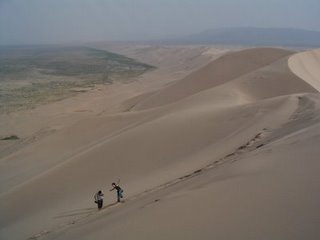
From where I was sitting atop a 200 meter high sand dune I could see hundreds of miles of desert in every direction. I was there with Marion and Christoph, a friendly Austrian couple with whom I was traveling in the Gobi desert. Far below us, visible only as a speck, was the ger where we would be staying that night (gers are the felt tents that Mongolian nomads live in, you may also have heard them referred to as yurts). It had taken us about half an hour to walk up this sand dune. The tallest dunes at Khongoryn Els reach 300 meters in height and they call them the "singing sands."
I was sitting there trying to catch my breath after the climb, looking around at the incredible vista, and wondering what the heck "singing sands" was supposed to mean, when suddenly I heard a noise. Actually, "heard" might not be the best word. I was aware of a noise. It was so loud and so deeply resonant that I wasn't sure it was actually coming in through my ears, it might have just been humming up through my body. As far as I could tell, the entire 600 foot high pile of sand was vibrating, and felt as if it might just slide away to nothing at any moment. Since I was sitting on top of it, I don't have to tell you that it was a rather awesome and unnerving sensation. A few minutes later it happened again, but more-so.
From a September 1997 Scientific American article by Paul Sholtz, Michael Bretz and Franco Nori: "Sound-producing sand grains constitute one of nature's most puzzling and least understood physical phenomena. Large-scale slumping events on dry booming dunes can produce acoustic emissions that can be heard up to 10 km away and which resemble hums, moans, drums, thunder, foghorns or the drone of low-flying propeller aircraft. These analogies emphasize the uniqueness of the phenomenon and the clarity of the produced sound. Although reports of these sands have existed in the literature for over one thousand years, a satisfactory explanation for this type of acoustic emission is still unavailable."
Witnessing such a strange natural phenomenon so unexpectedly was alarming and wonderful. Let me also just say, when you go running straight down a sand dune as fast as you can, falling is simply inevitable, and the sand is much harder than you think it is. Also, you will (if you do not have access to a shower and clean clothes) spend the next several days picking sand out of your hair, ears, nose, teeth, shoes, pockets, etc... We sat out late that night, staring up at the most stars I have ever seen, and the next morning we watched as the family we were staying with disassembled one of their gers and packed it into a van.
And there are the stories. They do not, of course, make a complete story. For example, they fail to mention Radigan, a former Macalester student who now lives in Ulaanbaatar (because, I quote, "Mongolia is the best country in the world"). Radigan showed me around a bit, introduced me to some folks, let me crash in his apartment for a few days while he was out of town and, perhaps most important of all, came with me as moral and logistical support when I went to get a visa extension. (He also lent me his copy of "Genghis Khan and the Making of the Modern World.") Nor do these stories mention Ruth and Woody, two friendly British women who had just spent a month traveling around the Mongolian countryside, and who were not relishing the thought of returning to England. It was through Ruth and Woody that I met Tulga.
Then of course there was China. I took the train from Ulaanbaatar to Beijing (Mongolia and China use different gauge railways, and at the border all the train cars were decoupled, lifted up on hydraulic jacks, and fitted with new wheel assemblies). I hung out in Beijing for 12 days doing all the tourist things. Tiananmen Square, The Forbidden City, The Temple of Heaven (covered with scaffolding), acrobats. I spent a day hiking along the Great Wall, which really is pretty great. I ate lots of Peking (Beijing?) duck, which is really, really good.
Then I headed home. Well, not directly. There was the small matter of a wedding in San Francisco. In Minnesota I was very happy to see family and friends again. My former employer was kind enough to offer me a temporary position working on a very cool project. And so, for six months, I have a job. I expect to be leaving sometime around the end of June for more travel, but have not yet decided where to go. I'll keep you posted.
Take care,
Ben
P.S. Pictures!
http://www.bengeance.blogspot.com/