Showing posts with label Chinggis Khaan. Show all posts

Sunday, March 13, 2011

Art by Nicholas Roerich

"My heartiest thanks for the magnificent work which you sent to me. I admire those creations so much that I can say without exaggeration that never have landscapes made such a great impression on me."

--Albert Einstein, letter to Roerich Museum, 1931

RoerichTrust.org


The Black Gobi
1928

And We Do Not Fear
1922

Book of Life
1938

Changthang, Northern Tibet
1939

Song of Shambhala

Idols (Pagan Russia)
1910

Issa and the Skull of the Giant

Message to Tiron
1940

Abode of Gesar
1947

Mongolia

Mongolia I
1938

Monhegan, Maine
1922

Mother of Genghis Khan
1933

Most Sacred Treasure of the Mountain
1933

On the Heights, Tumo
1936

Stronghold of Tibet
1932

Descent into Hell
1933

Star of the Hero
1936

Guests from Overseas
1901
USSR postage stamp
1974


1874-1947 Russian

Tuesday, June 15, 2010

Queens of Mongolia

"Jack Weatherford will give a talk entitled 'Queens of Mongolia' this coming Wednesday the 16th of June at 8pm.

"His presentation will focus on the daughters of Genghis Khan, their history and achievements and their place in Mongolia’s society. This is the story of his second book: The Secret History of the Mongol Queens: How the Daughters of Genghis Khan Rescued His Empire.

"Jack Weatherford is a professor of anthropology at Macalester College in Minnesota. He is a specialist in tribal peoples and the author of Indian Givers, Native Roots, Savages and Civilization, The History of Money, and Genghis Khan and the Making of the Modern World.

"Come early as this talk is expected to be exceedingly popular. See you all then!

"--Café Amsterdam"

Monday, April 19, 2010

Sudden Prosperity

“Mongolia’s billions of dollars worth of copper, gold, uranium and coal reserves promise the greatest influx of wealth for the country since Genghis Khan conquered much of the known world in the 13th century.

“They also may spawn a crisis. Sudden prosperity can overwhelm an economy, exposing it to commodity-price swings. Mongolia’s leaders say they are determined to avoid a sudden surge in wealth that ultimately hampers expansion....

“'If you go to most developing countries, they’ll tell you, “We’re saved; we’ve found uranium,”' said Hernando de Soto, a Peruvian free-market economist. Mongolia has 'a president who says, “We are in grave danger because we have discovered we have a lot of natural resources.”' The fact that 'they are forewarned gives you hope.'”


--Michael Forsythe, Bloomberg.com, 2010 February 15

Friday, March 19, 2010

the felt tents of his encampment

“In the 1190s a young and somewhat embittered Mongol who had become khan of his people began to seek revenge for slights and injuries to them by the Tatars (another nomadic nation). Within a few years he was accepted by all the Mongol tribes as their 'universal khan,' or, in their own tongue, 'Chinghis Khan.' Mispronounced in Arabic, this name became 'Genghis Khan' to Europeans. He proved to be the greatest conqueror the world has ever seen, terrorizing Europe and Asia alike. But Chinghis also built up something much more like a true empire than any other nomad chief, even though its only capital was the felt tents of his encampment....

“The unity of Chinghis Khan's empire had given way to a loose connexion of khanates ruled independently by Mongol princes, but with much in common. A sort of Mongol federation stretched at its greatest extent over something like a sixth of the old world's land surface. Its communications were good and well policed and the Mongols made intelligent use of their conquered subjects. They enlisted them in their armies, while Chinghis used Chinese civil servants to run his taxation system and borrowed the Turkish script in order to write down the Mongol language.... The Great Khans came to see themselves as somewhat like Chinese emperors. They expected other peoples to pay them tribute, not to negotiate with them as equals, and believed they exercised a universal monarchy on behalf of their own sky god. Yet they were tolerant in religion and the diversity of belief at the Mongol court impressed Christians.”


--J.M. Roberts, A Short History of the World, 1993

Friday, September 04, 2009

spiritual over-lord

"The Buddhism of Tibet is not the pure original doctrine of the gentle Indian prince who lived and died six centuries before the birth of Christ. It is the usual degenerate form, full of devils and spooks, and it has forgotten a great many of the noble teachings of the founder of that great Asiatic faith. But Tibet has been a bulwark of Buddhism which has been of great help in preserving that religion against the attacks of the Mohammedans from the west and the pagan creeds of southern India....

"During the reign of Kublai Khan, the grandson of Genghis Khan and an ardent convert to Buddhism, the abbots of an important Tibetan monastery were recognized as the political rulers of all Tibet. In return for this favor, the new Dalai Lama, in his quality of spiritual over-lord of the whole Buddhist world, officially crowned the Tartar Khan Emperor of Mongolia, just as Pope Leo III had crowned Charlemagne."


--Hendrik van Loon, Van Loon's Geography: The Story of the World We Live In, 1932

Tuesday, January 20, 2009

reputation for barbarism and cruelty

"The Mongol period is not only noted for its supposed barbarity, but also for the plethora of historians and chronicles it produced. These many scribes, both within the Mongol camp and without, were happy to pander to the Mongols' desire for notoriety and a reputation for barbarism and cruelty. Primary sources in a wealth of languages have survived the so-called Mongol mayhem. Critical analysis and comparison of these various sources yield a more balanced and less sensationalist picture of what actually occurred during the thirteenth and fourteenth centuries than the lurid portrait that myths and legends have conjured up. Since Bernard Lewis questioned the basis of the Mongols' tainted reputation in 1995, scholarly opinion has grown more sympathetic toward the legacy of Genghis Khan."

--George Lane, eNotes.com

Tuesday, August 12, 2008

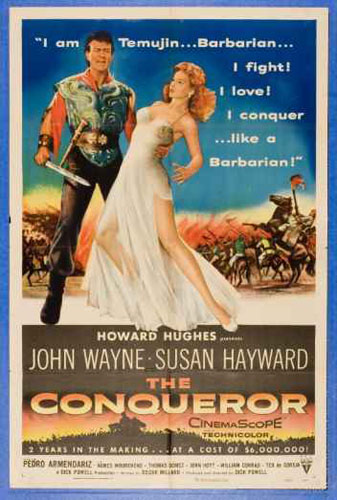
The Conqueror


"When you think of Genghis Khan (Mongolian, conqueror of half the known world, shrewd military tactician, Mongolian, mass murderer, Mongolian, vengeful, Mongolian) who do you picture? John Wayne, right? Exactly. And that's why he was an inspired casting choice for Howard Hughes' 1956 epic The Conqueror. Speaking before the film was made, Wayne said 'the way the screenplay reads it's a cowboy picture, and that's how I'm going to play Genghis Khan. I see him as a gunfighter.'"

--Danny Harkins, Cracked.com

Monday, June 11, 2007

Origin Story

“A great turning-point in the religious history of Mongolia came a few years later when Altan Khan, a powerful prince who was descended from Genghis, invited a Tibetan lama to come and see him and bestowed upon this figure the rank of Dalai Lama. Hence it was a Mongolian prince who created this title for the highest office in the Tibetan Buddhist church, and thereafter the links between Mongolia and the Yellow Faith grew from strength to strength.”

--Nick Middleton, The Last Disco in Outer Mongolia, 1992

Saturday, December 30, 2006

Jack Weatherford: Great Law of Genghis Khan in Iraq

Los Angeles Times, 2006 December 29

“In his final televised speech to the Iraqi people in 2003, Saddam Hussein denounced the invading Americans as ‘the Mongols of this age,’ a reference to the last time infidels had conquered his country, in 1258. But the comparison isn't very apt — unlike the Mongols, the Americans don't have the organizational genius of Genghis Khan...

“The legal justification for the Mongol invasion of Iraq derived from the reluctance of the caliph of Baghdad to control the Shiite Cult of the Assassins, whom the Mongols accused of attempting to kill their khan.

“The Assassins operated from a series of fortified mountain camps spread from contemporary Afghanistan to Iraq, and the Baghdad invasion did not begin until the Mongols had eradicated the threat from the Assassins and destroyed their fortresses...

“The Mongols took no prisoners and allowed no torture, but they executed swiftly and efficiently, including the soldiers of the defeated army who, they believed, would be a constant source of future problems if allowed to live. The first several months of a Mongol invasion were bloody, but once the takeover ended, the bloodshed ended.

“By contrast, the American military campaign was quick, with comparatively few Iraqi (or coalition) casualties, but the bloodshed has continued for years...

“And while the violence continues, the U.S. can't come close to establishing a government that rivals what the Mongols achieved...

“They fiercely enforced religious freedom, which created an essentially secular state... They lowered taxes for merchants and eliminated them for religious, medical and educational professionals. They educated women along with men...

“Fundamentalist Muslims look back at Mongol secularism as a scourge. But, although U.S. rule in Iraq has produced a constant flow of refugees, particularly religious minorities, out of the country, under Mongol rule Christian, Muslim, Jewish and even Buddhist immigrants poured into the newly conquered Iraq to live under the Great Law of Genghis Khan...

“By the time of the U.S.-led invasion of Iraq, the political achievements of the Mongols had been forgotten, and only the destructive fury of their wars was remembered.”

-Jack Weatherford

Wednesday, December 20, 2006

Mongolia, China, and Chinggis Khaan in *The Economist*


"Battle for Mongolia's soul

"On the 800th anniversary of his empire's birth, China and Mongolia both claim Genghis Khan as their own"

The Economist, Dec 19th 2006

"The Mongolian government has already suffered the downsides of economic nationalism. By law, all gold output is supposed to be sold to the Bank of Mongolia, the central bank. This year the amount sold has fallen by half even though production has continued to rise, says the central bank's former governor, Ochirbat Chuluunbat. He blames a windfall tax that has encouraged small producers to sell gold on the black market rather than to the bank. Most black-market gold is smuggled across the 4,677km border with China...

"For all Mongolia's nationalism, the government remains acutely aware of the dangers of upsetting its powerful southern neighbour. Officials studiously avoid criticism of China, which provides vital port facilities for Mongolia's exports...

"In order to avoid falling under the sway of either Russia or, particularly, China, Mongolia pursues what it calls a 'third neighbour' policy. This involves remaining on good terms with its giant neighbours but also reaching out to countries such as America and Japan (Mongolia's biggest aid donor). America has been delighted by Mongolia's support for its military operations in Iraq, including the dispatch of some 200 support troops. This is the first time Mongolian troops have been stationed in Iraq since Genghis's grandson, Hulagu, conquered Baghdad...

"A Mongolian general, given warning by an American counterpart of the dangers of operating in Baghdad, is said to have quipped: 'I know. We've been here before.'"

Monday, November 27, 2006

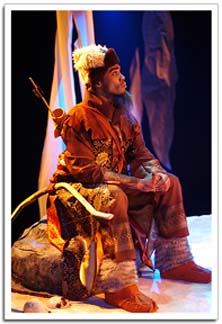
A Genghis Khan Opera in Austin, Texas


A production at the Salvage Vanguard Theater that opened last spring:

"So today I got the coolest email and I’m just going to paste it below. Graham and I talked about this quite a bit last year when we were writing the opera Genghis Khan. Check this out…

"Mr. Neulander

"My name is Dawadash and I am the Second Secretary of the Embassy of Mongolia in Washington DC. I came across to SVT website and the Genghis Khan Opera blog while surfing the net. We congratulate you on the production of Genghis Khan, who is national symbol and hero for my country. The Embassy of Mongolia regrets that we did miss the chance to watch the show, which was a success in Austin. This year Mongolia celebrates the 800th anniversary of the Great Mongolian State created by Genghis Khan in 1206. That year Temuchin was proclaimed Genghis Khan, the ruler of the first unified Mongolian state. We are eager to learn if the Genghis Khan production is still on stage and where and when we can watch it. Have you thought of putting it in other countries, for example in Mongolia. This would great.
Anyways, congratulations on the production and hope to hear from you.
Any questions are welcome at the address below.
Cheers,

"Dawadash Sambuu
Second Secretary
Embassy of Mongolia"

Salvage Vanguard Theater blog

Salvage Vanguard Theater - Genghis Khan: The Opera

Thursday, October 19, 2006

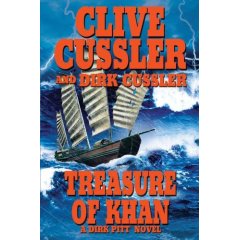
Treasure of Khan


"The action, and there's plenty of it, ranges from Siberia's Lake Baikal and the wilds of Mongolia to the Hawaiian islands. The treasure is that of Genghis and Kublai Khan, the great Mongolian conqueror and his grandson. The villain is a modern-day Mongol with dreams of restoring national power and pride."
-Publishers Weekly

A couple years ago in Costa Rica, an archaeologist friend told me about the adventure novels of Clive Cussler, which kind of incorporate maritime archaeology somewhat. He was reading one of them--I think it had to do with the Aztec--and he offered it to me when he was finished. I opted for Under the Volcano.

Last weekend at the ranch, we watched the mighty crap-bomb that is Sahara, based ("loosely," allegedly) on one of Cussler's novels. The pirate Chinese DVD crashed before the end of the movie, and we cheered.

Today, while researching a dead poet guy, I got into one of those spiraling click-chains that somehow led to Cussler. So, I discovered that his new novel has a Mongolian flavor. And is being released next month.

"When Dirk Pitt is nearly killed rescuing an oil survey team from a freak wave on Russia's Lake Baikal, it appears a simple act of nature. When the survey team is abducted and Pitt's research vessel nearly sunk, however, it's obvious there's something more sinister involved. All trails lead to Mongolia, and a mysterious mogul who is conducting covert deals for supplying oil to the Chinese while wreaking havoc on global oil markets utilizing a secret technology. The Mongolian harbors a dream of restoring the conquests of his ancestors, and holds a dark secret about Genghis Khan that just might give him the wealth and power to make that dream come true."
-Amazon.com