Thursday, October 12, 2006

Friday, October 06, 2006

Russia and China

"Chinese immigrants find opportunity in the fertile emptiness of Siberia. But hosts fear a gradual takeover."

Ulemj


Met up with Ulemj and a couple of his buddies last night. We sat in a bar called "Zona" just north of the Parliament building and drank beer. Got drunk.

Ulemj is one of the first people I met after returning to Mongolia a year and a half ago. He teaches engineering at the Technological University.

He went to Khovsgol with his family over the summer and sent a photo.

Wednesday, October 04, 2006

simulation argument

Is this a simulated reality?

The simulation argument, claimed by the philosopher Nick Bostrom, investigates the possibility that we may be living in a simulation. The argument attempts to prove the disjunction of three hypotheses (that is, that at least one of the following three propositions must be true), that:

either
  • the human race will never reach a level of technology where we can run simulations of reality so detailed they can be mistaken for reality; or
  • races who do reach such a level do not tend to run such simulations; or
  • we are almost certainly living in such a simulation.

-- http://en.wikipedia.org/wiki/Simulated_reality

Thursday, September 28, 2006

"Jack Weatherford awarded Mongolia's highest national honor"


"Jack Weatherford has been awarded the Order of the Polar Star by President Nambaryn Enkhbayar and the parliament of Mongolia. Weatherford is the author of The New York Times best-seller Genghis Khan and the Making of the Modern World. Weatherford will travel to Mongolia to receive the award in person in February."

-Macalester College

furry traditional costumes


"When I was told about them, in my mind, I somewhat had painted a very bias picture of what to expect of people from Mongolia. I pictured them in their furry traditional costumes living in tents of the mountaneous Ulaan Bataar. . .

"Well, they certainly proved me wrong of everything I'd imagined them to be. They were very fashionable and way more advanced than many of us in terms of mentality and technology. They were very open and assertive about issues deemed taboo here. . . True, they were playful at times but they made up for it through their diligence and eagerness to learn."

-Soleiliana's Diary

Tuesday, September 26, 2006

Andrew McLaughlin at Slate: tech commentary from 2003

"Ulaanbaatar is home to a surprisingly cosmopolitan cultural mélange. . .

"In the area of Internet and communications, I am left with the agonizing sense that Mongolia is poised to squander an incredible opportunity. . . .it's suicidal for a government to try to force particular services to be channeled restrictively to particular elements of infrastructure, using the law to bludgeon everyone into compliance. . . With its well-educated population, relatively free markets, and open society, Mongolia could embrace the Internet's potential to supply cheap, reliable, ubiquitous communications for all."

- http://www.slate.com/id/2084072

Thursday, September 21, 2006

Singing Sands


"One knows these modern travelers, these over-grown prefects and pseudo-scientific bores dispatched by congregations of extinguished officials to see if sand-dunes sing and snow is cold."

-Robert Byron, The Road to Oxiana, 1937

Thursday, August 31, 2006

Lenin in Erdenet from Lkhamaa


--"I studied for years what Lenin and Marx did, so I feel really happy to see them on the buildings."

--"Yes, I miss the bust of Lenin that I had on my desk in Moscow. I could rub his bald head for luck."

Associated Press Reports on Religion in Mongolia

http://www.usatoday.com/news/religion/2006-08-24-mongolia-religion_x.htm?csp=34

Bollywood in Mongolia

http://www.newkerala.com/news4.php?action=fullnews&id=14135

"Ulan-Bator"


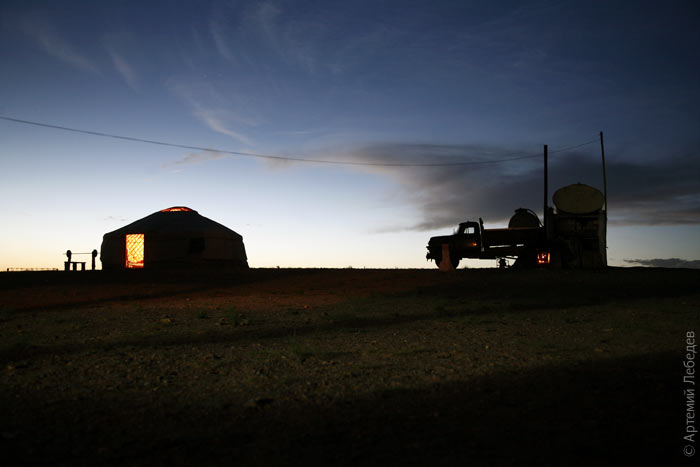
Very striking photos of Ulaanbaatar and the countryside by Artemii Lebedev

In four parts, taken at the end of July, 2006, with amusing commentary in Russian:

http://tema.ru/travel/mongolia-1/

http://tema.ru/travel/mongolia-2/

http://tema.ru/travel/mongolia-3/

http://tema.ru/travel/mongolia-4/


* * *

From Dan in San Francisco:

Hey, that guy is Art Lebedev, a relatively famous industrial designer. He's popular in computer geek circles for the "optimus keyboard" he's working on:
http://www.artlebedev.com/everything/optimus/

For a laugh:
http://www.artlebedev.com/everything/optimus/answers/

Monday, May 29, 2006

Quotable

"Being a billionaire isn't that great. It's not as good as average sex. Average sex is better than being a billionaire."

--Ted Turner, billionaire

Sunday, May 28, 2006

gertee baina aa


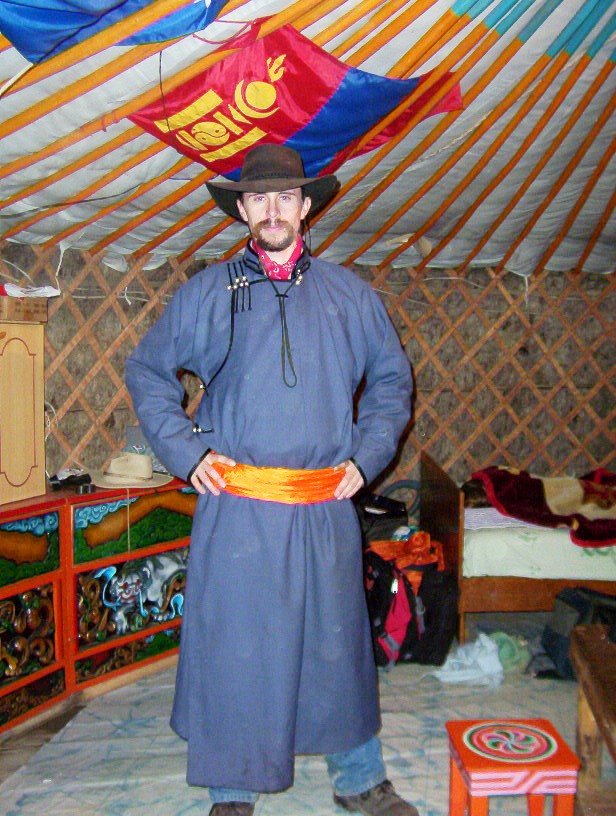
Since the city turned off the central heating as scheduled on May 15th, and it snowed the next day, and then it snowed again the following week, here's me at home in my winter deel (lined with sheepskin), in front of a thangka of the Wrathful Deity and a map of Mongolia.

Monday, May 15, 2006

1%

This is awesome.

“According to Japanese newspapers, Mr. Kadokawa (producer of the film) met Mongolian Prime Minister to ask the preparation of 20,000 extras from countryside for this film shoot.... It sounds ridiculous. He must have no idea about Mongolia. ‘20,000 people’ means almost 1% of the whole Mongolian population.”

Wednesday, April 19, 2006

Facts about Ninja

Ninja do not sleep; they wait.

Ninja can change clothes in less than one second.

When it rains, ninja do not get wet; the rain gets ninjaed.

Bullets dodge ninja.

Ninja can breathe underwater anytime they want.

Only a ninja can kill a ninja. Regular humans are useless.

Ninja never wear headbands with the word "ninja" printed on them.

Ninja always land on their feet. If they do not have feet, then they land on their nubs.

Ninja tears cure cancer. Too bad they never cry.

A ninja always moves to America when attempting to make a new start as a non-assassin.

Ninja can crush golf balls with two fingers. . . any two fingers.

Ninja do not play sports. Unless killing is a sport.

Ninja swords are always straight. Always. Curves are for girls.

Ninja lack any personality.

A ninja can remove a spleen in one swift motion.

Ninja invented skateboarding.

Ninja live in your house secretly for days.

A ninja can obliterate his shadow if necessary.

Ninja go anywhere they want instantly.

Ninja kill themselves if they make a noise.

Ninja can run one hundred miles on their hands.

Ninja can hover for hours.

Ninja split planks vertically with their noses.

Ninja can hide in incense smoke.

Ninja are allowed to talk about Fight Club.

Ninja do not wear Spandex.

In an average living room, there are 1,242 objects a ninja could use to kill you, including the room itself.

If you see a ninja, he is not a ninja.

Tuesday, February 14, 2006

Subject: Mongolia


Photo and email message by Benjamin Warde:

Hey Everybody,

It has been so long since my last travel email that at this point a blow-by-blow retelling seems a bit beside the point. Instead, I am going to tell you two discreet stories about my time in Mongolia. You won't have a lot of context for each story, but that's probably OK.

Morin Khuur

I woke up at 5:15 AM, on board the train from Ulaanbaatar (capital city of Mongolia) to Orkhontuul, a small town of about 1,400 people in the north of Mongolia. With me was Tulga, a young man who I met through a mutual friend. I don't speak Mongolian, and Tulga spoke only a few words of English, but we did OK passing back and forth a Mongolian-English/English-Mongolian dictionary.

We were headed for the home of Tulga's parents. At 6:00 AM we arrived at our stop and disembarked into the dark and freezing cold. The stars were still out, and I saw the constellation Orion for the first time this year. The train station is about 20 kilometers away from the town where we were headed, and we waited in the dark for 10 minutes or so until an old Russian minibus pulled up and we, and 17 other people with luggage, piled inside. The eastern horizon turned pink and orange as we spent an hour bumping along rutted dirt tracks until we reached Tulga's village. His parents were happy to see him,and welcomed me, a complete stranger, into their two-room house, and immediately started to feed me, something which they did not stop doing for the rest of the day. I ate practically nonstop, and even so Tulga said, "My parents are worried about you, because you eat so little."

Tulga and I played pool on a home-made pool table in their front garden, and we dug up potatoes and carrots, and fed pigs. There was a school holiday that day, and all the children were engaged in a horse race, followed by wrestling. We watched the festivities, little children riding bareback at full gallop, and then throwing each other around in the grass. Then I think there was more eating. Hanging on the wall in Tulga's parents' home was a small Morin Khuur. The Morin Khuur, or Horse Headed Fiddle, is the national musical instrument of Mongolia. In the old days the sound box was actually made with a horse's skull, but these days they are usually wood. This particular Morin Khuur was hand carved by Tulga's father, and he took it down off the wall and presented it to me as a gift. At first I thought I was misunderstanding him, and when I finally realized that he really did mean to give it to me I was quite taken aback. It looked to me like the most precious thing in the home, and I couldn't possibly accept it, and yet it was even more impossible to refuse, which surely would have been insulting. I tried to be very grateful, without being excessively grateful. Mongolians seem to always be very genuine, but low-key, with their thanks, and if one is too effusive it seems to cause embarrassment. The translation might be a little iffy, but the gist of what Tulga said was that his father knew that I had had to overcome many obstacles to come all the way to his home, and that he appreciated the effort and wanted me to feel welcome.

We had to leave soon, but not before some more eating. Lots of buuz, which are small, meat-filled dumplings. Also home-made pickles, home-made yogurt, and home-made steamed bread. Actually, I can probably drop the "home-made" and you can just take that as a given, because everything was home-made, since there's nowhere that it could be store-bought. I had brought a bottle of vodka for Tulga's father, and he insisted I have a shot of that, and I brought several packages of fruit for Tulga's mother (it's very hard to get fruit out in the countryside), one of which she hid back in my bag when she thought I wasn't looking. Perhaps she was worried that Tulga and I wouldn't have enough to eat over the next couple days, as we were planning to ride horses across the Mongolian steppe to a remote 18th century Buddhist monastery called Amarbayasgalant. Mongolians often sniff each other hello and goodbye, in much the same way that we might kiss each other hello and goodbye. Like the French style of one kiss on each cheek, the Mongolians give one sniff to each cheek. When we left that night Tulga's father held my head in his hands and sniffed each of my cheeks before sending us on our way.

Singing Sands

From where I was sitting atop a 200 meter high sand dune I could see hundreds of miles of desert in every direction. I was there with Marion and Christoph, a friendly Austrian couple with whom I was traveling in the Gobi desert. Far below us, visible only as a speck, was the ger where we would be staying that night (gers are the felt tents that Mongolian nomads live in, you may also have heard them referred to as yurts). It had taken us about half an hour to walk up this sand dune. The tallest dunes at Khongoryn Els reach 300 meters in height and they call them the "singing sands."

I was sitting there trying to catch my breath after the climb, looking around at the incredible vista, and wondering what the heck "singing sands" was supposed to mean, when suddenly I heard a noise. Actually, "heard" might not be the best word. I was aware of a noise. It was so loud and so deeply resonant that I wasn't sure it was actually coming in through my ears, it might have just been humming up through my body. As far as I could tell, the entire 600 foot high pile of sand was vibrating, and felt as if it might just slide away to nothing at any moment. Since I was sitting on top of it, I don't have to tell you that it was a rather awesome and unnerving sensation. A few minutes later it happened again, but more-so.

From a September 1997 Scientific American article by Paul Sholtz, Michael Bretz and Franco Nori: "Sound-producing sand grains constitute one of nature's most puzzling and least understood physical phenomena. Large-scale slumping events on dry booming dunes can produce acoustic emissions that can be heard up to 10 km away and which resemble hums, moans, drums, thunder, foghorns or the drone of low-flying propeller aircraft. These analogies emphasize the uniqueness of the phenomenon and the clarity of the produced sound. Although reports of these sands have existed in the literature for over one thousand years, a satisfactory explanation for this type of acoustic emission is still unavailable."

Witnessing such a strange natural phenomenon so unexpectedly was alarming and wonderful. Let me also just say, when you go running straight down a sand dune as fast as you can, falling is simply inevitable, and the sand is much harder than you think it is. Also, you will (if you do not have access to a shower and clean clothes) spend the next several days picking sand out of your hair, ears, nose, teeth, shoes, pockets, etc... We sat out late that night, staring up at the most stars I have ever seen, and the next morning we watched as the family we were staying with disassembled one of their gers and packed it into a van.

And there are the stories. They do not, of course, make a complete story. For example, they fail to mention Radigan, a former Macalester student who now lives in Ulaanbaatar (because, I quote, "Mongolia is the best country in the world"). Radigan showed me around a bit, introduced me to some folks, let me crash in his apartment for a few days while he was out of town and, perhaps most important of all, came with me as moral and logistical support when I went to get a visa extension. (He also lent me his copy of "Genghis Khan and the Making of the Modern World.") Nor do these stories mention Ruth and Woody, two friendly British women who had just spent a month traveling around the Mongolian countryside, and who were not relishing the thought of returning to England. It was through Ruth and Woody that I met Tulga.

Then of course there was China. I took the train from Ulaanbaatar to Beijing (Mongolia and China use different gauge railways, and at the border all the train cars were decoupled, lifted up on hydraulic jacks, and fitted with new wheel assemblies). I hung out in Beijing for 12 days doing all the tourist things. Tiananmen Square, The Forbidden City, The Temple of Heaven (covered with scaffolding), acrobats. I spent a day hiking along the Great Wall, which really is pretty great. I ate lots of Peking (Beijing?) duck, which is really, really good.

Then I headed home. Well, not directly. There was the small matter of a wedding in San Francisco. In Minnesota I was very happy to see family and friends again. My former employer was kind enough to offer me a temporary position working on a very cool project. And so, for six months, I have a job. I expect to be leaving sometime around the end of June for more travel, but have not yet decided where to go. I'll keep you posted.

Take care,
Ben

P.S. Pictures! http://www.bengeance.blogspot.com/

Sunday, November 27, 2005

Arr!

I really prefer the title "Swashfuckler." In fact, "swashfuckler" is my new favorite word. Of all time.

New Haven Advocate

Friday, November 18, 2005

"...stop itinerant cows or sheep..."

FROM THE NORTH AMERICA-MONGOLIA BUSINESS COUNCIL (NAMBC)

November 17, 2005

RE: President Bush and Secretary of State Condoleeza Rice to visit Mongolia November 21

Dear Friends,

President Bush's visit to Mongolia next week caps two years of unprecedented high-level visits by senior US officials and a year that has seen a record number of special conferences devoted to Mongolia in the US.

In January 2005, General Richard B. Myers, chairman of the US Joint Chiefs of Staff, visited Ulaanbaatar, followed four weeks later by the visit of Richard Armitage, US Deputy Secretary of State. This past summer, US House Speaker Dennis Hastert (R-IL) led a high-ranking Congressional Delegation to Mongolia, followed by a smaller Congressional delegation headed by Congressman Jim Leach (R-IO), chairman of the Asia and Pacific Subcommittee of the House International Relations Committee. [When Leach was in the US Foreign Service as a young man, he was one of the few officers assigned to Mongolian language training.]

Last month, Defense Secretary Donald Rumsfeld visited Ulaanbaatar (and received a horse that he named "Montana"), during which he committed $17 million for additional training of the Mongolian military for UN peace-keeping operations (PKO). We are grateful to US Ambassador Pam Slutz for her unrelenting advocacy and facilitation of these high-ranking visits.

Mongolian Ambassador to the US Ravdan Bold was the driving force and "invisible hand" behind three important and high-profile conferences devoted to Mongolia this year. The first was in Washington last February at the Heritage Foundation, co-sponsored by the Asia Foundation and Georgia Tech; the second last month, also in Washington, sponsored by the Asia Society, featured lectures by every former US ambassador to Mongolia plus Ambassador Pam Slutz; the third was held last week in Honolulu, on Northeast Asia and Mongolia, co-sponsored by the Asia-Pacific Center for Security Studies, the School of Hawaiian, Asian and Pacific Studies, the East-West Center and the Mongolian Academy of Management. Ambassador Bold will be in UB for President Bush's visit.

Adding to this new visibility are the growth in the number of English-language websites devoted to coverage of Mongolia. One of the best is _www.mongolianartist.com_ (http://www.mongolianartist.com/), which covers a lot more territory than its site name suggests.

PRESIDENT BUSH TO SPEND A CROWDED FIVE HOURS IN UB -- The President will spend only about five hours in Mongolia on November 21, arriving in the morning from Beijing on Air Force One (a specially configured Boeing 747 jet) and departing in the afternoon for a re-fueling stop at Elmsdorf Air Force Base in Alaska en route home to Crawford, TX, for Thanksgiving. Because of the length of the runways at UB, Air Force One can only land with gas tanks half full.

The President is traveling with an entourage of about 500 people, including Secretary of State Condoleeza Rice and other officials, White House and NSC staff, Secret Service and the entire press corps that will have accompanied the President on his visits to Kyoto, Pusan and Beijing before arriving inUB.

[This is not unusually large for a Presidential party, especially since the trip includes the APEC Summit as well as working visits to Japan, Korea and China. When Secretary of State Madeleine Albright visited UB in 1998, her party numbered around 250 people.]

The White House characterizes this trip as a "working visit," not a "State Visit." The Administration said that Bush was coming to Mongolia at the invitation of President N.Enkhbayer, who himself first met with President Bush in the fall of 2001 as Prime Minister, soon after Mongolia became the first Asian country to offer support to the US following the terrorist attacks of 9/11.

President Bush will deliver an address in the newly-refurbished auditoriumin Government House, which will be broadcast live on Mongolian TV. He will hold separate meetings with President N.Enkhbayar and Prime Minister Ts.Elbegdorj and meet with Mongolian soldiers who served in Iraq and their families to thank them. Mongolia maintains a force of over 130 peacekeepers in Iraq, which distinguished itself by adroitly interdicting a terrorist assault on US troops. The White House said the President and First Lady Laura Bush will also visit a "traditional Ger village" and see a cultural performance that includes Mongolian throat singing and horse-head fiddle playing.

Despite Ambassador Pam Slutz's best efforts, it proved impossible to carve out time in the President's schedule to meet with the NAMBC -- or even just American ex-pats working in Mongolia.

Buyant-Ukhaa International Airport will be hard-pressed during the visit by the number of Boeing 747 planes carrying the President's party. Regular commercial air traffic will be delayed or grounded. One US plane will be carrying the President's specially made bullet-proof limousine, which the Secret Service requires on every trip. Security experts tell us US fighter jets will be circling UB to protect Air Force One.

An advance team of about 250 Secret Service officers and staff arrived in Ulaanbaatar 10 days ago. Among their requests was to immediately repair potholes on the road between the airport and the city so that the President's motorcade can race into the city at top speed. Mongolian police and security forces will closely patrol the shoulders -- primarily to stop itinerant cows or sheep from wandering into the roadway. For security reasons, when moving the President by car, the Secret Service prefers to travel at the maximum safe speed. Even in Washington, DC, when the President goes to Capitol Hill from the White House, streets are closed off to all other traffic briefly so that the motorcade can move at 60 MPH or faster. Security will be tight on November 21.

Bush is the first US President to visit Mongolia. US Vice President Henry Wallace, who served under President Franklin D. Roosevelt during his third term, visited Mongolia during World War II. Secretaries of State James Baker and Madeleine Albright visited during the Bush-41 and Clinton Administrations, respectively. In 1995, Senator Hilary Rodham Clinton (D-NY) visited Mongolia as First Lady. Twenty-eight years before he was elected President, Herbert Hoover visited Mongolia when he was working in China as a mining engineer and President Jimmy Carter visited Mongolia 24 years after the left the White House.

BUSH AGENDA IN UB --- The simple fact and symbolism of the Bush visit to Mongolia is probably more significant than any specific issues that might be discussed. One retired Chinese diplomat told us, "That your President detours to visit a country with a population smaller than metropolitan Washington, DC, says a lot to Moscow and Beijing all by itself. It is a message like thunder."

Although there is still some hope that President Bush might announce some progress towards signing a Millennium Challenge Account compact, the President's remarks in a seven-minute on-camera interview with UB's EagleTV on November 8 appeared to signal that an MCA compact was not imminent.

According to Agence France Presse, Bush "warned Mongolia that there 'should be no corruption in government,' if it wanted to receive American aid." As a matter of policy, countries eligible for MCA grants have experienced reductions in the level of normal USAID grants; Mongolia's annual USAID allocation has dropped to US$7 million from US$12 million.

Bush also told Eagle-TV: "I will say on your TV screens, there should be no corruption in government, that one of the foundations of any government is the ability for the people to trust the government, itself...A foundation of our foreign policy, and a foundation of our Millennium Challenge Account is that there be honest government." Bush described Mongolia as "a friend" but then went on to say, "On the other hand, we will insist that as a condition of the Millennium Challenge checks being written that there be honest government, that there be investment in health and education of the people, that there be a dedication to rule of law and to the marketplace." Bush concluded by commenting that "I think investments will help the people of Mongolia. In other words, there's a way for people in America --businesses, for example -- to invest in Mongolia, because that means jobs and stability and a good future...you'll find Americans are very compassionate people that love freedom. And they want to help people be free. And by the way, your form of government is democracy, but it ought to reflect your traditions and your great history. And I know it is. Listen, I'm looking forward to going to your wonderful country. It's going to be a fantastic experience. I'm excited, I truly am excited to come."

The National Security Council Asia Director, Dr. Michael Greene, responded to an email question on the White House website recently about why the President was going to Mongolia: "In Mongolia the President will congratulate the Mongolian people on the progress they have made to become a mature and stable democracy and he will thank them for their role in Iraq. Per capita only two other countries have sent more of their soldiers to help the Iraqi people establish a democratic and stable nation. It is young democracies like Mongolia's that often understand freedom the most, and the President wants to say thank you. He also wants to demonstrate that even remote countries have a strong friend in the United States when they embark on the path of reform and good governance.