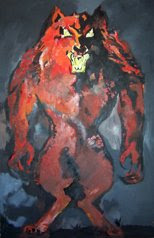
"How much is this?"
"Fifty lire. It is very cheap."
"All right. I want two extra clips and a box of cartridges."
She brought them from under the counter.
"Have you any need for a sword?" she asked. "I have some used swords very cheap."
"I'm going to the front," I said.
"Oh yes, then you won't need a sword," she said.
--Ernest Hemingway, A Farewell to Arms, 1929
Monday, June 20, 2011


Sunday, June 19, 2011
what is called supernatural
“My theory is that the supernatural is the impossible, and that what is called supernatural is only a something in the laws of Nature of which we have been hitherto ignorant.”
--Edward Bulwer-Lytton, “The Haunted and the Haunters; or, The House and the Brain,” 1859
--Edward Bulwer-Lytton, “The Haunted and the Haunters; or, The House and the Brain,” 1859
Friday, June 10, 2011
“Ecologists: Time to End Invasive-Species Persecution”
“[S]ome ecologists say it’s time to... demilitarize our environmental borders and accept the inevitable reality of non-native invasion.
“‘People like to have an enemy, and vilifying non-native species makes the world very simple,’ said ecologist Mark Davis of Macalester College. ‘The public got sold this nativist paradigm: Native species are the good ones, and non-native species are bad. It’s a 20th century concept, like wilderness, that doesn’t make sense in the 21st century.’
“Davis is one of 18 ecologists to sign a June 9 Nature essay entitled ‘Don’t judge species on their origins.’ They argue that while some non-natives are indeed destructive, such as Guam’s brown tree snakes and Great Lakes zebra mussels, they’re the exception.
“Most are actually benign, relegated to a lower-class status that reflects prejudice rather than solid science, write the authors. Non-natives are assumed to be undesirable, and their benefits go ignored and unstudied.
“As examples of unfairly maligned invaders, the authors mention Australia’s devil’s claw plants, subject to a 20-year-long plant hunt that’s done little to contain a species that may cause little ecological disturbance. In similar fashion, tamarisk trees in the U.S. southwest have been targeted for 70 years by massive eradication programs, but are now seen as providing important bird habitat. Ditto the honeysuckle, banned in many U.S. states, but providing an apparent boost to native bird biodiversity.
“‘Classifying biota according to their adherence to cultural standards of belonging, citizenship, fair play and morality does not advance our understanding of ecology,’ wrote the essay’s authors. They also consider ecological nativism to be hypocritical — nobody’s complaining about lilacs or ring-necked pheasants — and a form of denialism: In a globalized, human-dominated world, plants and animals will get around.
“‘Most human and natural communities now consist both of long-term residents and of new arrivals,’ they wrote.”
--Brandon Keim, Wired, 2011 June 8
“‘People like to have an enemy, and vilifying non-native species makes the world very simple,’ said ecologist Mark Davis of Macalester College. ‘The public got sold this nativist paradigm: Native species are the good ones, and non-native species are bad. It’s a 20th century concept, like wilderness, that doesn’t make sense in the 21st century.’
“Davis is one of 18 ecologists to sign a June 9 Nature essay entitled ‘Don’t judge species on their origins.’ They argue that while some non-natives are indeed destructive, such as Guam’s brown tree snakes and Great Lakes zebra mussels, they’re the exception.
“Most are actually benign, relegated to a lower-class status that reflects prejudice rather than solid science, write the authors. Non-natives are assumed to be undesirable, and their benefits go ignored and unstudied.
“As examples of unfairly maligned invaders, the authors mention Australia’s devil’s claw plants, subject to a 20-year-long plant hunt that’s done little to contain a species that may cause little ecological disturbance. In similar fashion, tamarisk trees in the U.S. southwest have been targeted for 70 years by massive eradication programs, but are now seen as providing important bird habitat. Ditto the honeysuckle, banned in many U.S. states, but providing an apparent boost to native bird biodiversity.
“‘Classifying biota according to their adherence to cultural standards of belonging, citizenship, fair play and morality does not advance our understanding of ecology,’ wrote the essay’s authors. They also consider ecological nativism to be hypocritical — nobody’s complaining about lilacs or ring-necked pheasants — and a form of denialism: In a globalized, human-dominated world, plants and animals will get around.
“‘Most human and natural communities now consist both of long-term residents and of new arrivals,’ they wrote.”
--Brandon Keim, Wired, 2011 June 8
Wednesday, June 08, 2011
the ex-Corporal
"...[T]he whole Reichstag and an astounding array of Generals had been summoned to hear his speech. Appropriately this glittering event took place in the Kroll Opera House. Hitler's speech was a long one and he used it to claim personal credit for the victories of 1940. 'I advised the German forces of the possibility of such a development and gave them the necessary detailed orders,' said the ex-Corporal to one of the most dazzling arrays of military brains ever gathered under one roof....
"When the applause of that multitude of Generals, politicians, and foreign dignitaries died away, Hitler began to distribute the honours. He created no less than twenty-seven new Generals. Mostly they were men who had commanded armies or panzer groups to win for him the great victories in Poland, Norway, and the west. But artfully Hitler arranged that yes-men such as Alfred Jodl and Wilhelm Keitel who had told Hitler, 'my Führer, you are the greatest military commander of history' got double promotions and seniority. While Gustav von Wietersheim — whose motorized infantry corps had consolidated the panzer thrust by which Guderian skewered France — was passed over because he had argued with the Führer in 1938....
"So many new promotions were announced that there was not time for the Generals to receive Hitler's personal congratulations. As each name was called, a General stood up and gave the Nazi salute....
"By the time that Hitler had finished creating Generals, and no less than a dozen Field Marshals, there could have been few men in the opera house who did not understand that this was a cunning piece of megalomania that, while thoroughly debasing the coinage of high rank, defined Hitler as the man who owned the mint.
"It was an unprecedented step. The Kaiser made only five Field Marshals in the whole of the First World War. Even General Erich Ludendorff had failed to find a baton in his knapsack. Now Hitler made twelve after less than a year of war, and the fighting had covered only a few weeks. But the new Generalfeldmarschalle were delighted. In Germany such exalted rank, from which the holder could neither be retired nor demoted (or even promoted), brought the provision of an office, a secretary, a staff officer, motor vehicles and horses, and full pay and privileges. And all this for life or until defeat. A Field Marshal ranked above Reich Chancellor in the protocol lists but not above Führer, which was a new post invented by Hitler for himself."
--Len Deighton, Fighter: The True Story of the Battle of Britain, 1977
"When the applause of that multitude of Generals, politicians, and foreign dignitaries died away, Hitler began to distribute the honours. He created no less than twenty-seven new Generals. Mostly they were men who had commanded armies or panzer groups to win for him the great victories in Poland, Norway, and the west. But artfully Hitler arranged that yes-men such as Alfred Jodl and Wilhelm Keitel who had told Hitler, 'my Führer, you are the greatest military commander of history' got double promotions and seniority. While Gustav von Wietersheim — whose motorized infantry corps had consolidated the panzer thrust by which Guderian skewered France — was passed over because he had argued with the Führer in 1938....
"So many new promotions were announced that there was not time for the Generals to receive Hitler's personal congratulations. As each name was called, a General stood up and gave the Nazi salute....
"By the time that Hitler had finished creating Generals, and no less than a dozen Field Marshals, there could have been few men in the opera house who did not understand that this was a cunning piece of megalomania that, while thoroughly debasing the coinage of high rank, defined Hitler as the man who owned the mint.
"It was an unprecedented step. The Kaiser made only five Field Marshals in the whole of the First World War. Even General Erich Ludendorff had failed to find a baton in his knapsack. Now Hitler made twelve after less than a year of war, and the fighting had covered only a few weeks. But the new Generalfeldmarschalle were delighted. In Germany such exalted rank, from which the holder could neither be retired nor demoted (or even promoted), brought the provision of an office, a secretary, a staff officer, motor vehicles and horses, and full pay and privileges. And all this for life or until defeat. A Field Marshal ranked above Reich Chancellor in the protocol lists but not above Führer, which was a new post invented by Hitler for himself."
--Len Deighton, Fighter: The True Story of the Battle of Britain, 1977
Monday, June 06, 2011

Saturday, May 21, 2011
Mongolian Cultural Days, Los Angeles, 2011

June 3-7, 9 a.m.-7 p.m.
Mongolian Art and Cultural Items Exhibit
The Korea Daily Gallery, 690 Wilshire Place, Los Angeles, CA 90005
Mongolian calligraphy, L.A. community photo exhibit, puzzle toys, hand-crafted clothes, and souvenirs.
Free Admission
June 3, 10 a.m.
Mongolian Cultural Informational Conference
USC Park Campus, Taper Hall (THH) #202, 2718 Hoover Street, Los Angeles, CA 90007
Mongolian art, culture, music, clothes, language, business, and economy.
Free Admission
RSVP: contact@lamgl.com by May 25
June 4, 10 a.m.-5:30 p.m.
Mongolian Cultural Festival and Fair
The City of Los Angeles, South Lawn, 200 North Spring Street, Los Angeles, CA
Mongolian wrestling, ankle-bone shooting, archery, mask dancing, clothes, long song, throat singing, food, and music.
Tickets: $5
June 4, 7:30 p.m.
LAMA 5-Year Anniversary Reception Dinner
3255 Wilshire Boulevard #100, Los Angeles, CA 90010
Mongolian fashion show, silk evening gown auction, throat singing, contortionism, and music.
Tickets: $100
Sunday, May 15, 2011
"Thus, I give up the spear!" - literary translation
"Vers toi je roule, baleine destructrice qui ne récolte que le néant, je suis aux prises avec toi jusqu’au dernier instant, du cœur de l’enfer je te frappe, au nom de la haine je crache contre toi mon dernier souffle. Sombrez tous cercueils, tous corbillards dans la mare commune puisque nuls ne peuvent êtres miens, que je sois déchiqueté et lié à toi en te chassant, baleine maudite ! C’est ainsi que je rends les armes !"
--la traduction est celle de Henriette Guex-Rolle
http://www.ebooksgratuits.com/html/melville_moby_dick.html
--la traduction est celle de Henriette Guex-Rolle
http://www.ebooksgratuits.com/html/melville_moby_dick.html
Sunday, April 24, 2011
Happy Anzac Day
"I remember watching a TV news story some years back about the Anzac Day ceremony at Gallipoli.
"The reporter was interviewing a young Australian wrapped in a flag, and asked her why she had come to Gallipoli.
"'I came to pay my respects,' she said. 'They died so that we could be free.'
"I was utterly depressed by her answer. Gallipoli, of course, had nothing to do with dying for anyone's freedom, and that is the tragedy of the story.
"For that young woman to have travelled all that way, braved the freezing wait for dawn, and still not really have a clue about what happened there and why it was about so much more than pro patria mori, it seemed to me to be another tragedy."
--Ben Knight, "Breaking through our Gallipoli 'myth'", ABC News, 2008 November 2

"As the cries of the wounded continued and the hot sun rose, the Anzacs were moved to pity. They had never seen such bravery before. A truce was arranged and Anzacs and Turks together helped to bury the dead."
--A.K. Macdougall, Australia in History: Gallipoli and the Middle East, 1915-18, 2004
"We mounted over a plateau and down through gullies filled with thyme, where there lay about 4000 Turkish dead. It was indescribable. One was grateful for the rain and the grey sky.... I talked to the Turks, one of whom pointed to the graves. 'That's politics,' he said."
--Aubrey Herbert, Captain in the Australian and New Zealand Army Corps, 1915 May
"The reporter was interviewing a young Australian wrapped in a flag, and asked her why she had come to Gallipoli.
"'I came to pay my respects,' she said. 'They died so that we could be free.'
"I was utterly depressed by her answer. Gallipoli, of course, had nothing to do with dying for anyone's freedom, and that is the tragedy of the story.
"For that young woman to have travelled all that way, braved the freezing wait for dawn, and still not really have a clue about what happened there and why it was about so much more than pro patria mori, it seemed to me to be another tragedy."
--Ben Knight, "Breaking through our Gallipoli 'myth'", ABC News, 2008 November 2

Gallipoli battlefield cemetery
statue of an Ottoman soldier carrying a wounded ANZAC soldier
"As the cries of the wounded continued and the hot sun rose, the Anzacs were moved to pity. They had never seen such bravery before. A truce was arranged and Anzacs and Turks together helped to bury the dead."
--A.K. Macdougall, Australia in History: Gallipoli and the Middle East, 1915-18, 2004
"We mounted over a plateau and down through gullies filled with thyme, where there lay about 4000 Turkish dead. It was indescribable. One was grateful for the rain and the grey sky.... I talked to the Turks, one of whom pointed to the graves. 'That's politics,' he said."
--Aubrey Herbert, Captain in the Australian and New Zealand Army Corps, 1915 May
Saturday, April 23, 2011

Thursday, April 21, 2011
The Ancient Athenian Sophists (for an irreproachable legacy, be a philosopher, not a lawyer)
"From Wikipedia, the free encyclopedia
"In the second half of the 5th century BC, particularly at Athens, 'sophist' came to denote a class of mostly itinerant intellectuals who taught courses in various subjects, speculated about the nature of language and culture, and employed rhetoric to achieve their purposes, generally to persuade or convince others.... A few sophists claimed that they could find the answers to all questions. Most of these sophists are known today primarily through the writings of their opponents (specifically Plato and Aristotle), which makes it difficult to assemble an unbiased view of their practices and beliefs....
"Owing largely to the influence of Plato and Aristotle, philosophy came to be regarded as distinct from sophistry, the latter being regarded as specious and rhetorical, a practical discipline. Thus, by the time of the Roman Empire, a sophist was simply a teacher of rhetoric and a popular public speaker....
"The Sophists certainly were not directly responsible for Athenian democracy, but their cultural and psychological contributions played an important role in its growth. They contributed to the new democracy in part by espousing expertise in public deliberation, since this was the foundation of decision-making, which allowed and perhaps required a tolerance of the beliefs of others....
"In addition, Sophists had great impact on the early development of law, as the sophists were the first lawyers in the world. Their status as lawyers was a result of their extremely developed argumentation skills."
"In the second half of the 5th century BC, particularly at Athens, 'sophist' came to denote a class of mostly itinerant intellectuals who taught courses in various subjects, speculated about the nature of language and culture, and employed rhetoric to achieve their purposes, generally to persuade or convince others.... A few sophists claimed that they could find the answers to all questions. Most of these sophists are known today primarily through the writings of their opponents (specifically Plato and Aristotle), which makes it difficult to assemble an unbiased view of their practices and beliefs....
"Owing largely to the influence of Plato and Aristotle, philosophy came to be regarded as distinct from sophistry, the latter being regarded as specious and rhetorical, a practical discipline. Thus, by the time of the Roman Empire, a sophist was simply a teacher of rhetoric and a popular public speaker....
"The Sophists certainly were not directly responsible for Athenian democracy, but their cultural and psychological contributions played an important role in its growth. They contributed to the new democracy in part by espousing expertise in public deliberation, since this was the foundation of decision-making, which allowed and perhaps required a tolerance of the beliefs of others....
"In addition, Sophists had great impact on the early development of law, as the sophists were the first lawyers in the world. Their status as lawyers was a result of their extremely developed argumentation skills."
Tuesday, April 12, 2011
Restaurant and guesthouse equipment for sale, Mongolia
"Сайн байцгаана уу?
Кафе-д ашиглагдаж байсан модон болон зөөлөн буйдан сандап ширээ, хөргөгч, кофе чанагч машин, мөсний машин, мөс нунтаглагч гэх мэт бусад эд зүйлийг зарна. Мөн guesthouse-д ашиглагдаж болох модон давхар ор зарна.
Утас : 99112075"
Кафе-д ашиглагдаж байсан модон болон зөөлөн буйдан сандап ширээ, хөргөгч, кофе чанагч машин, мөсний машин, мөс нунтаглагч гэх мэт бусад эд зүйлийг зарна. Мөн guesthouse-д ашиглагдаж болох модон давхар ор зарна.
Утас : 99112075"
Sunday, April 10, 2011
North Dakota is New Norway
Like Norway, North Dakota has a strong energy industry, a strong overall economy, abundant natural resources, stalwart fiscal management, increasing tourism, and cold weather. A full 30% of North Dakotans claim Norwegian heritage.
http://en.wikipedia.org/wiki/Norwegian_American#Norwegian_Americans_by_state

Nodak is currently implementing its second ten-year economic development plan. The strategy, concisely presented in a single document, advocates aggressive policies.

http://www.commerce.nd.gov/resources/
North Dakota Economic Development Strategic Plan 2010-2020
"This plan is intended to be a catalyst for state and local economic development efforts by providing common direction, strategic areas of emphasis, and priorities for investing state and local dollars.
"This strategy is grounded on North Dakota’s assets:
• Educated, hardworking people
• Abundant natural resources
• Strong academic, transportation, and technology infrastructure
"Strategies for Continued Growth:
• Maintain a positive business climate that supports private sector investment
• Continue investing in university-based research and development
• Embrace entrepreneurship and foster a culture of entrepreneurship
• Promote export trade by linking North Dakota businesses with foreign buyers and markets
"North Dakota, 2009:
• Population estimates show out-migration has reversed and the state is growing.
• North Dakota leads the nation in growth of gross domestic product.
• North Dakota has the lowest unemployment rate in the nation.
"North Dakota emerged as an economic leader during the recent global recession by making fiscally sound investments that leveraged our state’s natural strengths.
"The economic assessment contained in the 2002 North Dakota Economic Development Foundation Strategic plan painted a much different picture about North Dakota compared to today. North Dakota has improved considerably in almost all measurements of economic activity.
"Working with the North Dakota Trade Office and with industry groups, the state can take advantage of a lower U.S. dollar and continue building on recent export growth in commodities, processed foods, machinery, and computer and electronic products.
"Growth Challenges
"North Dakota faces a number of challenges for future economic development, some are new but many of them are familiar.
"Geography/Image
Distance from markets, lack of a major metropolitan area, and a negative image are familiar challenges for North Dakota. New technology and the internet have decreased some of the geographic barriers. And the recent attention North Dakota has received as a result of its strong economy provides a different national storyline about North Dakota that highlights some of the state’s most attractive qualities and provides a sharp contrast to the traditional national story about the state’s remoteness and cold weather.
"Other Issues
North Dakota’s strong economic growth is creating new challenges such as housing shortages, childcare needs, stress on infrastructure and water resources, and the recruitment and retention of workforce.
"Value-Added Agriculture
"North Dakota ranks as the largest United States producer of 16 different commodities, including spring and durum wheat, sunflowers and barley, among other crops. The state currently has an obvious competitive advantage in agricultural production.
"North Dakota Opportunities
• Biotech manufacturing: Among high-tech manufacturing industries, North Dakota has the greatest competitive advantage in biotechnology manufacturing.
• Agricultural biotech: This is a niche within biotechnology. Also referred to as bioengineering, this technology promises to drastically alter the way farmers produce foods. North Dakota’s natural resources in production agriculture provide an obvious competitive edge for ag-biotech.
• Specialty foods for niche markets: Specialty production presents North Dakota with an opportunity to generate growth from higher impact sectors such as agricultural biotech and 'natural' foods. In addition, food production has traditionally been a strong point in North Dakota’s economic, cultural, and political foundations. To the extent that North Dakota has an international reputation, food has been a significant asset. Building on that identification will facilitate greater global recognition for the state.
"Energy
"North Dakota is poised to be a model for America in the development of diverse energy resources. North Dakota has massive wind energy potential, and is the top producer of 16 different agricultural commodities that provide materials to support biofuels and biomass industries. North Dakota is home to the nation’s only National Center for Hydrogen Technology.
"North Dakota is nationally recognized as having the greatest potential of any state in its capacity to produce energy through wind power. Full realization of our wind power will require further development of the power transmission grid.
"Tourism
"North Dakota’s tourism growth has outpaced the nation, 37.6 percent since 2001 compared to the nation’s growth of 31 percent according to the U.S. Travel Association.
"Tourism ranks third among industries contributing to North Dakota’s economy with $4.1 billion spent in 2008. The growth of tourism is felt statewide.
"The legendary branding, creative strategies, and comprehensive media plans are showing a strong return on investment with $123 returned for every $1 invested in advertising. Advertising North Dakota as a tourism destination also has a positive impact on the image of North Dakota.
"North Dakota Opportunities
• Aggressive marketing: North Dakota continues to be challenged by our lack of image, climate, geographic location, and lack of nationally recognized landmarks which precipitates the need for aggressive marketing.
• Canadian travel continues to be strong. Although affected by exchange rates and border security, a targeted year-round campaign is needed to increase the 1.5 million trips to North Dakota by Canadians.
• Rural and agri-tourism is an area visitors are looking to experience in North Dakota. Efforts to expand these opportunities will help these sectors grow.
• Green travel: As the demand for environmentally friendly travel options grows, North Dakota needs to be prepared to offer green options. Nature-based opportunities do exist and need to be tied to these efforts.
"Strategies
• Continue to measure aggressive media relations campaigns that enhance North Dakota’s image and increase awareness of North Dakota as a great place to live, work, play, visit, and be in business.
"Existing Initiatives
• Fully integrated marketing and communication program to attract visitors from targeted countries including Canada, Norway, Sweden, Denmark, Finland, Iceland, Germany, and Australia."
Innovate ND

"A unique entrepreneurial community that connects coaches, business leaders, investors, and mentors to budding entrepreneurs to create economic growth in North Dakota."
http://www.commerce.nd.gov/innovate/innovatend/

http://www.experience.nd.gov/work/north-dakota-rankings/
"How does North Dakota compete with the national business climate?
"Nationally, North Dakota ranks:
#1 for production of 16 agricultural commodities, more than any other state (2008 National Agricultural Statistics Service)
#1 for Safest State (2007 Morgan Quitno Press)
#1 for Cost of Doing Business (2007 CNBC)
#2 for High School Students That Graduate With A Diploma (2007 Education Week, Quality Count)
#3 for Postsecondary Participation (2007 Education Week, Quality Count)
#3 for State Economic Competitiveness (2008 Beacon Hill Institute)
#7 for Best States to Look for Jobs (2008 US Census Bureau; Bureau of Labor Statistics)
#10 for Most Livable State by (2008 Morgan Quitno)"

http://www.business.nd.gov/uploads/resources/203/webquick-factsbrochure08.pdf
"Microsoft Business Solutions
1,333+ employees and division HQ in Fargo
North Dakota-grown Great Plains Software acquired for $1.1 billion in April 2001
"ING
750+ employees at Customer Service Operations center in Minot
"Amazon.com
300+ employees at Internet Distribution Center in Grand Forks
"Goodrich Corporation
Building aerospace cargo systems and replacement military structures in Jamestown
"Great River Energy
Capitalizing on reducing the carbon footprint in North Dakota
Leader in the energy industry
"Steffes
Leading manufacturer of electric thermal storage equipment
"LM Glasfiber
Manufacturing fiberglass blades for wind turbines in Grand Forks
• "State exports nearly 70% of electricity produced
• "Person-to-person access to public officials
• "Only state-owned bank in the nation that offers business expansion loans
• "Taxes: #3 in nation for lowest cost of doing business
"Foreign trade zone
• Two Canada-Mexico Trade Corridors
• Fourth largest port of entry for Canadian goods by truck and rail
• 24-hour ports of entry along the North Dakota-Canadian border
• Four international airports - Bismarck, Fargo, Grand Forks, and Minot
"Education
• #2 public high school graduation rate
• #3 in SAT scores
• #3 college continuation rate for high school graduates
• #3 college participation rate for 19 year olds
• Nineteen college and university campuses, including two major research universities
"Workforce
Unisys Shared Service Center - Bismarck (325 employees - accounts payable):
• Annual turnover rate 11%, compared to industry standard of 35-40%
• Absenteeism rate 1%
"Quality of Life
• #1 safest state in the nation for 10 out of last 11 years (Morgan Quinto Press)"

From the entry on North Dakota (Nord-Dakota) in the Norwegian Wikipedia:
http://no.wikipedia.org/wiki/Nord-Dakota
"På 1800-tallet ble Nord-Dakota regnet som en del av den ville vesten."
English translation: "In the 1800's, North Dakota was counted as part of the Wild West."
http://en.wikipedia.org/wiki/Norwegian_American#Norwegian_Americans_by_state

* * * * *
Nodak is currently implementing its second ten-year economic development plan. The strategy, concisely presented in a single document, advocates aggressive policies.

http://www.commerce.nd.gov/resources/
North Dakota Economic Development Strategic Plan 2010-2020
"This plan is intended to be a catalyst for state and local economic development efforts by providing common direction, strategic areas of emphasis, and priorities for investing state and local dollars.
"This strategy is grounded on North Dakota’s assets:
• Educated, hardworking people
• Abundant natural resources
• Strong academic, transportation, and technology infrastructure
"Strategies for Continued Growth:
• Maintain a positive business climate that supports private sector investment
• Continue investing in university-based research and development
• Embrace entrepreneurship and foster a culture of entrepreneurship
• Promote export trade by linking North Dakota businesses with foreign buyers and markets
"North Dakota, 2009:
• Population estimates show out-migration has reversed and the state is growing.
• North Dakota leads the nation in growth of gross domestic product.
• North Dakota has the lowest unemployment rate in the nation.
"North Dakota emerged as an economic leader during the recent global recession by making fiscally sound investments that leveraged our state’s natural strengths.
"The economic assessment contained in the 2002 North Dakota Economic Development Foundation Strategic plan painted a much different picture about North Dakota compared to today. North Dakota has improved considerably in almost all measurements of economic activity.
"Working with the North Dakota Trade Office and with industry groups, the state can take advantage of a lower U.S. dollar and continue building on recent export growth in commodities, processed foods, machinery, and computer and electronic products.
"Growth Challenges
"North Dakota faces a number of challenges for future economic development, some are new but many of them are familiar.
"Geography/Image
Distance from markets, lack of a major metropolitan area, and a negative image are familiar challenges for North Dakota. New technology and the internet have decreased some of the geographic barriers. And the recent attention North Dakota has received as a result of its strong economy provides a different national storyline about North Dakota that highlights some of the state’s most attractive qualities and provides a sharp contrast to the traditional national story about the state’s remoteness and cold weather.
"Other Issues
North Dakota’s strong economic growth is creating new challenges such as housing shortages, childcare needs, stress on infrastructure and water resources, and the recruitment and retention of workforce.
"Value-Added Agriculture
"North Dakota ranks as the largest United States producer of 16 different commodities, including spring and durum wheat, sunflowers and barley, among other crops. The state currently has an obvious competitive advantage in agricultural production.
"North Dakota Opportunities
• Biotech manufacturing: Among high-tech manufacturing industries, North Dakota has the greatest competitive advantage in biotechnology manufacturing.
• Agricultural biotech: This is a niche within biotechnology. Also referred to as bioengineering, this technology promises to drastically alter the way farmers produce foods. North Dakota’s natural resources in production agriculture provide an obvious competitive edge for ag-biotech.
• Specialty foods for niche markets: Specialty production presents North Dakota with an opportunity to generate growth from higher impact sectors such as agricultural biotech and 'natural' foods. In addition, food production has traditionally been a strong point in North Dakota’s economic, cultural, and political foundations. To the extent that North Dakota has an international reputation, food has been a significant asset. Building on that identification will facilitate greater global recognition for the state.
"Energy
"North Dakota is poised to be a model for America in the development of diverse energy resources. North Dakota has massive wind energy potential, and is the top producer of 16 different agricultural commodities that provide materials to support biofuels and biomass industries. North Dakota is home to the nation’s only National Center for Hydrogen Technology.
"North Dakota is nationally recognized as having the greatest potential of any state in its capacity to produce energy through wind power. Full realization of our wind power will require further development of the power transmission grid.
"Tourism
"North Dakota’s tourism growth has outpaced the nation, 37.6 percent since 2001 compared to the nation’s growth of 31 percent according to the U.S. Travel Association.
"Tourism ranks third among industries contributing to North Dakota’s economy with $4.1 billion spent in 2008. The growth of tourism is felt statewide.
"The legendary branding, creative strategies, and comprehensive media plans are showing a strong return on investment with $123 returned for every $1 invested in advertising. Advertising North Dakota as a tourism destination also has a positive impact on the image of North Dakota.
"North Dakota Opportunities
• Aggressive marketing: North Dakota continues to be challenged by our lack of image, climate, geographic location, and lack of nationally recognized landmarks which precipitates the need for aggressive marketing.
• Canadian travel continues to be strong. Although affected by exchange rates and border security, a targeted year-round campaign is needed to increase the 1.5 million trips to North Dakota by Canadians.
• Rural and agri-tourism is an area visitors are looking to experience in North Dakota. Efforts to expand these opportunities will help these sectors grow.
• Green travel: As the demand for environmentally friendly travel options grows, North Dakota needs to be prepared to offer green options. Nature-based opportunities do exist and need to be tied to these efforts.
"Strategies
• Continue to measure aggressive media relations campaigns that enhance North Dakota’s image and increase awareness of North Dakota as a great place to live, work, play, visit, and be in business.
"Existing Initiatives
• Fully integrated marketing and communication program to attract visitors from targeted countries including Canada, Norway, Sweden, Denmark, Finland, Iceland, Germany, and Australia."
* * * * *
Innovate ND

"A unique entrepreneurial community that connects coaches, business leaders, investors, and mentors to budding entrepreneurs to create economic growth in North Dakota."
http://www.commerce.nd.gov/innovate/innovatend/
* * * * *

http://www.experience.nd.gov/work/north-dakota-rankings/
"How does North Dakota compete with the national business climate?
"Nationally, North Dakota ranks:
#1 for production of 16 agricultural commodities, more than any other state (2008 National Agricultural Statistics Service)
#1 for Safest State (2007 Morgan Quitno Press)
#1 for Cost of Doing Business (2007 CNBC)
#2 for High School Students That Graduate With A Diploma (2007 Education Week, Quality Count)
#3 for Postsecondary Participation (2007 Education Week, Quality Count)
#3 for State Economic Competitiveness (2008 Beacon Hill Institute)
#7 for Best States to Look for Jobs (2008 US Census Bureau; Bureau of Labor Statistics)
#10 for Most Livable State by (2008 Morgan Quitno)"
* * * * *

http://www.business.nd.gov/uploads/resources/203/webquick-factsbrochure08.pdf
"Microsoft Business Solutions
1,333+ employees and division HQ in Fargo
North Dakota-grown Great Plains Software acquired for $1.1 billion in April 2001
"ING
750+ employees at Customer Service Operations center in Minot
"Amazon.com
300+ employees at Internet Distribution Center in Grand Forks
"Goodrich Corporation
Building aerospace cargo systems and replacement military structures in Jamestown
"Great River Energy
Capitalizing on reducing the carbon footprint in North Dakota
Leader in the energy industry
"Steffes
Leading manufacturer of electric thermal storage equipment
"LM Glasfiber
Manufacturing fiberglass blades for wind turbines in Grand Forks
• "State exports nearly 70% of electricity produced
• "Person-to-person access to public officials
• "Only state-owned bank in the nation that offers business expansion loans
• "Taxes: #3 in nation for lowest cost of doing business
"Foreign trade zone
• Two Canada-Mexico Trade Corridors
• Fourth largest port of entry for Canadian goods by truck and rail
• 24-hour ports of entry along the North Dakota-Canadian border
• Four international airports - Bismarck, Fargo, Grand Forks, and Minot
"Education
• #2 public high school graduation rate
• #3 in SAT scores
• #3 college continuation rate for high school graduates
• #3 college participation rate for 19 year olds
• Nineteen college and university campuses, including two major research universities
"Workforce
Unisys Shared Service Center - Bismarck (325 employees - accounts payable):
• Annual turnover rate 11%, compared to industry standard of 35-40%
• Absenteeism rate 1%
"Quality of Life
• #1 safest state in the nation for 10 out of last 11 years (Morgan Quinto Press)"
* * * * *

From the entry on North Dakota (Nord-Dakota) in the Norwegian Wikipedia:
http://no.wikipedia.org/wiki/Nord-Dakota
"På 1800-tallet ble Nord-Dakota regnet som en del av den ville vesten."
English translation: "In the 1800's, North Dakota was counted as part of the Wild West."
* * * * *
previous posts on North Dakota
previous posts on Norway
Saturday, April 02, 2011
Sharewood.org

Moi,
Auta Japani jaloilleen!
Liity nyt Sharewoodiin, niin Aurinkomatkat lahjoittaa puolestasi euron Punaiselle Ristille Japaniin.
Sharewood on uusi suomalainen vastuullinen sosiaalinen media, jossa voit lahjoittaa mainostajien rahaa hyväntekeväisyysjärjestöille ja voittaa itsellesi palkintoja.
Sharewoodin hyväntekijöitä ovat jo muun muassa näyttelijä Mikko Leppilampi, työministeri Anni Sinnemäki ja vuoden urheilija Minna Kauppi.
Liity mukaan ja klikkaa linkkiä:
Hi there,
Help the Japanese back on their feet!
Join Sharewood now to donate to the Red Cross for Japan.
Sharewood is a responsible new Finnish social media, where you can donate money to charities and win prizes.
Celebrity Sharewood benefactors include the actor Mikko Leppilampi, the Minister of Labour Anni Sinnemäki, and the athlete Minna Kauppi.
Click the link below and join:
Thursday, March 31, 2011


Monday, March 28, 2011
Ray Neuhalfen: North Dakota Garbage Man

On his debut album North Dakota Garbage Man, Ray Neuhalfen tells in his uniquely comical style about cooking for his daughter, helping his dad, dealing with his ex-wives, handling Facebook, being on trial, calling bingo, breaking bones, quitting smoking, and having the Greatest Job in the World!
North Dakota Garbage Man by Ray Neuhalfen
Track Listing:
1. I Like the Microphone
2. On Trial
3. You Can't Make Me Eat Them
4. Traditional American Denny's Thanksgiving
5. Lefse and Deer Sausage
6. She Called the Cops on Herself
7. Facebook
8. Every Single Parent Ever
9. Lemonade Stand
10. Brett Favre Did the Same Thing
11. Did I Tell You My Phone Broke?
12. Smoking
13. North Dakota Garbage Man
14. Are You Going to Apologize?
15. Tipped Them a Bottle of Vodka
Sunday, March 27, 2011
message from Japan
"subject: Mongolia
2011-03-12
"Hello there. I am an Australian currently writing from Japan and have been given some information that Mongolia may be one of the safest places as far as natural disasters are concerned. As you are aware we got shaken up terribly yesterday...
"Anyway I am seriously considering moving to Mongolia and would like to discuss how things over there are..."
=
RE: Mongolia
Thanks for your message. It's terrible about the disaster in Japan.
Here is a post I wrote about earthquakes in Mongolia, and particularly in the capital city of Ulaanbaatar:
http://radiganneuhalfen.blogspot.com/2010/04/earthquake-in-ulaanbaatar.html
Here is a recent article on the rapidly-changing society of Mongolia:
http://www.foreignpolicy.com/articles/2011/01/02/welcome_to_minegolia
Cheers,
Radigan


2011-03-12
"Hello there. I am an Australian currently writing from Japan and have been given some information that Mongolia may be one of the safest places as far as natural disasters are concerned. As you are aware we got shaken up terribly yesterday...
"Anyway I am seriously considering moving to Mongolia and would like to discuss how things over there are..."
=
RE: Mongolia
Thanks for your message. It's terrible about the disaster in Japan.
Here is a post I wrote about earthquakes in Mongolia, and particularly in the capital city of Ulaanbaatar:
http://radiganneuhalfen.blogspot.com/2010/04/earthquake-in-ulaanbaatar.html
Here is a recent article on the rapidly-changing society of Mongolia:
http://www.foreignpolicy.com/articles/2011/01/02/welcome_to_minegolia
Cheers,
Radigan

2009 October 16
Mongolia, Ulaanbaatar
models backstage at Gobi cashmere fashion show
photo by Timothy Fadek / Polaris Images

2010 June 17
Mongolia, worksite near Uyanga
ninja miners playing pool
photo by Timothy Fadek / Polaris Images

2010 June 25
Mongolia, Gobi Desert, Oyu Tolgoi gold and copper mine
miners
photo by Timothy Fadek / Polaris Images

2010 June 27
Mongolia, Ulaanbaatar, Tuul River
swimming
photo by Timothy Fadek / Polaris Images

2010 July 14
Mongolia, Erdenet
woman with umbrella
photo by Timothy Fadek / Polaris Images
Friday, March 25, 2011
a series of things
"No matter how you dress it up, that's what the world is. A community of idiots doing a series of things until the world explodes and we all die."
--Daniel O'Brien, "5 Things They Never Told Us," Cracked.com, 2011 March 25
--Daniel O'Brien, "5 Things They Never Told Us," Cracked.com, 2011 March 25
Wednesday, March 23, 2011
"Hacker"
"To the popular press, 'hacker' means someone who breaks into computers. Among programmers it means a good programmer. But the two meanings are connected. To programmers, 'hacker' connotes mastery in the most literal sense: someone who can make a computer do what he wants--whether the computer wants to or not.
"To add to the confusion, the noun 'hack' also has two senses. It can be either a compliment or an insult. It's called a hack when you do something in an ugly way. But when you do something so clever that you somehow beat the system, that's also called a hack. The word is used more often in the former than the latter sense, probably because ugly solutions are more common than brilliant ones.
"Believe it or not, the two senses of 'hack' are also connected. Ugly and imaginative solutions have something in common: they both break the rules. And there is a gradual continuum between rule breaking that's merely ugly (using duct tape to attach something to your bike) and rule breaking that is brilliantly imaginative (discarding Euclidean space)."
--Paul Graham, "The Word 'Hacker'," 2004 April
"To add to the confusion, the noun 'hack' also has two senses. It can be either a compliment or an insult. It's called a hack when you do something in an ugly way. But when you do something so clever that you somehow beat the system, that's also called a hack. The word is used more often in the former than the latter sense, probably because ugly solutions are more common than brilliant ones.
"Believe it or not, the two senses of 'hack' are also connected. Ugly and imaginative solutions have something in common: they both break the rules. And there is a gradual continuum between rule breaking that's merely ugly (using duct tape to attach something to your bike) and rule breaking that is brilliantly imaginative (discarding Euclidean space)."
--Paul Graham, "The Word 'Hacker'," 2004 April
Tuesday, March 22, 2011
Straw Dogs --> Laozi's reference --> and elucidating commentary
"Heaven and Earth are heartless
treating creatures like straw dogs"
--Laozi, Tao Te Ching
"Heaven and Earth are not partial. They do not kill living things out of cruelty or give them birth out of kindness. We do the same when we make straw dogs to use in sacrifices. We dress them up and put them on the altar, but not because we love them. And when the ceremony is over, we throw them into the street, but not because we hate them."
--Su Ch'e, as quoted in Lao-tzu's Taoteching: with Selected Commentaries of the Past 2000 Years, translated by Red Pine
treating creatures like straw dogs"
--Laozi, Tao Te Ching
"Heaven and Earth are not partial. They do not kill living things out of cruelty or give them birth out of kindness. We do the same when we make straw dogs to use in sacrifices. We dress them up and put them on the altar, but not because we love them. And when the ceremony is over, we throw them into the street, but not because we hate them."
--Su Ch'e, as quoted in Lao-tzu's Taoteching: with Selected Commentaries of the Past 2000 Years, translated by Red Pine
Saturday, March 19, 2011

"Bidders Line Up to Purchase World’s Largest Coal Deposit"
"Seven bidders, including Arcelor Mittal, Vale, Xstrata, Peabody, Shenhua and Mitsui, plus a Japanese, Korean and Russian consortium have been shortlisted to develop Mongolia’s massive Tavan Tolgoi reserves.
"The site, owned by Mongolia’s state-owned Erdenes, has 6 billion tons of coal reserves and is capable of producing 15 million tons annually for over 30 years. The site is expected to require an initial US$7.3 billion investment to get it ready for development. A separate IPO is also being planned for the mine, with estimates this could raise at least US$15 billion.
"The Tavan Tolgoi site is in the Gobi Desert, about 540 kilometers south of Mongolia’s capital of Ulaan Baatar. The winning bid is expected to be announced on June 30, 2011."
--2point6billion.com
"The site, owned by Mongolia’s state-owned Erdenes, has 6 billion tons of coal reserves and is capable of producing 15 million tons annually for over 30 years. The site is expected to require an initial US$7.3 billion investment to get it ready for development. A separate IPO is also being planned for the mine, with estimates this could raise at least US$15 billion.
"The Tavan Tolgoi site is in the Gobi Desert, about 540 kilometers south of Mongolia’s capital of Ulaan Baatar. The winning bid is expected to be announced on June 30, 2011."
--2point6billion.com
Wednesday, March 16, 2011
rest and oblivion
“What I want are rest and oblivion -- or at least, a seclusion amidst ancient scenes wherein I may cast off the actual modern world in a quiet round of reading, writing, and pilgrimages to quaint and historic places.”
--H.P. Lovecraft, correspondence, 1926
--H.P. Lovecraft, correspondence, 1926
Sunday, March 13, 2011
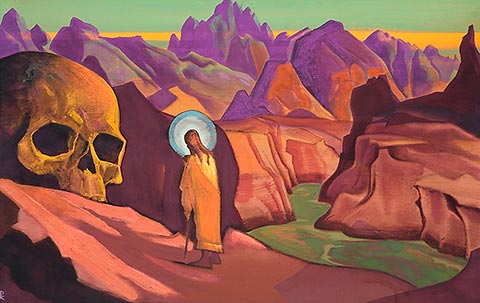
Art by Nicholas Roerich
"My heartiest thanks for the magnificent work which you sent to me. I admire those creations so much that I can say without exaggeration that never have landscapes made such a great impression on me."
--Albert Einstein, letter to Roerich Museum, 1931
RoerichTrust.org

 And We Do Not Fear
 Book of Life
 Changthang, Northern Tibet
 Song of Shambhala
 Idols (Pagan Russia)
 Issa and the Skull of the Giant
 Message to Tiron
 Abode of Gesar
 Mongolia
 Mongolia I
 Monhegan, Maine
 Mother of Genghis Khan
 Most Sacred Treasure of the Mountain
 On the Heights, Tumo
 Stronghold of Tibet
 Descent into Hell
 Star of the Hero
 Guests from Overseas
--Albert Einstein, letter to Roerich Museum, 1931
RoerichTrust.org

The Black Gobi
1928

1922

1938

1939


1910

1940

1947


1938

1922

1933

1933

1936

1932

1933

1936

1901
USSR postage stamp
1974
1874-1947 Russian
Monday, February 28, 2011
The Sedlec Ossuary


"From Wikipedia, the free encyclopedia
"The Sedlec Ossuary is a small Roman Catholic chapel located in Sedlec, a suburb of Kutná Hora in the Czech Republic. The ossuary is estimated to contain the skeletons of between 40,000 and 70,000 people.
"Henry, the abbot of the Cistercian monastery in Sedlec, was sent to Palestine by King Otakar II of Bohemia in 1278. When he returned, he brought with him a small amount of earth that he had removed from Golgotha and sprinkled it over the abbey cemetery. The word of this pious act soon spread and the cemetery in Sedlec became a desirable burial site throughout Central Europe. During the Black Death in the mid 14th century, and after the Hussite Wars in the early 15th century, many thousands of people were buried there and the cemetery had to be greatly enlarged.
"In 1870, František Rint, a woodcarver, was employed by the Schwarzenberg family to put the bone heaps into order. The macabre result of his effort speaks for itself. Four enormous bell-shaped mounds occupy the corners of the chapel. An enormous chandelier of bones, which contains at least one of every bone in the human body, hangs from the center of the nave with garlands of skulls draping the vault. Other works include piers and monstrances flanking the altar, a large Schwarzenberg coat-of-arms, and the signature of Rint, also executed in bone, on the wall near the entrance."

Sunday, February 27, 2011
The Great Wave

The Great Wave off Kanagawa
from the series Thirty-six Views of Mount Fuji
1760-1849 Japanese
Thursday, February 24, 2011
Teaching with Calvin and Hobbes
As requested, here are photos of the remarkable but desperately rare Teaching with Calvin and Hobbes.
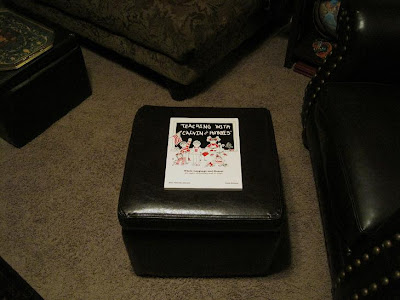
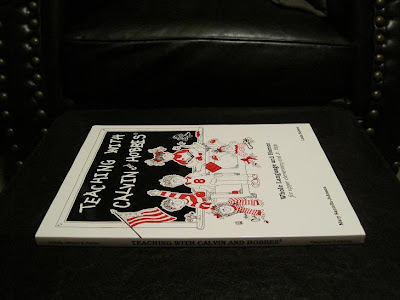
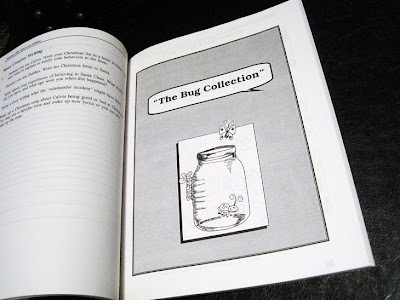


A total of 57 Calvin and Hobbes comic strips (56 daily strips and 1 Sunday strip) appear in Teaching with Calvin and Hobbes, organized into five lesson units. Each strip is numbered and each panel in each strip is lettered for reference in the unit questions.
Number of comic strips per lesson unit:
1. The Binoculars - 10 strips
2. The Find - 10 strips
3. The Christmas Story - 1 Sunday strip + 9 daily strips = 10 strips
4. The Bug Collection - 17 strips
5. The Report - 10 strips


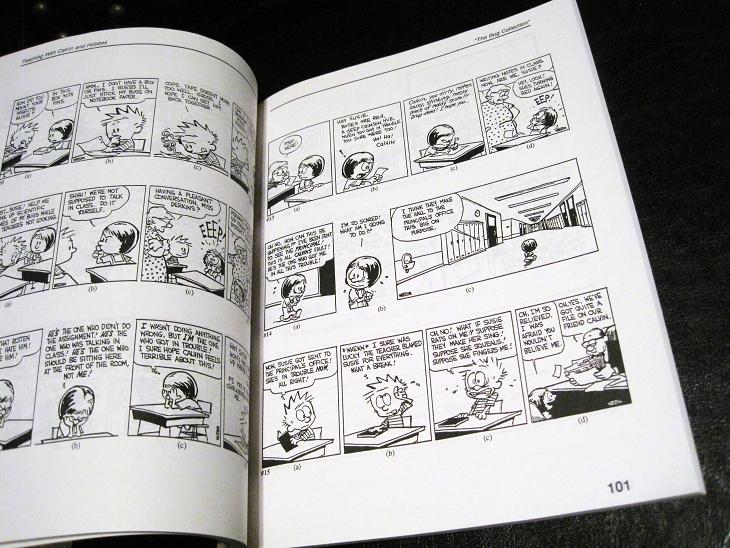


A total of 57 Calvin and Hobbes comic strips (56 daily strips and 1 Sunday strip) appear in Teaching with Calvin and Hobbes, organized into five lesson units. Each strip is numbered and each panel in each strip is lettered for reference in the unit questions.
Number of comic strips per lesson unit:
1. The Binoculars - 10 strips
2. The Find - 10 strips
3. The Christmas Story - 1 Sunday strip + 9 daily strips = 10 strips
4. The Bug Collection - 17 strips
5. The Report - 10 strips
Subscribe to:
Posts (Atom)